Can Guys and Girls “Just be Friends”?

justfriends

A buddy of mine (who happens to be married) recently came across an old girlfriend, and they ended up going for lunch and catching up on each other’s lives. He mentioned this to me because they ended up exchanging numbers and talked about getting together again, and he wasn’t sure if it was a good idea. Especially because he enjoyed seeing her, and it brought back happy memories of the times they shared.

For anyone who’s a regular reader on thezombieshuffle.com, I’m pretty sure you can guess my advice. Umm, did I mention that he’s married? Yeah, he is. From talking to people, and reading assorted relationship books and blogs I know his situation is far from unique. I’ve touched on thoughts on straying when your relationship is in a rut and on affairs before. But I thought this story provided me with an opportunity to provide a slightly different twist on things.

Radio Story

I commonly listen to the radio on the ride in to work, and for the morning show they have both a male and a female host. A number of months back they had a discussion on whether or not guys and girls can ever be “just friends”. Their perspectives weren’t surprising.

The girl said yes, of course, and she cited a number of people she knew who had platonic guy friends. The guy had a different take on things. He said no, not a chance. Guys and girls can be friends, but in most cases the guy is looking for more. And the guy is probably actively thinking/imaging the girl in, shall we say, less platonic situations. His opinion was that the guy is content to be just friends, but if the girl were to “open the door” for things to go further, then the guy would be more than happy to comply.

As a guy, I have to agree with his perspective. I’m not sure if women are just naive about this or if they are just wired differently. But in most circumstances the guy would be more than happy to move beyond the friend zone. I’m not suggesting this applies in all cases. I have a handful of female friends who remain friends. But I also recognize that my female friends are definitely different from my male friends, making the nature of the relationship different.

So can guys and girls ever be “just friends”. My belief is sure, they can be. But it depends on both their history and their present. What I mean by this is that although it is possible, it depends on their shared history. If they have been more than friends in the past, then it changes things considerably. It’s still *possible*, but old feelings will always be there. This is where the present is also relevant. If neither of you are in a relationship then there should be no issues. If one or both of you are? That changes things.

Digging up the Past

A while back I read an article talking about how social media and cell phones has changed the way affairs happen, and it has also caused a rise of broken relationships due to “exes”. Sadly I didn’t bookmark it, but it was a great article.

If you were in a relationship with someone in the past, then no matter how it ended there were good times. It’s normal to sometimes think about exes. Maybe there’s something that reminds you of them, a song, or a sight, and memories that were forgotten come rushing back. Those memories may make you think about them, and wonder how they are doing and where their life has taken them. The social media world has made it easy to take things beyond just memories, and to actively reach out and see how the other person is doing. That’s something I strongly caution against. It’s best if exes remain exes, and remain in the past.

If you are in a relationship, friendships with members of the opposite sex come with a number of potential risks. But adding exes to the mix? That’s a recipe for disaster. It’s one thing to wonder about how someone is doing, but if you are actively looking them up you have to ask yourself what you hope to accomplish. Especially if you are doing it at a time that your own relationship is in need of some attention.

When Does an Affair Become an Affair?

One common misconception people have is about what an affair actually is. Commonly people believe that affairs are only happening with sex is involved. But that is completely untrue. Relationships rarely start with sex. Heck, some couples still buy into the notion that they want to wait until they are married for sex (a dying breed, but it still happens). Relationships are built on connection, and emotion. The physical side simply comes out of that.

What people often think of as affairs is really the physical side, but any emotional connection is just as much of an affair. I found the following on this site, and it sums is up well:

It starts very innocently. Very slowly they get to know each other. It’s often an emotional affair to begin with. Maybe they have long conversations, whatever.
However it happens, eventually they realize that they’ve crossed some sort of line. But they realize it after they’ve crossed it. And it feels wonderful because it was a line they were hungry to cross. But it also feels terrible because they know it’s cheating, and they know they never wanted to be a cheater. But it keeps going.

Crossing the Line

So where does crossing the line start? Where does a friendship start to develop into something more? It starts with flirting. Wikipedia refers to flirting as:

Speaking and behaving in a way that suggests a mildly greater intimacy than the actual relationship between the parties would justify, though within the rules of social etiquette, which generally disapproves of a direct expression of sexual interest. This may be accomplished by communicating a sense of playfulness or irony

Some people are flirts, but if you are already in a relationship flirting is a dangerous game. And you have to ask yourself, what is the purpose of the flirting? Is it to seek attention? To feel beautiful and wanted? To make yourself feel better about yourself? Perhaps the biggest question is, are you flirting when your partner is not around in a way that you would not when they are?

People know when they are doing something wrong. So if you are behaving differently when your partner is not around you are essentially defining your flirting as unacceptable to the partnership.

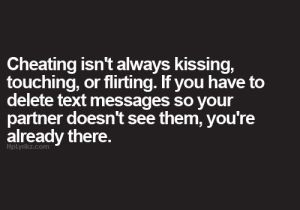
This is where I disagree with the notion that people don’t realize it until after they’ve crossed the line. They knew all along that they were doing something wrong. They may have set lines that they believed they wouldn’t cross. The problem was, they set those lines incorrectly. Instead of setting the line at kissing or sex, it should have been set at other things. It should have been set as soon as you were doing something that you felt you needed to hide.
textingcheating

Emotional Affairs

There are all sorts of great articles on emotional affairs, but here are a few signs that your relationship has crossed the line:

  • You share frustrations about your marriage or relationship with the other person
  • Your flirting is starting to get more aggressive and intense
  • You are arranging to meet the other person for things like coffee and lunch, but you neglect to tell your partner about this
  • You are thinking about and contacting the other person at unusual times – early mornings and late at night

If you are doing any of the above, you may still be telling yourself that it’s innocent, but in your heart you know that you are lying. It may or may not have become physical, but guess what, it’s still an affair. And if you don’t actively stop it, you run the risk of it getting more serious.

cheating8

What to do?

I opened with talking about my buddies lunch meeting. The fact that he was asking my opinion tells me that he already knew the answer to his own question. Affairs don’t just happen, they are a result of choices. If you want to stay faithful to your partner the best thing you can do is not put yourself in a situation that can result in an affair.

One thing about affairs is that happy people don’t cheat. Chances are, if you are thinking about other people then there is something missing in your relationship. In my buddy’s case, he’ll be the first to acknowledge that his marriage is “in a rut”. Being in an unhappy situation makes you more likely to look for happiness elsewhere.

Thing is, affairs are the easy way, and I would even suggest the cowards way out. If your relationship is in a bad spot, look inwards and see what you can do to repair it. Make it your priority and work together with your partner to see if you can repair things. If you find you can’t, accept that your relationship has ended and go your separate ways first.

But acknowledge the fact that you can’t actively work on your relationship if your mind is partially with someone else. You NEED to cut that other person out of your life completely if you expect to have any hope of addressing the issues in your relationship. Unfortunately many people believe they won’t be caught, so they try to have the best of both worlds.

One of my sons occasionally will do naughty things, and sometimes when I ask him to stop he tells me “I don’t want to, it’s fun”. He knows it’s wrong, but he does it anyhow because he enjoys it. That is a self absorbed approach to the world, and shows no respect for the rest of the family. He’s 8 though, an age where the world seems focused just on you. If you are still doing that as an adult there’s a word for it – narcissism. If you are in a relationship it’s supposed to be built on trust, and respect. As soon as you cross those lines and start hiding things from your partner, all you are doing is showing you are not worthy of the trust they have given you. It may start small, but soon you are juggling two lives, and your pursuit of your own “happiness” is liable to hurt everyone around you.

People-Say-You-Dont-Know-What-Youve-Got-Till-Its-Gone

Accountability Part 1 – Responsibility

Responsibility

When you think of someone who is “responsible”, what is the first thing that comes to mind? Often someone who is responsible is seen as someone who is stable, and has their stuff together. They have a decent job (that they have been able to hold), they have a plan, and they are dependable.

Sometimes being responsible is seen as the opposite of being a dreamer. Dreamers live for the moment, while responsible people live a few steps ahead, and are less likely to throw caution to the wind.
But is responsibility really just about stability, structure and planning? Can’t a dreamer also be responsible?

Responsibility Process

I recently came across an approach to looking at responsibility that makes a lot of sense to me. In it, responsibility is defined as a mental process, whereby you own your ability and power to create, choose, and attract.

The idea behind the responsibility process is that there are different stages of behaviors that can culminate in responsibility.

This process starts with Denial, and then moves to Blame, Justification, Shame, Obligation, and finally Responsibility. Each of these stages represents a mode of thinking, and I’m sure every single one of us has operated from each of these modes at one point in time or another (I know I have).

Life is easy when things are going well, and these behaviors usually arise in response to some form of problem or stresses.

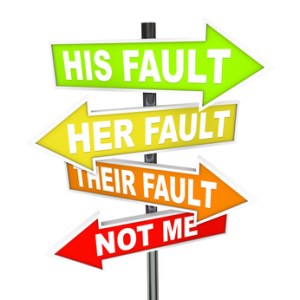
The first three, denial, blame and justification are easy to explain. In these, rather than taking any sort of ownership we are deflecting the issue away from us. In denial there is no problem. In blame the problem is seen, but it’s not “my” problem, it’s someone else’s. And in justification I only partially accept that it’s my problem. I am saying that yes, it’s my problem – but there are a number of reasons as to “why” it happened (and these reasons somehow absolve me of any blame).

Arrow SIgns - Not My Fault Shifting Blame

Shame and obligation are where I think things get really interesting. According to the responsibility process, acting from a state of shame or obligation is almost worse than the previous three. This is because in the first three you are deflecting an issue away from yourself, while for these two you are taking partial ownership. With shame or obligation, you feel as though you are being compelled to do something by some external force. When this happens you are liable to build up resentment that you “have to” do something. Doing something from a state of shame or obligation is fine occasionally, but if it is a common state for you then are liable to give up or quit.

The responsibility process is explained as follows:

When something goes wrong large or small (for example, lost keys or a lost retirement account), The Responsibility Process kicks in. The mind offers Lay Blame as a reason. If you accept blame as a sufficient reason, then you will act on that blame. If you don’t accept it, then your mind offers you an excuse (Justify). And so on. Thus taking personal responsibility is a step-wise process of refusing to act on a series of irresponsible thoughts that your mind offers up.

The Responsibility Mindset

It’s easy to be responsible when things are going well, but this responsibility process is something that largely happens in times of stress, or when things have gone wrong. So how does one shift from operating from a state of shame or obligation to a state of responsibility? Basically it’s all about mindset.

In all aspects of life there are things we “have to do” even though we may not want to, and the attitude you bring into these things is very important. It’s very easy to approach these “have to” moments from a state of obligation, but as noted above doing so runs the risk of building up resentment.

The change in your mindset from obligation to responsibility is subtle, but it’s very important. In both cases you “have to do something”. But in obligation you have to do it because you are being forced to, or because you are trying to meet some sort of external expectations. With a mindset of responsibility these expectations have been internalized. It’s no longer because someone else expects you to do something, it’s because YOU expect yourself to do it. And you expect yourself to do it because you see it as required or believe it is the right thing to do at the time.

The early states of the responsibility process (denial, blame, justification, shame and obligation) are reactionary, almost primal responses. They are also very “me” focused; only seeing a situation in terms of how it affects you personally. Operating from responsibility is different in that it is a conscious decision. Operating from this state requires three things:

  1. Intention – Intending to respond from Responsibility when things go wrong.
  2. Awareness – Catching yourself in the mental states of Denial, Lay Blame, Justify, Shame, Obligation, and Quit.
  3. Confront – Facing yourself to see what is true that you can learn, correct, or improve

Being responsible is a conscious process. You “choose” to act and respond in a certain way. You may later find out that the decision you made wasn’t a good one, but owning that decision is an act of responsibility.

responsibility-the-ability-to-choose-your-response

The “Have To’s”

To illustrate the responsibility process, let’s walk through it with a simple example. Imagine you are a parent, and your child has filled their diaper:

Denial. You can always pretend that the diaper hasn’t been filled (and hope that someone else notices and changes your child for you). But the other person may do that too, and eventually the wonderful aroma will become too much to bear. More importantly, your child will be uncomfortable and crying will probably start (it could be yours or thiers).

Blame and Justification. You can blame your child for filling their diaper, but that won’t change anything. And you may try justifying things (I shouldn’t have to change him/her, I did it last time!!!), but what does that really accomplish? The child will still be uncomfortable, and still need to be changed.

Shame and Obligation. Here you decide that yes, you will change the diaper. But you don’t “want” to do it. You’re only doing it because you have to. Are you going to get resentful with your child? Some parents actually do, and over time this can lead to things like child abuse. But those cases are fairly extreme, and hopefully rare.

Responsibility. This is the natural course of action for your mind to take. You still probably don’t “want” to change the diaper. But you recognize that the diaper has been filled, the child is uncomfortable and incapable of changing themselves. Plus you care about your child and recognize that the diaper simply needs to be changed, so you do it.

In this scenario I suspect that most of us would automatically operate from a position of responsibility. In times of high stress we may slip back into some of the other stages temporarily, but we change the diaper anyhow because it is the right thing to do. It’s an easy choice.

Many of life’s “have to’s” fall into this category. Going to work every day? You don’t always want to and you may have days you are resentful. You may even have a few “sick” days that are actually mental health days. But going to work is something that we have to do.

Making Choices

The examples above are easy ones. But now consider something like your relationship.

What if your partner loves ballet while you don’t, and they periodically ask you to go with them? In a prior post I mentioned that it’s positive for your relationship if you can show some interest in their interests, as it’s a way for you to show interest and caring for them.

You may prefer that they find a friend with some interest in the ballet to go with, but there may be times that you “have to” go with them. What attitude do you bring into those times? If you attend the ballet out of a sense of obligation, you may go in expecting to hate it, and see it as wasted time where you could be doing something else that you enjoy more.

Perhaps a better (and more responsible) approach is to see it as an opportunity to share something with your partner that is special to them. In both cases you “had to” do something. But in one case you owned the decision to attend.

Choosing Responsibility

No one is always responsible. When faced with challenges and stresses the default is for us to respond with the lower level states – denial, blame, justification, shame and obligation. That’s normal, and common. And honestly, sometimes it’s a lot easier to stay in those states. But it’s also not healthy.

If you find that you are frequently angry or resentful, then think of this process. Think of something you are upset about, and ask yourself where you fall on this scale. Are you blaming? Justifying behavior that at least a part of you knows is wrong? Are you doing things due to shame or obligation? All of these things can lead to resentment, and anger. Which of course leads to hate, which leads to the dark side of the force (ummm, wrong movie)…

In seriousness though, resentment and anger are some of the most toxic emotions you can have. So being able to switch from a mindset of obligation to one of responsibility is very important to both your own health, and the health of your relationships.

I’m not suggesting that anyone should always have to do something. If you find that you are constantly doing things because you feel obligated to, ask yourself if you really “have to” do it. Can you simply say no? Don’t be afraid to set boundaries and say no sometimes. But if you truly “have to” do something then there’s a reason for it. Try approaching it from a framework of responsibility, and you will probably be happier and healthier for it in the long run.

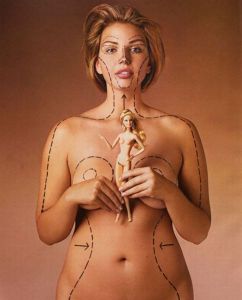
What Does a “Real Person” Look Like?

barbie-proportions

If you’re a regular at thezombieshuffle, you know that I’m a big proponent of accepting yourself for who you are, while always striving for self-improvement. At first glance those two concepts may seem contradictory. If you accept yourself for who you are why should you strive to be something more? Rather than being contradictory, I see them as complementary.

By accepting yourself, I mean that it’s important to truly be able to love yourself for who you are, as you are. The person you are today may not be perfect, but you are “enough”. This doesn’t however mean you can’t improve, and strive to be something more. And in fact I think we should always strive to improve ourselves in all aspects of life. Saying you are enough simply means you are measuring your self-worth against who you actually are, instead of some ideal of who you believe you should be. It’s saying I don’t NEED to be more to be worthy of love and acceptance by myself and others. I am worthy of love and acceptance as I am right now.

Body Image

In order to accept yourself for who you are you need to be able to accept all of yourself for who you are. But when we look in the mirror, we don’t see our hearts and souls – we see our bodies. Think of our bodies, and our ideas of beauty for a moment.

People magazine has an annual “sexiest man alive” issue. Over the past few years the winners were Adam Levine, Channing Tatum, Bradley Cooper, Ryan Renolds, Johnny Depp, Hugh Jackman, Matt Damon and George Clooney. In 1989 it was Sean Connery, who was 60 at the time. That list has considerable diversity among both age and body type.

Now look at the equivalent for women. Esquire has a “sexiest woman alive” list, and over the past few years they have Scarlett Johansson, Mila Kunis, Rihanna, Minka Kelly, Kate Beckinsale, Halle Berry and Charlize Theron. The women all seem to be between their early 20’s and early 30’s, and they all share a similar body type. The cover photos of the women are much more sexualized, with greater focus on their… shall we say “physical attributes”. The mold women need to fit to meet the standard of beauty seems very rigid. Let’s face it, you sure don’t see any 60 year old women on that list. Why not? Why is age fine for men, but not for women?

In most movies or TV shows, if there is a female character that is supposed to be “ugly” they are always someone who is beautiful by most standards. They just have less makeup, or are dressed in frumpy or quirky clothes.
If you think about age, in movies it is so common to see an older male protagonist with a much younger woman that you don’t really notice it. But if an older woman is with a younger man then it’s likely some sort of plot device. Older men are seen as “distinguished”, while older women are just seen as old.

Seeing all this, I have to admit sometimes I’m really glad I am a guy. I can only image how hard it is for a woman to constantly be bombarded with this sort of media imaging of what is beautiful, and how it must impact their self image.

You are More Beautiful Than You Think

A few years back, Dove had an ad campaign that touched on body image issues for women. In one ad women sat down with a police forensic artist who couldn’t see them, and he drew them based on how they described themselves.

Afterwards the women left and a second drawing of the person was done based on the descriptions provided by a person who had met them in the lobby.

The women tended to be critical of themselves, while the person who had met them in the lobby was more inclined to be positive in their descriptions of the woman. As shown the in commercial, the second drawing depicted the woman in a more flattering light (and also seemed more accurate). At the end of the ad, after seeing the two different pictures of her one woman noted:

We spend a lot of time as women analyzing and trying to fix the things that aren’t quite right, and we should spend more time appreciating the things we do like.

Body Transformation

Thinking of this unrealistic standard of beauty and negative body image reminds me of a mini controversy that erupted on social media a while back. An extremely fit mother of three posted a photo of herself in workout gear with her children, and a heading at the top that said “What’s your excuse?”

When it happened there was an outcry of people who felt that her image was an example of body shaming, and people saying that she didn’t represent what “real people” look like. Things took a nasty turn as photos of obese people started circulating social media in response with headings like “Is this what a real person looks like?”

It ended up making national news, and there was an ABC News interview where she said:

No matter how many children you have, especially when you’re working and trying to maintain your shape, you don’t have to lose yourself in becoming a mother. You can still maintain a sense of self physically and professionally. If I can do it, you can do it.

I think that instead of using “What’s your excuse” she probably should have used something like “You can do it too”. But part of me agrees with her. You CAN do it. Heck, I can do it too (though I may look somewhat ridiculous in a sports bra). You own your life, and make your own decisions. If you want changes in your life, the only way to do it is by taking ownership and making changes on your own.

So yes, you can get in great shape. But guess what? It requires work, time, and effort. And you have to ask yourself, what do you have to give up? What are your priorities?

What Do You Want?

If you want to get into better shape, stop and ask yourself WHY you want to get into better shape. What do you hope to accomplish? Be introspective and honest here. Are you trying to fit an arbitrary mold of beauty?

If so, let me give you perhaps a different perspective on body image. A buddy of mine plays competitive volleyball, and to keep playing as he has aged, he had a workout routine tailored to his needs. He made a comment to me that made a lot of sense. He said it was more important that he had functional muscles for what he wanted to do with his life than it was to have the sort of muscles that would attract attention in a bar.

We aren’t all competitive athletes, but the same idea applies. Instead of comparing yourself to fashion models and movie stars, ask yourself what are the things you enjoy doing? Travelling? Swimming? Bike riding? Softball? Keeping up with your children? Going for walks in the park? Are you able to do the things that you enjoy, or does your body and your physical conditioning hamper your ability to do these things? I think THAT should be the most important thing. Not trying to fit the mold of what society says is beautiful.

There are health risks associated with being overweight, so from a health perspective alone it is important to take care of yourself. But how your body “looks” isn’t necessarily an indicator of the sort of shape you are in. I’ve seen people with heavier builds power through high intensity aerobic classes while thinner and more “fit looking” people struggled to keep up.

Accepting yourself

Going back to what I said at the beginning, we all need to accept ourselves for who we are. That doesn’t mean giving up, or saying that I can’t get “better”. But we shouldn’t measure ourselves against the current standard of beauty. It’s also important to remember that your beauty starts from the inside, not the outside. There are many men and women whose outward appearance may be beautiful, while inside they are anything but.

Although we all do this, it’s best not to compare ourselves to others. There are different body types out there, and that’s fine. I won’t pretend to speak for all guys, but based on a sample of myself and a sizable group of male friends, I have to tell you ladies there isn’t a single mold of what is beautiful. People are all different, and just as our personalities are different so are the characteristics that we find attractive. Instead of trying to be someone else, strive to be the best “you” that you can be.

So what does a real person look like? You see them every day. Your neighbor, your best friend, your co-worker, and most of all you. We are all real people.

The Pursuit of Happiness

happiness

Are you happy? We all want to be happy, and we are all deserving of happiness.

Previously I’ve touched on what I believe happiness is. Unfortunately, happiness is not like a switch, where you are either happy or you aren’t. It’s more like a sliding scale where you can fall anywhere on the spectrum between happiness and unhappiness. But it’s complicated further because there are different areas in your life where you can be happy, and chances are good that you land on different spots in the “happiness spectrum” in each of those areas.

Think of some of the main areas of your life. I’m guessing most of us break our lives down into something like the following:

  • Committed relationship (spouse or partner)
  • Immediate families (parents, siblings, children, grandchildren)
  • Extended families
  • Social Networks (friends and acquaintances)
  • Jobs
  • Personal interests/hobbies
  • Additional organizations/memberships

Those are the first things that came to my mind, and you can add and subtract from that list in whatever way best applies to you. If you think of all the different roles that you play, you can have a different level of happiness in each of them. For example, you may not be happy in your job (which will affect your overall level of happiness), but still consider yourself happy.

Looking at the different roles that you play, how can you really measure happiness? If you are largely happy, or at least content, then it’s probably not something you even think about as it’s just a natural state.

The Search for Happiness

If you characterize yourself as an unhappy person, it seems obvious that you need to do something about it.

FindingHappiness

It’s clear that you need to change something. But what should you change? It’s probably best to try changing the “small” things first. Maybe take up a new hobby, or join a club or a team. If there are people in your life that are bringing you down, try talking to them about it, and if that doesn’t work spend less time with them. The same applies to family.

But what if it’s something bigger, like your job or your relationship with your partner/spouse? If you aren’t happy in your job, you can (and perhaps should) change your job. If it’s your relationships, then there are some bigger questions to answer. A few posts back I talked about questioning your relationship, so I won’t go over that again (in summary you either communicate and try to work on things or you move on).

One problem is that people who are in search of happiness often don’t know how to go about trying to achieve it. To make matters worse, they often go about searching for it in the wrong way.

There are countless cautionary tales of people who have embarked on self destructive behaviors, or made questionable life choices in the pursuit of happiness. In the search of happiness people often start engaging in activities either to make them “feel good” or to mask the pain of the unhappiness they feel.

Things like shopping, comfort eating, gambling or sex become outlets that give them a bit of a high. People may also turn to an actual high through drugs and alcohol. A more recent trend is turning to social media, and measuring happiness by the number of friends, likes, or complimentary remarks to posts.

Unfortunately these things are only temporary fixes, ways of numbing the pain and emptiness that they are feeling inside. They are like putting a band-aid on a gaping wound. And guess what? In most circumstances these people don’t actually end up any happier.

Happiness comes from within

One of the most difficult things about the search for happiness is that there is no magic pill; and you can’t “find it”. All the money and fame in the world can’t make someone happy. Just think of all the rich and famous people who make the news for things like addictions, behavioral issues or even suicide. Nothing can “make you happy”, you have to find it within yourself.

One problem with the pursuit of happiness is that I believe people aren’t actually pursuing happiness. They are really looking for meaning and fulfillment. There is a correlation between happiness and meaning, as people who find meaning in their lives generally are people who would describe themselves as happy (or at least leaning towards happiness on the happiness spectrum).

Ideally you find meaning in all aspects of your life – your committed relationship, your family, your social networks, job, and your personal interests. The reality is, very few people have a job that they love. Hopefully you find some fulfillment in your job, but many people find themselves in jobs that they don’t like, and they stay due to complacency and/or a need to pay the bills. Sometimes it’s worth taking a pay cut to find something more fulfilling, but if you have dependents then it’s easy to feel “stuck” in your job.

If you aren’t happy in one aspect of life (such as your job) it becomes especially important to find meaning in other areas. One of the most common areas that people neglect is their personal interests, and self nurturing. We all have talents and interests and it is important to take some time out for ourselves to nurture these. Often this involves engaging your creative side, such as music, art, writing, crafts, mechanical “tinkering” or cooking. It could also be things like volunteering, joining a sports team, or taking up some sort of regular activity.

I read somewhere that taking me time is necessary, as it provides the space needed to allow your relationships to flourish and grow. Without it you unfairly put all of your needs on your partner, and that holds them to a standard that they will never be able to meet.

That’s true, but there are different types of me time, and it is important that you choose things that provide meaning and help “feed your soul”. Taking time to watch your favorite TV show is great, and we all do it. But it doesn’t exactly provide the sort of fulfillment that will improve your happiness. Doing things to improve yourself is one of the best ways to provide meaning, and help build happiness from within.

happiness-is

Appreciation

In the workplace, employers have found that salary increases are ineffective tools for employee retention. Similar to drugs and alcohol from above, the effects are short lived. When someone gets a raise, they have an initial moment of excitement at the increased pay. But after a few pay periods that new pay becomes their norm. Unfortunately it is human nature to take the things we have for granted, and we do this in all aspects of our lives.

I live in Canada, and Canada is often cited as one of the best countries in the world by various measures. Wikipedia states that it “ranks among the highest in international measurements of government transparency, civil liberties, quality of life, economic freedom, and education, and stands among the world’s most educated countries”. Sounds great right? And it is. But it’s also been my home for my whole life so it is my norm, and as a result I often don’t appreciate it for what it is.

When I finished university I went on a trip to Vietnam, and I stayed with a family in Ho Chi Mihn city (the locals still call it Saigon) for a month. It was an incredible experience and it was the first time I had ever left North America. There were good and bad moments on the trip, but they were all new experiences and I loved every minute of my trip. Well, maybe not every minute. Getting into an argument with a customs agent because I refused to pay a bribe and almost missing my flight home wasn’t so great. But that’s a whole other story.

One of the most important things about my trip was that when I returned it gave me a different point of reference and allowed me to see Canada in a different light. It allowed me to truly appreciate my home in a way that I never would have had I not gone on the trip.

Another moment that made me appreciate things in a different way was an early experience as a new dad with my son. I’ll never forget the first time I took him for a walk in the neighborhood. He had just turned one, and was still a little unsteady on his feet. It was summer, and it was his first time exploring the outside world. Everything was new to him and we had to stop everywhere. He’s ten now, but I can still picture the sheer joy on his face as he touched and played with grass, felt the texture of the bark on trees and watched ants walking down the sidewalk. I picked some up and let them walk on his arms (which was cute, until he tried to eat them). He even explored the cracks in the concrete of the sidewalk. It took us almost an hour to make it two houses down, but it was a beautiful magical hour.

I looked at the yard and I saw grass that needed to be cut and weeds that needed to be pulled. Looking at the sidewalk I saw the cracks as flaws, signs that the concrete would need to be repaired or replaced. My son saw those things, and I won’t pretend to know what was going through his head (he was one). But from his expressions, it was wonderment. For him the world was shiny and new, and experiencing it with him allowed me to see the world that way again. I had forgotten the beauty that we have all around us, and stopped seeing it. All I saw were the flaws and the work that needed to be done. That day my little man taught me a lesson I have tried hard not to forget.

Relationships and Appreciation

As we age we lose that innocence and we fail to appreciate the little things in life. We have all this beauty and wonder around us all the time. We have people who love us. And we don’t even see it or appreciate it. We take for granted what we have.

We stop to see the good because it has been right in front of us for so long that is has become our norm. Once that has become our norm, we don’t appreciate it and instead we see the problems and the flaws.

If you talk to counselors or look at relationship books, one of the most commonly prescribed things is to try to focus on the positive. They will tell you to do things like make lists of the positives in a situation or a relationship and remind yourself of them.

This is all about looking at what you have and trying to appreciate it again. Rather than focusing on the positive I think it’s more accurate to say that this is trying to find again the positive that we have taken for granted over time.

I generally focus on relationships, but I believe this applies to all aspects of your life. Chances are there is a lot of good that you simply have lost the ability to see.

Finding Inner Peace

People do deserve to be happy, and by no means am I suggesting that people should stay in relationships or jobs that make them unhappy. People should be free to pursue interest that make them happy, and be around friends that bring them joy.

But sometimes we have simply lost the ability to see what has been around us the whole time. Sometimes instead of seeing the good all we are seeing is the cracks, and the flaws.

Change can be very positive. But sometimes it can’t be undone. If you are unhappy and looking to make changes in your life, first look at the things you have in your life and try to see them in with new eyes. Try to appreciate the good and the wonder in the things in your life. Try to see the world through the eyes of a child again.

If you are a parent, think back to the wonder your children showed as they first explored the world. If you aren’t a parent then find a kid between one and two that you can borrow for a while. Just make sure you get permission first (local law enforcement tends to frown upon it if you don’t).

If you can’t do that, just go out on your own and slow down. Take your time to look at things again for the first time. Feel the texture of the grass, and the bark of the trees. Don’t eat the bugs though, because that’s pretty gross.

You won’t necessarily “find” happiness, but you can try to take pleasure in the little things in life and try to let happiness in again.

Would You Be Your Friend?

I’ve never reblogged something before, but I think this is important. It is a big part of what I was trying to get at in my Identity Crisis series of posts.

I really believe that when a relationship ends, frequently for the person who “fell out of love” the problem wasn’t the relationship, but it was that they didn’t love themselves enough to sustain a loving relationship.

Anyhow, read on. It’s pretty great.

heartbeatapp's avatarThe Fickle Heartbeat

would you be your friend

Shared by Michele Bolitho.

Think on this.

If I ask you what sort of a person you are, you may tell me: ‘I’m powerful. I’m thoughtful and kind.’ You effectively tell me you’re a good person.

Powerful. Thoughtful. Kind. This is what you want me to think of you. You want me to think of you as a person of value. You want me to think you’re ‘Worth it’. I may well do this. I may take your self-assessment on face value and don’t sense any deeper. That’s fine with me.

But are you being honest?

Powerful. Thoughtful. Kind.  How true is this? It may be the appropriate way you tell yourself to inter-relate with me but is this what you really think of yourself?

Yes, you are powerful because you are running your own life. Powerful is accurate as I see it, but do you think you are…

View original post 1,232 more words

You’re not alone (Identity Crisis – Epilogue)

The focus of my writing is relationships (specifically long term relationships), and the trials and tribulations they can run into. As my thoughts on relationships have evolved I have realized that beyond the interpersonal dynamics that come to play in a relationship, everything is still built on individuals.

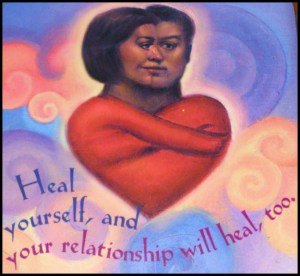
In relationships the whole is often greater than the sum of the parts. But at the same time a chain is only a strong as its weakest link. Cliché? Sure. But that doesn’t make it any less true. When one person is going through a difficult time, the other person needs to step up and help them. One individuals problems affect the whole relationship, and can potentially destroy it. So for the health of both the relationship and the individual, it’s very important that the members of the relationship deal with their own issues.

HealYourself

Because of that, the last few weeks I’ve taken a bit of a step back and focused more on the individual. My last two entries have been about understanding who we are, and accepting ourselves for who we are. Today’s entry finishes off that line of thought with a few additional thoughts that didn’t quite fit anywhere else.

A Perfect World?

I would like to think I came from a pretty good home. I’m sure it was better than some and worse than others, but for me it was home. Back in my high school days I had a buddy who would hang out at my place (my parents place) all the time. One day when he was over, he witnessed some sort of a family blow up. I can’t remember the details, but as with any family it could have been any number of things. I do remember what came next though. In the awkward/embarrassed silence that followed, he turned to me and said

I always thought you had the perfect family, but yours is just as screwed up as mine.

Fast forward many years, and a few months back I was talking to another friend. His family is going through some very difficult times, and he needed to vent. You know how on a hot day when you look down a road into the distance you can see the heat radiating off of it? This was kind of like that; as he talked I could almost see the pain radiating off of him. When we parted we did one of those awkward half pat man-hugs, acknowledging that something significant had just passed between us, but we weren’t quite sure what to do about it. He thanked me, and told me that he was glad we talked because it’s been weighing him down and he doesn’t really have anyone else to talk to.

These stories illustrate two very important things to me:

  1. We tend to believe other people’s situations are better than our own. In reality, every person and every family has their own issues.
  2. When our own issues are weighing us down, we often feel alone.

Dealing with Pain

I have always considered myself a “strong” person, and believed I could deal with anything life threw at me. I have also always been fiercely independent, taking a sense of pride in the fact that I had been able to fairly successfully navigate the waters of life on my own.

When my life took its unexpected turn a few years back, all of that was tested. I found myself in waters I couldn’t navigate and I was flailing, drowning if you will. I was a basket case, and from day to day I had no idea how to cope. It was a difficult time, and thinking back what stands out the most is how alone I felt.

I knew I had people who I could turn to, but I didn’t even want to talk to my closest friends and family. I didn’t want to tell them what was going on. I was embarrassed by it. To tell people would be to admit it – to admit that I was a failure. So instead I tried to pretend nothing was happening. I got up every day and got ready for work. But now in addition to putting on my clothes I had to put on my fake smile, while inside of me everything felt broken.

Sharing Your Story

The first person I opened up to was my brother. He will probably always see me as the annoying little brother, but to me he’s always been an easy person to talk to and I’ve always known he would be there if I ever needed him. One of the things I remember from those early conversations is him telling me to make sure I had my support net – people I could talk to.

One of the next people I talked to was a close buddy. I felt guilty “dumping my issues” on him because I knew he was dealing with some fairly serious issues of his own. But something interesting happened. Although our situations were different, he could relate to everything I felt. All the emotions I was going through were things that he had gone through as well. And my opening up to him allowed him to open up to me as well. We talked, we laughed and we cried. But that opening up and allowing ourselves to be vulnerable was cathartic. And I would like to think it helped both of us.

Over time I opened up to more people and I was surprised by how common my story was, and by how many people were going through similar issues. One guy’s wife left him just after their first child was born because she found the role of wife and mother wasn’t quite what she expected and she wanted “to be free”, another guy found out his wife was having an affair after many years of marriage, and yet another was living in a marriage where he and his wife were nothing more than roommates anymore. The stories were different, but the pain was the same. So was the sense of isolation and the feeling of failure.

Knowing that other people were going through similar things didn’t change my situation, but it made me realize I wasn’t alone. And somehow that helped.

Struggling to Cope

About a year ago a co-worker killed himself, and it sent a wave of shock through my company. Suicide? The guy in question had always seemed so positive and happy. How could this happen? That got me wondering if he had also been getting dressed every morning and then putting on a smile, hiding the turmoil inside.

I didn’t know him well, and I don’t know what his support net was like. Maybe if there were more people he had been able to open up to, he would still be here today.

Suicide is pretty extreme, and I won’t pretend to know the specifics of his case. But I will say that everyone has their own ways of coping with things. Usually those approaches work for us and we are able to “get by”. But sometimes we face situations or issues where our coping mechanisms are no longer sufficient, and we don’t know what to do.

I’m guessing this is how a lot of addictions start, as they are ways to numb ourselves to the situations that we are facing. And this is also probably where mental health issues start to arise. I’m not a doctor, but from what I understand mental health issues often arise due to a traumatic event or prolonged periods of stress causing brain chemistry to change slightly, altering the way someone perceives the world.

When I was younger I would hear stories of people “snapping”, and having some sort of mental breakdown or psychotic episode. The person in question was always referred to as “going crazy”. The things that make the news are always the extreme cases, but like everything else it can happen to varying degrees.

We are all Damaged

Look around at the people you see on a day to day basis – your co-workers, friends, classmates, even your family. How well do you really know them? If you think back to my gemstone analogy, we only see certain aspects of people.

We choose which parts of ourselves we present to the outside world, and it stands to reason that the parts we show are the ones we are least likely to fear being judged on. Statistically speaking, some of the people you talk to every day are struggling with very real issues. Alcoholism, drug abuse, gambling problems, serious illness (both physical and mental) to themselves or a loved one, failing marriages…

…the list goes on. It is probably happening right in front of you, and you don’t see it. They come to work every day, putting on their smiles, and trying to mask the pain they feel inside.

Even for your closest friends and family, you may know them well but do you really know the intimate details of their lives? You may know their job, but do you know how much money they make? You see the material things that are on display like their clothes, their cars and their homes. But do you know what their level of debt is? You may see how they interact with their spouses in public, but does that really tell you how happy they are in their marriage? Sometimes people hear about a couple splitting up and it comes as a complete shock. Sometimes the first thought is “I thought they were happy together”. Even with our closest friends and family, we still choose which parts of our story we want to reveal.

In reality, we are ALL damaged in one way or another. All the people you see on a day to day basis have their own flaws and issues. Everyone has problems. Every relationship has problems.

And you know what? That’s okay. It doesn’t make us any better or worse than anyone else, it just makes us human.

There is a crack in everything.
That’s how the light gets in. – Leonard Cohen

Don’t Compare!!!

Going back to my buddy at the beginning, he knew all the details of his family but had a limited view of my family. Comparing them, he thought we were “perfect”.

It’s a difficult thing to do, but try not to compare yourself to others. Because really, it’s impossible to do an accurate comparison. You know all the details of your own life, but you don’t know the details of anyone else’s. Chances are some parts of their lives are better than yours, and other parts are worse. Everyone has problems. Perfection doesn’t exist.

It is especially damaging to compare relationships. You don’t know the details of someone else’s life. Chances are, it has problems too. Instead of focusing on what you are missing, it’s better to focus on what you can do to improve things.

Another common problem is comparing your current relationship to a previous one. There may be some things that were better before, but how much time has passed? Are you the same person you were then? Did you have the same responsibilities then that you do now?

If you are ever making comparisons about your life or your relationships to look at what is wrong, or missing, you are doing yourself and your relationship a great disservice. No good can ever come of it. You need to judge your situation on its own merits.

Look for the Positive

Accept that there will always be issues, and that life will always have disappointments. It’s easy for the “bad times” to overshadow the good, but instead of focusing on the negative focus on what is good in your life.

Remember that you aren’t alone. Everyone has issues, everyone has problems. I haven’t read the book “The Happiness Project” (it’s on my to-do list), but from what I know of it, it mirrors my personal philosophies. Happiness is a choice. Perhaps you can’t “make yourself be happy”, but at the very least you can influence your level of happiness by how you approach life.

Look for the positive in things. Instead of focusing on what is wrong, look at all the good around you. Take time out every day to appreciate what you have instead of focusing on what you don’t. Accept that problems and issues are normal, and that’s alright. Problems are simply opportunities for improvement.

If you have been set in a negative mind-set this sort of change isn’t easy, but it is possible. Make it part of your everyday life. It will feel forced at first, but over time it will become natural.

Identity Crisis Recap

As individuals we are all seeking happiness, fulfillment and belonging. We are social creatures, and it is through our relationships that we find these things.

We are constantly juggling many roles though, and sometimes it can feel overwhelming and we can feel lost. I’ve talked to many people who have spoken of how they lost their identity in their relationship/marriage. Or more accurately, they allowed their relationship to define their identity.

Your relationship should be important to you. I would argue that it, and the person you are choosing to be with should be the most important thing in your life. But they should never be the only thing. We are complex, and have many interests and needs. Always take time away from your spouse to pursue other interests. That time away is just as important for nurturing your relationship as the time you spend together.

Commit yourself fully to your relationship, body, mind and soul. Never hold back. This opening up and allowing yourself to be vulnerable allows you to maximize the satisfaction you can get out of the relationship. Yes, you will get hurt sometimes. But you will also be open to a level of connection that can’t be achieved if you build up walls to “protect yourself”.

In order to commit yourself fully to a relationship, you must first love yourself. Stop trying to play a role. No one is perfect, and that’s alright. You need to accept yourself as you are, and be able to say “I can always improve, but I am enough”.

Don’t compare yourself and your situations to others. Everyone has problems and everyone has issues. It’s part of what makes us human. In order to be happy, it’s important to focus on the positive and not the negative. Even problems are simply opportunities for improvement.

Lastly, when times are tough remember that you aren’t alone. Don’t be embarrassed to reach out and ask for help. Vulnerability isn’t a sign of weakness.

Accepting who you are (Identity Crisis pt. 2)

In the past few years I’ve read a lot of different relationship books, and most of them are psychology books. They tend to be factual and talk about the way people work, the way relationships work, positive and negative actions etc. They usually have quite a bit of valuable content, but honestly? Most of them are pretty damned boring to read.

Every relationship is different, so I don’t believe there is a “one size fits all” solution to relationship issues. So when reading something my approach has always been to see if anything resonates with me. If so, I try and adopt it. If not, I ignore it. A lot of the content in relationship books is just common sense – things that seem obvious. “be kind to your spouse”, “don’t sleep with other people” kind of stuff. But although obvious, they do talk about many traps that are easy to fall into if you aren’t careful. So sometimes getting a reminder of that “common sense” is beneficial.

The Gifts of Imperfection

The Gifts of Imperfection
Recently someone recommended I read “The Gifts of Imperfection” by Brené Brown. I knew a little bit about what it was about, but I was still expecting more of the same old dry psychology texts with case studies. I ordered it online, and when it showed up I was a bit alarmed to see a “featured by Oprah” sticker on the cover.

Now, I don’t think I’ve ever even seen a full episode of Oprah. The only time I ever see daytime television is at the dentist’s office and the daytime television of choice there seems to be Springer or Dr. Phil (which is surprisingly entertaining).

Even if Oprah was on, usually I’m only half paying attention. It’s kind of hard to focus over the sound of the drill, polisher or questions/commentary from the dentist (side note – why do dentists talk to you while they work? Their freaking hands are in your mouth – It’s not as if you can respond!!!)

Anyhow, although I’ve never watched Oprah I have this image of her stuff as being all new age touchy-feely. Sure I spend a lot of time thinking and writing about relationships, and I’m relatively in tune with my emotions. But I’m still a guy. When I see a nail, I look for a hammer. I’m not sure if new age is really my thing.

But I bought the book, so I started reading. It opened with the following:

Wholehearted living is about engaging in our lives from a place of worthiness. It means cultivating the courage, compassion, and connection to wake up in the morning and think, No matter what gets done and how much is left undone, I am enough. It’s going to bed at night thinking, Yes, I am imperfect and vulnerable and sometimes afraid but that doesn’t change the truth that I am worthy of love and belonging.

Wholehearted living is not a onetime choice. It is a process. In fact I believe it’s the journey of a lifetime.

I mentioned earlier that when I read something, I see if anything resonates with me. And I’ve gotta say, that opener hit home. I didn’t just read it, I felt it.

If you’ve read any of my prior posts you will know that I believe life is all about choice. Your outlook on life is up to you. Happiness is a choice that you make. Even love is a choice. Situations and problems don’t resolve themselves – we choose what actions we take (and doing nothing at all is also a choice). So that opening really spoke to me.

This wasn’t like most of the books I had read. And honestly, it wasn’t even a relationship book. It wasn’t all about facts, instead it was full of big ideas.

I’m Worthy Now

One of the keys of the book was the idea that we as people are worthy of love and acceptance today. Right now. Many people believe they are only worthy under certain conditions: If they could get a better job, if they could lose 10 lbs, if they could gain the approval of their parents, if they could…

…well, you get the idea. If maybe our situation was different, or we were something other than what we are right now. Part of it may be fear – oh I can’t do this because… But another part of it is that people often don’t feel they are “enough” and they think they need to be something more.

The message was that you need to accept yourself as you are and believe in yourself. You need to accept that although the person you are isn’t perfect, you are enough. Embrace yourself and accept yourself for who you are. That’s not to say we shouldn’t all strive for self improvement. But we should be accepted for who we are and not feel we need to fit some mold.

Perfection Doesn’t Exist

One of my mantras is that perfection doesn’t exist – it’s an ideal for us to strive towards. And I’ve always thought perfectionism was striving towards that ideal. Brené Brown has a different take though, and she sees perfectionism as a bad thing. According to her:

Perfectionism is not about achievement and growth. Perfectionism is the belief that if we live perfectly, look perfectly and act perfectly, we can avoid the pain of blame, judgment and shame.

Healthy striving focuses on you. It occurs when you ask yourself, “How can I improve?” Perfectionism keeps the focus on others. It occurs when you ask, “What will they think?”

This had never occurred to me, but I think it makes sense. A healthy approach to problems is that they are opportunities for improvement. But I’ve seen cases where people get really upset when one little thing goes wrong. Something may be going 98% right, and instead of appreciating how well things have gone I have seen people who place what appears to be an irrational focus on the 2% that went wrong.

Numbing Behaviors

In our search for worthiness, people have things they turn to when times are tough. Escapes that allow them to take the edge off any pain they may be feeling. The book talks about numbing behaviors, and defines them as any actions people take to avoid experiencing the pain of feeling unworthy. Addictions are the most common things people would think of as numbing behaviors, and they can be drugs, alcohol, gambling etc. But really, anything can be a numbing behavior. Books, TV, the internet, Facebook, video games, even exercise.

Everyone has their own outlets, their own escapes. Any of these escapes can become an addiction when someone turns to these behaviors frequently and compulsively. That makes sense, but here’s the part that I really thought was interesting. She goes on to state:

We cannot selectively numb emotions. When we numb the painful emotions, we also number the positive emotions.

So when we turn to something to try and escape the lows points in life, at the same time we are dulling the enjoyment we can have, and limiting the high points in life.

Loving Yourself

Suffice to say, I enjoyed the book and thought it presented some really interesting ideas. The book was largely about learning to love yourself. In order to do that it says we need to:

Practice letting go of who we think we’re supposed to be and embracing who we are. Embracing who we are means accepting that we are not perfect, loving ourselves for who we are

I think that self love and accepting who you are is very important. And the importance of it can be seen when you look at how it impacts us in relationships.

At one point in the book the question is raised – can you love others more than you can love yourself? Brené Brown never conclusively answers that question (she has some arguments for and against), but here’s my take on it:

I believe that to feel loved we need to believe we are accepted for who we are. But if you go back to the gemstone idea from my last entry, it’s not easy to say who we really are. We are a lot of different things. In that entry I mentioned that the people who are closest to us are able to see the most of us, and our spouse should be the person who is closest to seeing the whole person. Everyone holds back to some degree though. We all have parts of ourselves that we are embarrassed of or ashamed about, and we try to hold those back even from those closest to us.

Here’s the problem – if we don’t love ourselves we are liable to hold more of ourselves back from the relationship. This is kind of like the numbing behaviors from the book. If we try to numb the pain, we also numb the positive emotions. As we hold back from our relationship for whatever reason (maybe we are scared to not be accepted or we are scared to fail), then we are also limiting the happiness that we can potentially have in that relationship.

What we get out of our relationships is directly proportional to what we put in. So for the greatest level of fulfillment we need to commit ourselves fully, body and mind to the relationship. But in order to fully vest ourselves in the relationship, we first need to be able to look in the mirror and be happy with what we see. And that’s not always easy.

So today’s advice to anyone out there is quite simply, love yourself. Love yourself and accepting yourself for who you are, and work on loving yourself every single day. Accepting yourself for who you are isn’t the same as resignation that you can never change. It doesn’t mean you can’t improve the things that you aren’t happy about. But it does mean that you don’t believe you need to change those things in order to be happy.

Identity Crisis

Have you ever felt lost, and wondered “who you really are?” I suspect all of us have an identity crisis at one point in time or another, a time in your life that you feel lost and are searching for “you”.

In many ways that’s what a mid-life crisis is. You hit a point that you realize “hey, I’m getting older here” and you question where you are in life, and the decisions that led you there. Some people are largely at peace with the choices they have made and the life they have built, so it doesn’t hit them very hard. Other people look at where they are and wish life came with a rewind button.

It can happen to anyone, at any point in time and it doesn’t matter how old you are. You can be closing in on retirement and still have days when you ask yourself what you really want to be when you grow up.

How do we find ourselves in these spots? How do we lose sight of who we are?

Playing Roles

A lot of it comes down to roles. Think of the different roles we play. We all take on a number of roles in our lives and these roles change and evolve along with us.

For family roles at first we are a child, sibling, grandchild, nephew or niece. Over time we may become a spouse, parent, son or daughter in law. To our spouses we are a friend, support, confidant and a lover.

If you are a parent, think of all the roles you play just with your children. You are a caregiver, teacher, friend, disciplinarian (both judge and jury). These roles can sometimes conflict too. You want to be a friend to your children, but when it’s time to be a disciplinarian that needs to trump the friendship.

I’m not trying to give an exhaustive list, but the point is that we are a lot of different things and different people see us in different ways.

If my parents look at me, they see the child that I will always be to them. I’ve been on my own now for longer than I lived with my parents; but although they know I am an adult and a parent to my own children, I am first and foremost their child and they will always see me that way.

Beyond these types of social roles, we develop different interests that in turn become roles for us. We become a musician, a dancer, an artist, an athlete. Even though we may not follow these things as a career we all have aspects of all of these within us (no matter what our aptitude for them is).

When we are younger, we probably dabble in a bit of everything while trying to find ourselves. Some people find their “calling”, other never do. Only a lucky few are able to base their careers off the things that truly interest them. Most of us continue to dabble in our interests on the side, while many of us stop working on that part of ourselves completely.

We play all these roles, and each of them comes with their own fears and insecurities. For example, it’s not really accurate to say that someone is a confident person. Maybe they are confident as an athlete, but terrified as a public speaker.

Gemstones

I was talking to a buddy about all these different roles we play and what they mean to who we really are, and he came up with a great analogy. His idea was that people are like cut gemstones (I’m not sure if it was really HIS idea, but it was the first time I heard it).

Think of a cut gemstone:

Cut Gemstone

Cut Gemstone Cross-Section

People are like this. We have all these different faces or surfaces – and the different surfaces represent different aspects of us. The roles we play, our interests, the sides of our personalities etc.

In our lives we encounter all sorts of different people, and each of those people only sees a part of us – a few aspects of us at a time. They are still “seeing us”, but they don’t see ALL of us. As the picture shows, a person can look different depending on which sides of them you are able to see.

The closer a person gets to you, the more of you they are able to see (which technically would be backwards for the gemstone analogy, but I’ll ignore that for now). Acquaintances only see a few aspects of you, while your closest friends will get to see more sides of you.

Depending on how much you are able to open up to other people, it’s possible that no one ever sees all of you. But you are still all of these different aspects (some of which may even conflict). To me this analogy really works.

So who is the “real” you? Is the real you the person your parents see? The one your children see? Your co-workers? Your friends? All of them are the real you – they are just different aspects of you.

What does this mean for relationships, and specifically for spousal relationships? There are two important things to take away from this.

Your spouse should be your best friend

First, your significant other should be the person who is closest to seeing the whole you. Interestingly, there may be a difference between men and women in this though. Many studies have shown that when asked who their best friend is, men are most likely to say their wives. Women on the other hand are most likely to name another female friend. As a guy, I buy into the notion that your spouse should be your best friend. They are the person you will hopefully spend the rest of your life with.

My dream is to grow old with my wife, and be able to walk hand in hand with her, laughing and loving one another each step of the way. Without being best friends I don’t see how that can happen.

You still need to be You

A while back I had a post that talked about the idea of a marriage box. The idea was that some people expect marriage to come with everything they need while in reality to you need to continue to grow and nurture your relationship. Just as some people expect marriage to give them everything they need, some people go into relationships expecting their spouse to be everything to them.

You hear stories all the time about people who start a relationship and then drop their friends. Their lives and their sense of identity become completely wrapped up in the marriage and in the other person. This is not a healthy approach to marriage.

Think of the gemstone analogy, people are complex and have many facets. The romantic notion of “you complete me” is somewhat true. Couples should be similar in some ways and complement each other in others. But no one person can meet all the different complex and conflicting needs – and we shouldn’t want them to.

Ever if one person could meet all of your needs it wouldn’t be healthy. Time apart and time with other friends is important to a relationship.

Here’s a quote I found (at this site) that I love:

As you give up those things you find fulfilling and important for the sake of the relationship, this places a tremendous burden on your spouse to fill the void of whatever you gave up. And this burden will create neediness and dependency, as well as resentment and boredom.

Every marriage needs space between the spouses. It is within this space that you find energy, passion, eroticism, quiet time, and personal fulfillment.

Balancing the “we” with the “me”

One place I disagree with the guy who wrote the above quote is that in the full article he says your spouse should not be your best friend, as he believes it’s damaging to the relationship. I believe your spouse “should” be your best friend, but they shouldn’t be your only friend.

While embracing being part of a couple (the “we”) it’s important not to lose sight of yourself (the “me”). This last part is where the struggle comes in. The things you did before you and your spouse met shouldn’t stop. They may not happen as often as you are now fitting someone new into your life, but they are part of what made you who you are. Giving that up is not only a disservice to yourself, but also to the long term health of your relationship (well, unless one your things was sleeping around, then ya it probably needs to stop).

Let’s say you love football and your spouse doesn’t. That’s fine – they don’t have to. It’s great if they show some interest in it, and maybe you will occasionally go to or watch a game with them. Your spouse showing an interest in football is really them showing an interest in you, and wanting to share things with you. But if you had friends that you watched football with before, that shouldn’t go away. And you shouldn’t feel like you need to bring your spouse all the time.

It’s important to find things that you can do together as a couple. And it is good to support your spouse in their interests that you don’t share. You need to find a way to balance “you” as an individual with “you” as part of a couple.

Remember though that time apart isn’t really time to be “you”. You are still you when you are with your spouse. Rather time apart is an outlet for different aspects of you. And this is needed in order for you to have the happiness and fulfillment required to allow your relationship to thrive.