It’s Not About The Sex

holding-hands-1

I read a number of relationship blogs, and a while back I ran across something written by a woman commenting she didn’t want to just be a “receptacle for her partners sperm”. I have to admit, it made me laugh. It was kind of crude, but funny. And it got across the point of what she felt her role had been reduced to in the relationship.

I recently read another blog by someone talking about what she wants in a man. It was something along the lines of wanting a man who will love her for who she is. For her mind and her soul, being someone who would be willing to support her and grow with her, and not just want her for sex or her body.

I agree. Any man worth being with should want her for all of her, and want to be there for all of her. But guess what? He’ll still want her physically, and he’ll still want sex. And that should never be a bad thing. Actually, she would probably be upset if he didn’t want her.

Reading other blogs, this sentiment seems fairly common. There seem to be lots of women out there feeling some variation on the receptacle idea.

Somehow, somewhere along the way sex seems to go from being this special thing a couple shares that happens to feel good to almost being something bad. It seems to have become a chore or a duty for many women.

If that’s the case, it seems clear that there is some sort of a disconnect between how men and women are expressing our sexual needs as well as our understanding each of other.

Generally I don’t buy into gender differences. I think there are a lot of guys out there with “female” traits and vice versa. But maybe this is one area where we ARE fundamentally different. After all, if you think of the very act – we experience it in a completely different way. I know how it feels as a guy, but as a woman? I have no clue, and never will.

I’ve written in the past about the benefits sex has for a relationship, so I won’t rehash them here.

But here are a few facts:

  • Sex provides many benefits to a relationship
  • Sex drives between partners vary, and are not constant over time
  • Sexual problems can spill over into the rest of the relationship
  • Sexual issues are cited among the leading causes of divorce

How is it that something that should bring us together drives us apart? Some guys may be jerks, but I think most truly do care. So how can any guy make their partner feel like a receptacle for sperm?

Speaking Different Languages

My thought, maybe we just don’t understand each other. And maybe if we can understand each other better we can start to break down these walls of resentment that take what should be a special act and turn it into a cause of conflict. I don’t pretend to represent all guys here, but these my thoughts on the subject…

Sex is not about sex.

Huh? What?

Let me explain…

Who do you have sex with? Random strangers? Unlikely. Your parents? If so, first – too much information. Second, ewww. Your buddies? Some people have “friends with benefits”, but generally that’s because they are not in a relationship and are looking for a regular outlet. In that case, yeah, I guess it’s about the act. But it still has a tendency to run into complications.

No, generally it’s reserved for a couple in a relationship. Why? And why is it that having sex with someone else while in a relationship is often defined as an affair, instead of having dinner with someone else or going for coffee with them? (Incidentally, I think it’s a huge misconception when people draw the line for affairs at sex. The line for affairs should be drawn LONG before that, and could potentially be extended to something as “simple” as dinner. But that’s a topic for another day).

No, sex is clearly different. There’s something special about it. But what?

Being Naked

Years ago one of my buddies caught me off guard when he started talking about his girlfriend and how beautiful and sexy she was when he saw her naked. There are all sorts of stereotypes of guys talking in the locker room about their “conquests”, or constantly talking about women. Maybe it’s just my peer group but we REALLY don’t do that, so it was a bit disconcerting to me when he mentioned this.

First, there’s the unwritten bro-code. You don’t look at or think about a buddies girlfriend/wife/whatever in a sexual way. That’s just not cool. So having him talk about her naked was awkward, as of course it meant my mind instantly imagined her naked.

Ahh!!! Brain what are you doing? Noooooo!!!

As my traitorous brain was processing these unwanted images, I was also thinking “dude, ummm, your girlfriend’s really not that attractive” (I didn’t say that of course). Everyone has their preferences, but for me? Even trying to be objective she didn’t do much for me.

But here’s a secret about sex and desire. Being sexy and beautiful has very little to do with your physical appearance – it’s mostly mental. Is it only young attractive people who desire each other? No (at least, it shouldn’t be).

Being naked with someone you love isn’t about admiring their “naughty bits”. It’s about vulnerability. You are being open with each other. It’s about safety, closeness and trust.

For years I thought sex was about sex. But it’s not. It’s about that feeling, that sense of complete vulnerability and openness. That feeling is intoxicating, and arousing, and will likely lead to sex. But I don’t think it’s the sex that we want, it’s the sense of connection.

The physical act is just insert A into B. The emotional act is one of wanting to connect with and give pleasure to someone you love in a way that is only shared by the two of you.

Because of this I actually believe sex in a long term committed relationship can be better than any other sex. “New love” may have sex more frequently, but it’s more lust than love at that point.

love

Different Drives

Young guys may hope they will be having sex all the time. As you get a bit older, you realize that it doesn’t work that way. It doesn’t mean you wouldn’t be happy to be having sex more frequently, but sex is just part of the relationship and the relationship is more important.

Drives fluctuate. It may be frustrating at times, but we get that. What really matters is that we feel valued, and feel as though our needs in the relationship still matter. There has to be a middle ground where the lower drive person isn’t constantly being pressured, but the higher drive person isn’t left feeling unfulfilled.

If you say no one day, that’s fine. But when one person is consistently rejecting the other and shutting them down sexually then there is a problem.

For anyone who isn’t having sex with some regularity, I ask you this – what is the general level of non-sexual touching and affection like in the relationship. If sex isn’t happening, I’ll guess affection is at a shortage too. How about communication? How easy is it to talk to your partner? Can you tell them anything? Do you? When you are unhappy in parts of your relationship do you tell them? Or do you hold things in? Do you still tell them that you love them?

When there is limited to no sex, the affection and communication has also usually broken down. If affection and communication were still there, the lack of sex would probably be bearable. But then, if the affection and communication were there, chances are the sex would be too. They go together. Sex is simply the natural extension of that affection and communication.

As such, sex is about much more than the physical act. It is symbolic of all the closeness and affection that makes a couple a couple.

A Symbol of the Relationship

Guys see sex as symbolic of the relationship, and because of this a lack of sex can REALLY start to mess with them.

First, they start to question themselves:

  • Is there something wrong with me?
  • I desire my partner, what is wrong? Am I terrible at sex?
  • Does my partner no longer find me attractive?
  • Does my partner not desire me?

There’s a good chance that the lack of sex is at least partially because their partner isn’t feeling good about themselves. But this lack of sex results in both people feeling bad about themselves, and can start a downward spiral of negative momentum.

If the problem persists for any length of time, guys start to question the relationship itself:

  • The person I committed to won’t touch me, do they not care about me anymore?
  • Do they not love me?
  • Is our relationship failing?
  • My needs are being ignored here, what about me? Don’t my needs matter?

At this point, the sexual drought is spilling over and affecting the rest of the relationships. Chances are you got here due to poor communication. Unfortunately improved communication is what you need to get out, as over time this will do considerable damage threatening the relationship itself.

People say that they don’t want to be bothered for sex. But someone pestering you for sex isn’t a problem. It becomes a problem when they have stopped asking, because when that happens resentment has set in and they have given up hope.

All About Sex

I opened with the idea that guys seem to be making women feel like they are only wanted for their bodies, and that things are “all about sex”.

I’m pretty sure that’s not the intent. Making your partner feel that way is simply going to cause any sexual rift to deepen, and that’s not something anyone wants. So why in the world do guys do it?

Here’s my theory:

One of the biggest issues that couples face is they get to a point where they feel they have lost “the spark”. They feel like roommates, and maybe feel taken for granted. They no longer feel special when they are around their partner. And likely they ARE being taken for granted somewhat. It’s easy to get caught up in day to day life and let the relationship suffer, but it doesn’t mean someone loves their partner any less.

I think this is the stage where some people start to resent sex.

For guys, sex is symbolic of the relationship. They need it on a fairly regular basis (“regular” being different from person to person) in order to feel that things are alright. But without enough focus on each other, to the woman it starts to feel as though all they are wanted for is sex. After all, if you aren’t taking time to nurture the relationship (which is usually the fault of both members) but still want sex, then it does start to seem like you are roommates who happen to have sex sometime. No one wants that.

I’ve heard it said that women need connection for sex, and men need sex for connection. I don’t think that’s quite accurate. Instead, I think maybe for women sex goes along with connection while for men sex is symbolic of connection. But even for the guys it’s not actually about sex. It’s still about connection.

I think maybe men and women are both actually looking for the same thing. We both want connection, and to feel valued in the relationship. We are just speaking different languages, and becoming resentful as a result.

Keeping Love Alive

The worst feeling in a relationship is the sense that you have become just roommates, and the sense of being lovers is gone. When this happens, men often seem to think that sex is the way to rebuild the connection, while women want the connection before the sex.

Both approaches are probably wrong. Sex without connection will feel devaluing for both parties. But going long periods without sex while trying to rebuild connection will undermine your ability to rebuild connection. The relationship has to be the focus, but sex needs to be included as part of that.

For any ladies out there who are feeling like they are just wanted for sex, chances are your partner is not just looking for the act (alright, maybe sometimes but not usually). Instead he’s looking for everything it means to him. He’s looking for connection, and a feeling of closeness. He doesn’t want just anyone, and he’s not looking for a repository for his sperm. He wants YOU. He’s looking for feeling loved, and valued by you.

And he sees sex as a way of expressing all of that.

I don’t know if this makes any sense, or helps anything. But to any ladies out there who are feeling used solely for their bodies, please be open to the possibility that there is a lot more to us than just that.

You may drive us crazy sometimes (just as we do to you). But we do love you for who you are. We love your personality, your quirks. The way you can make us laugh and how just thinking about you sometimes can bring a smile to our faces. We want to be there for you emotionally as best we can (which admittedly isn’t always the way you want). And we do want to grow with you and have a life with you. We just need sex to be a part of it.

Losing the Spark

dimmingflame

I spend my days in the world of business, and increasingly I see parallels between what it takes to succeed in business and what it takes to succeed in long term relationships (and life in general actually).

Two of the central concepts in business are Operations and Projects. Any business has *something* that they do, and the operational side of a business is the day to day tasks that allow the business to function in the here and now. This is the stuff that keeps money coming in, and sometimes you’ll hear this referred to as the things a business needs to do to “keep the lights on”.

A business can’t only worry about today though. They also need to keep their eye on the future and plan where they want to be tomorrow. See, even if they have a great business, markets change. New products appear (potentially reducing interest in existing ones) and new competitors appear with fresh ideas and approaches.

In addition to worrying about today, businesses have at least part of their energy and resources dedicated to ensuring there is a tomorrow. At the very least, they need to monitor the ongoing health of the business. This side of business where there is long term visioning is referred to as projects.

Operations may keep a business running and alive today, but the future still matters. A business needs to grow, or at least ensure that they aren’t becoming obsolete. It can be tough balancing both of these things, but it’s necessary to stay alive.

Those who don’t balance the present and the future tend to fail.

The Operations of Relationships

Think of the progression of a relationship.

The early days of relationships are all about building. You meet, and spend time together learning each other. It’s exciting, and it’s new. When you get together it’s an event. Even if all you do is rent a movie or watch some TV, you still made plans to get together. Think of this as your “business start-up”.

Then the relationship gets to another level, and you move in together or get married (and then move in together). What happens? We are no longer building the relationship, we have already built it. We know each other, and although there is still more to learn the pace at which this happens slows considerably.

We now start worrying about day to day life. Our “planned” time together gets taken up with things like grocery shopping, laundry and dishes. Then maybe we have kids, and for a number of years they become the priority. Life becomes all about feeing and changing the baby. It’s about teaching them, raising them. Helping with homework, and shipping the kids off to various events.

These things are all important, and we have to do them. And hey, maybe we even enjoy doing them. But all the while the energy we were once expending on our partner and our relationship is slowly diminishing.

If you talk to couples who are having problems, one of the biggest issues they face is they get to a point where they feel they have lost “the spark”. When this happens, couples will often say things like “they feel like roommates”, or “they feel taken for granted”.

I think this is the biggest killer of relationship, but what exactly is it that has happened here?

The couple has gotten caught up in “operations”. They have lost sight of the future (the fact that they need to have one). They aren’t monitoring the health of the relationship.

Instead, they are simply living life day to day, doing the things to keep the lights on. They haven’t focused on each other enough and spent enough time growing the relationships – or even just ensuring that they aren’t falling apart.

Part of it is “comfort”. Life gets busy, and when you *know* that the other person will be there it’s easy to let them slide. After all, when all the chores are done and the kids have been put to bed both of you are often tired. But over time this takes a considerable toll.

Some couples wake up one day and realize they no longer know the person sleeping next to them. And chances are both of them have a bit of resentment and a sense of loss for where they once were, and what they have become.

Look at your interactions with your partner. Look at the hours you spend together. How much of it is actually focused on them? How much time are you investing in being a couple? Now look at how much of it is time where you simply happen to be occupying the same space, but you are really focused on the kids, the chores, whatever.

Yes, all the “stuff” of day to day life has to happen. But you need to nurture the relationship too.

Signs of Distress

In long term relationships, I think all couples go through some sort of variation on “losing the spark”. Eventually we realize we have got caught up in running a household and raising a family (the world of operations), and we have lost sight of each other as a couple.

What matters is how far things are gone before we really notice, and what we do about it.

People talk about how communication forms the foundation for any relationship, and that becomes especially true when we recognize problems. People are different, so often one person will be the first to really notice “a problem”.

When this happens the biggest mistake people can make is to do nothing.

From reading books and other blogs, often women are the first to get the sense that something has gone wrong (us guys tend to be oblivious). It’s not always women noticing first, and the relationship may not even be a woman and a man – but let’s assume it is for this example.

She notices *something* has gone wrong by realizing that she isn’t really happy.

Maybe she says something to her partner, but he doesn’t get it. He hears her, but doesn’t understand. He thinks, “I love you, I’m providing for my family and I’m a good parent, I don’t understand what the problem is. I’m being a good partner here.”

He is stuck in the world of operations. Those things are important for keeping the relationship going, but not for keeping it ALIVE.

When she says something another response is to get defensive. Having his partner say “I’m not happy here” become misinterpreted, and in his head it becomes “you aren’t a good partner” causing him to start to withdraw (hey, we are emotional creatures and can be a bit sensitive sometimes).

A worse situation is when she doesn’t say anything at all. Rather, she pretends she’s happy and tries figuring out what is wrong on her own. All the while resentment towards her partner is growing, and he doesn’t even know anything is wrong.

Actually guys may be dumb, but we’re not stupid (mostly). So he has picked up on the fact that something is wrong, but he thinks it’s just a phase that will pass, or he completely misreads the severity of things. After all, they’re a couple and they’re committed to a life together, right?

Hah. Unfortunately life isn’t that simple.

Accepting a Problem

When it comes to relationships people REALLY don’t like to accept the existence of problems, so they deny it for as long as they possibly can. People are stubborn, and our natural response to things is to look for things to blame reasons, and we really don’t like change.

Eventually though, we accept that there’s some kind of problem.

I once read that most couples get to a counselor about 2 years later than they should have, and I believe it.

For the person who “caught on” late, they’re hurt and a little scared, so they do what they can to try and make things better. But by now the relationship is caught up in the resentment that comes with negative momentum, so there is a risk that the partner who noticed things first has withdrawn from the relationship, and ignores the efforts to improve things. They think it feels forced, and not genuine.

The couple is now in a downward spiral that does not have a happy ending unless they can both buy in that they want things to improve. And if they do, they need to realize that yeah, things will seem a bit forced at first – but that doesn’t make it any less real.

Digging Out

A LOT of relationships fail at this point. And a lot more stay together, accepting the “truth” that this is normal and long term relationships are simply doomed to a loss of love. Some are fine with a somewhat happy existence, and others stay together in name only – basically living separate lives.

I think there’s more to life than that. I think your relationship should be a source of joy. You should WANT to spent time with your partner whenever you can. After a long day at work, you should look forward to getting home and seeing their face. You should want to share experiences with them. And no matter how long you have been together, nothing should feel as good as being with your partner, holding each other and knowing you’ll never let each other go.

To get back to that spot, you need to focus on the relationship. Day to day life will always be there, but that can’t be your only interactions. You can’t use that as an excuse to not nurture the relationship.

Like a business that monitors it’s day to day health while having a plan for the future, the relationship HAS to become a priority. You need time focused on each other. You need to not only maintain the relationship, but build it.

Do things together.

I don’t think couples intentionally take each other for granted. Most couples will SAY “of course the relationship is a priority. Of course my partner is a priority”.

But actions speak louder than words.

Think back to my earlier question:

Look at your interactions with your partner. Look at the hours you spend together. How much of it is actually focused on them? How much time are you investing in being a couple?

Now ask yourself how much time you think you should be spending on being a couple. Everything needs some sort of sustenance and maintenance to survive, and relationships are no different in this regard.

If you feel the spark has been lost, rest assured that you aren’t alone. Many, many couples go through the same thing. But as long as there is still a flicker, no matter how faint, you can rebuild a flame.

But it’s up to you to do it. If your relationship is a priority, don’t let that only be in words. Back your words with action, and focus on it again. And this time, don’t let it go.

Momentum Shifts

Momentum

Momentum is defined as:

“the strength or force that something has when it’s moving”

Looked at this way momentum is often thought of in terms of a physical object, but physical objects aren’t the only things that can have momentum.

Momentum is also found in the world of sports. Take basketball (since that’s what I know best):

Maybe a player hits a few shots, then makes a great defensive play. Next thing you know the game is coming easily and the player (or team) is “in a zone”, confidence builds and everything seems to be working. In this case momentum is more like a feeling or an energy; and this energy can be seen through body language. When things are going well players are loose, carefree, and seem to be having fun. It can’t really be quantified, but anyone who has felt it or even just witnessed it knows it real.

One thing about momentum though, you can’t always control it and it’s not always positive. Just as positive momentum can build, players or teams can go cold and the momentum can shift. Sometimes a team appears to have a game well in hand, and then something happens. Maybe they start missing a few shots, or have some defensive lapses. At first it’s not a big deal as they still have the lead. But as the game becomes closer the energy starts to shift, and instead of playing freely players start to tighten up. Doubt starts to creep in and they start to rush. The opponent senses the shift, as do the fans.

When this happens a coach will often call a timeout to give the team a bit of a pep talk and try to prevent the negative momentum from building any further. See, momentum in this sense comes down a lot to confidence and belief. It is a form of energy visible largely through body language.

Momentum in Relationships

Relationships also have momentum. The early days of a relationship are often generally marked by a sense of positive momentum. The couple may just be getting to know each other, but they are relaxed, comfortable with each other and having fun.

Unfortunately just as there is positive momentum, there can also be negative momentum. And when you find yourself getting caught in negative momentum you can feel powerless to stop it.

The problem with negative momentum in relationships is that there is no coach to call a timeout and try to get things under control. Instead, this negative momentum can feed off itself and build, potentially spiraling out of control.

The Downward Spiral

I recently read an article by couples therapists Harville Hendrix and Helen LaKelly Hunt talking about how negative energy impacts relationships.

The therapists were a couple themselves, and as their own marriage was struggling they made an interesting discovery. Their discovery was that this negative momentum makes it very difficult to get out because people start to guard themselves, misinterpret things and look for offense even where none is intended.

As a result, even when partners are making attempts to improve the relationship and “make things better”, it often doesn’t work. People can become unable to recognize genuine love.

Harville ticks off the ways we deflect what we secretly crave: by devaluing praise; by assuming the other person is insincere; by criticizing the sender of a positive message for not getting it right, not doing it on time, or not doing it often enough; by not listening; or by feeling embarrassed.

For instance, there was the wife who told her husband she needed him to express more affection—then resisted his kisses and kind words because, she said, they didn’t feel genuine. Another husband admitted that when his wife offered verbal support, he shut down and didn’t respond. And when a new father took time off from work to help his exhausted wife with their twins, she refused to let him do his share.

“The common wisdom,” they write, “is that romantic relationships would stay happy if people did a better job of giving to each other. But that’s not what we’ve discovered. We’ve found that many people need to do a better job of receiving the gifts their partners are already offering. It’s surprising how often the compliments, appreciation and encouragement of a well-intentioned partner make no dent in the armor of an unhappy partner.

Ulterior Motives

When we are unhappy, we start to put up barriers, perpetuating our unhappiness and making it difficult for things to improve. One of the big problems is when we start looking for ulterior motives. If you are looking for hidden meanings and slights, you will always be able to find them.

This causes people to discount genuine attempts at improving and strengthening the relationship. People take the approach of “oh, he/she is only doing this because they want something”.

Yeah, they probably do want something. They want to make the relationship better. They want to see their partner smile again. They want to experience a loving relationship the way they once had. They want to be happy again as a couple. “Wanting something” doesn’t have to be a bad thing.

So they do their best to try to make things better, but they don’t know how. And when all their attempts at improving things are ignored or looked at suspiciously eventually they will give up.

That is when relationships die.

Loss of Hope

I’ve said before that I don’t think it’s ever too late. Sure, there are some cases where it’s best for everyone if a relationship ends. Often when relationships end I think that both people do still love each other. But that love is buried under layers of hurt and resentment, and it has gotten to the point where they don’t believe they will ever be happy again.

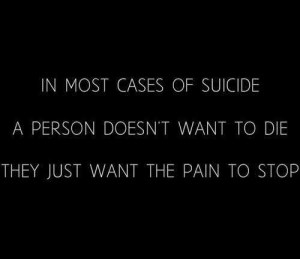
Consider the following:

suicide

It’s kind of a morbid thought, but I think the same thing happens in relationships. I don’t think anyone “wants” a divorce (alright, maybe some do but those are probably exceptions). They just want to be happy again, and they have lost hope that they will be able to.

Frequently when long term relationships fail, one or both members wish they could have made it work. And often long after the relationship has ended, people hold out hope that they will somehow be able to reconcile.

A buddy of mine ended up divorced after his wife walked out on him, and even after the divorce he wore his ring for 6 months hoping that somehow they could figure things out. Eventually he gave up and moved on with his life (only to have her come back wanting to patch things up after it was too late). Reading other blogs and comments sections, for the person who was dumped/scorned/left there is often a wish that things could be different, and they could be back together.

The failure of a long term relationship is not an easy thing, and the only people who seem to be unfazed by it are people who have already started a new relationship prior to ending the old one. Incidentally, those affair relationships are almost always doomed to failure. Stats say that 40-50% of first marriages fail (pretty depressing), but when you look at numbers on the affair relationships that cause marriages to end, the stats jump to around 80%.

Changing Perspective

I think people give up on their relationships too easily. Long term love isn’t always easy – you need to build it, and keep building it every day of your life.

Negative momentum can threaten to tear things down, so we need to find ways to recognize when it is happening, stop it and turn it around when it occurs.

We need to start opening ourselves up to genuine gestures of love, and stop looking for problems and issues. You will always be able to find things to be unhappy about if you are looking for them.

You get out of life what you put into it. It can be hard when you are unhappy, but you need to start focusing on the positive, and appreciating the things that are good. I’m sure there is a lot of good, but it can be hard to see when you are caught in negative momentum.

No matter what state your relationship is in, things can always get better. Things can always improve. But you need to open yourself up and allow love back in.

For any readers out there who have “been through the fires”, I would love to hear from you. What are some things that you have used to hold on and maintain your love when times were tough? Feel free to comment below or email me at thezombieshuffle@outlook.com

Making Changes

change_banner

I’ve mentioned before that I’m a big fan of basketball. Well I’ll let you in on a little secret – I can’t shoot. I’ve had days that I will hit 10 in a row, but those are rare, and tend to be followed by stretches where I won’t hit at all. If you meet me on a day that I happen to be hitting you may think I’m a good shooter. However if you play with me for long enough, it becomes apparent that I can’t.

Shooting is only part of the game and I would like to think I can get by with some of the other things that I do well (or at least better). But still, it would help my team if I was able to hit shots more consistently.

I have never been coached. As an uncoordinated youth, I started playing late and learned basketball largely through observation, then by trying to recreate what I saw. In the process I came up with a shooting mechanic that “worked for me”. Through the years I’ve recognized that my shot is a weakness in my game, so I try to listen to other people and get pointers when I can. I’ve made some adjustments over the years, but the only consistent thing about my shot is its inconsistency.

Last summer my son was at a basketball camp and there was a “shot doctor” who came in and taught the kids the proper mechanics of shooting. I’ve read books, watched videos etc, but this was the first time I had ever had someone really break down the mechanics of a shot into their components. As he taught the kids, I listened intently.

After the camp, when I came home from work I tried to put what I had learned into practice.

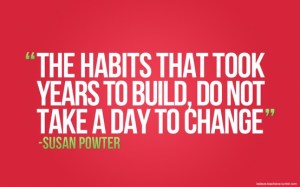
My “old” shot had been internalized. It was reactive, meaning I didn’t have to think about it. And that made it really hard to change. Here’s the thing, when you have YEARS of “bad habits” built up, it becomes really hard to change them.

To make changes you need to really slow down, think about what you are doing, and go back to the basics. It took me a while to get the feel for the “new” shot mechanic, but once I did it was amazing. I was hitting shots at a much higher rate, and more importantly with greater consistency over time.

slow-changes

This improvement had me looking forward to the start of my mens league season, and I believed that this year I would have more confidence in my shooting.

The season started, and guess what – the speed of an actual game is quite a bit different from shooting on your driveway with no defender. I didn’t have time to think about the shot mechanics, and in the pressure of the moment I found myself reverting to my “old” (you can also read that as bad) form.

You see, its one thing to understand what you have to do to change. It’s something entirely different to put it into practice on a regular basis and in a “real life” situation.

Putting in Effort

For me basketball is just a pastime. I love it, but it’s really not that important to my life. So I haven’t put in the hours needed to really internalize the improved mechanics so I can use them in a “real life” situation. I realize that true change takes effort, and that applies to any changes in life.

In a recent post my buddy Gandalf talked about changing his life. As he said:

One item needed for this is dedication. Without that, I wouldn’t have been able to see this through and continuously try to improve every week. I needed to put lots of effort into getting better, which is where hitting rock bottom helped. I knew the problem was me, and only I could make myself better.

Learning to Cope

Over our lifetime we develop coping mechanisms for getting by in life. Similar to how I learned to shoot in basketball, we find something that “works for us”, no matter how broken or ineffective these coping mechanisms may be. As long as we are able to get by, that’s good enough for us.

When times are good it’s not a problem. But life isn’t always easy, and times aren’t always good.

How do you react when life gets tough? My buddy’s approach was to run away. Well, not literally. But his avoidance was such that his way of dealing with things was to not deal with them at all. He would withdraw, not make decisions, and retreat into his comfort zone. And it worked for him – kind of. Unfortunately he wasn’t happy. In fact, he was miserable, and he hated himself. For years he blamed his unhappiness on external things. The reality was, his coping mechanisms were broken and they were causing him to spiral further and further down into unhappiness.

Even though his coping mechanisms were at the root of his problems, they were still safe, and they were what he knew.

It’s unfortunate that people seem to need to hit rock bottom before they can get better. But I guess until they do, their coping mechanisms are still “working” for them, no matter how much damage they are doing. It’s only when they fail completely that someone is forced to face themselves, and see the need for change.

It’s only then that someone will WANT change badly enough to make it happen.

The Need For Change

I think maybe rock bottom is needed because until then, people don’t NEED change. They may want it, and they may realize at an intellectual level that it would benefit them. But change is scary.

Until someone has hit rock bottom, they don’t want change badly enough to dedicate themselves to it. So they say they are trying, but their attempts are half-hearted. Because the effort isn’t truly there, the change doesn’t work or is ineffective, so they revert back to their old ways.

Then they can tell themselves “hey, I tried”. But in reality all they ever did was set themselves up for failure.

When you look around, it’s amazing how much effort people actually seem to put into avoiding change. I think it’s due to fear. People fear change, and so even when they know change is needed, they will half-heartedly attempt it. Then when it doesn’t work, they retreat back to the old ways. But giving up on change causes it to fail before it even has a chance. And this failure becomes proof that they didn’t really need to change after all, allowing someone to slip back into the comfort of their broken coping mechanisms.

It’s kind of like when I tried adapting my new basketball shooting mechanic in a game situation. I hadn’t put enough effort in to make the change sustainable, and the stress of a real game caused me to retreat back to my old form.

Baby Steps

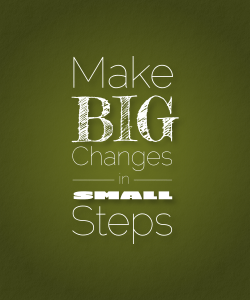
My buddy Gandalf had a lot of changes he needed to make. And looking at all those changes was daunting. So to move forward, he had to do it gradually.

With his doctor, he identified different levels of change, and he started with the easy changes and steadily progressed forward. There was a vision of where they wanted to be at the end, and they made a plan to get there.

Big changes are always made up of a number of smaller steps. But even for small changes, the desire and the effort has to be there. There has to be momentum. You have to WANT it, and you have to be willing to work at it.

make-big-changes-in-small-steps

Take a look at your coping mechanisms and ask yourself, are they really working? Or are you just “getting by”? If you tell yourself “that’s just the way I am”, guess what – you’re just like my buddy Gandalf used to be. That’s what he told himself. He expected other people to conform to him, after all, *he* couldn’t change.

As a result, he hit what for him was rock bottom. There’s a problem with rock bottom though. Depending on how far you have to fall, sometimes the climb back up is really hard. And sometimes you need to find a new path, because you’ve destroyed your old one in the process.

So ask yourself, are your coping mechanisms actually working? Or are you just getting by?

Change is hard, and it can be scary. But sometimes it’s needed for a happier future.

Learning to Love yourself

meditation-leaf

Of all the things you can do, loving yourself is perhaps the most important. It is probably THE key to happiness, affecting both personal happiness and happiness in a relationship. Unfortunately we don’t all love ourselves.

Over the last few posts I have been examining a lack of self-love, anxiety and depression with the help of my buddy Gandalf who has been down the rabbit hole of anxiety, depression and self-loathing. He struggled for years with self-love, and found that anxiety was central to his problem (as anxiety disorders break down the very fabric of what is needed for loving both yourself and those around you).

One important note about my buddy’s situation is that at the time he didn’t know he had a problem. For him, this was just how he was, how he behaved and how he viewed the world. It was horribly broken and unhealthy, but it wasn’t until he hit rock bottom and was able to get better that he was able to look back and see how much damage he was doing to both himself and those around him.

Over the last few posts I have talked about where my buddy’s lack of self love came from, and then how it affected him in day to day life. He was in a bad place emotionally and mentally, and had a number of negative and self-defeating mindsets.
Hopefully other people in a similar boat can learn from his situation and learn to love themselves either again or for the first time.

Facing the Mirror

One of the hardest parts of learning to love yourself is taking ownership of your issues. It’s very easy to blame other people or situations, and it’s easy to rationalize behavior. And when someone doesn’t love themselves, self-defeating mindsets are frequently the norm. It can be very difficult to turn things around, so I asked my buddy what his secret was.

That is an easy answer in theory, but DAMN difficult to put into practice. Simply put, I had to realize:

  1. there was a problem, and more importantly
  2. *I* was the problem.

Once you realize *you* are the problem, you now have nobody to blame but yourself. All the excuses, all the lies, all the daydreams and fantasies you comfort yourself with, the avoidance and coping mechanisms, all of it no longer works. And that is when you start on the path to recovery.

Hmmm, so no real shortcuts then?

No.

I want to clarify one item, and that is why I didn’t realize *I* was the problem. For me, I have always felt the hyper-active arousal and the anxiety that comes with it, so I thought that this is how I should normally feel and this is how other people feel too. After all, I’ve never felt anything else other than this, so I didn’t have a different state to compare it to. I didn’t know how I should really feel and I didn’t know what normal was, except that this was normal for me. So the connection between my behaviors and my anxiety never occurred to me until I was forced to confront these destructive behaviors and solve the root cause instead of using my coping mechanisms.

Sounds a lot like my buddy with sleep apnea, who is always exhausted but insists he is fine and that he isn’t tired (even while he’s nodding off when he’s supposed to be navigating). His point of reference is so messed up that he doesn’t know what it’s like to not be tired.

Yeah, it’s exactly like that. Being anxious had become my norm, so I didn’t realize how much damage I was doing to myself and the people around me that I cared about.

So your “secret” to getting better was to have all of your coping mechanisms fail? You’re saying you had to hit rock bottom before you would accept that you were your own problem, and it’s not until then that you stopped blaming your issues on others? You know, as secrets go, that kind of sucks.

Originally, I thought that I had lost everything when I got to this point, but that is not correct. That was the effect of what happened, not the cause. Being forced to abandon your comfort zone and forced to deal with reality on your own with no possibility of retreat caused me to confront the problem head on. I could no longer deny the problem; pretend it did not exist, or lie to myself thinking that it was somebody else’s fault. In essence, the coping mechanisms failed and I had to deal with the root cause.

Until this point, I had thought that it was everybody else’s problem rather than mine. This was a very logical conclusion because:

  1. hyper-arousal was normal for me
  2. I was scared of anything new
  3. I was self-centered (Narcissistic)
  4. I had a negative viewpoint of life

To me, I expected others to conform to my wishes and desires without having to conform to theirs. Yes, this is where entitlement came for me. I don’t know exactly where it came in, but eventually, I just had this mindset that others should conform to me instead of the other way around.

Because I was so scared of the real world, I ended up in my own fantasy world which I built up to be a comfort zone from reality. I won’t go into the details, as that’s irrelevant to the topic, but the point that I want to make is that this retreat into a fantasy world is normal for anxiety sufferers. The inability to deal with reality causes this retreat. For me, my retreat was into videogames.

I don’t advocate the use of coping mechanisms as I think they hurt more than help. This includes not only games and fantasies, but smoking and alcohol as well. Both have been shown to reduce anxiety temporarily, but the underlying root issues are still there, and the person hasn’t learned how to deal and confront them. It just prolongs the suffering, as games did for me.

rogers-paradox-478x500

Changing Mindsets

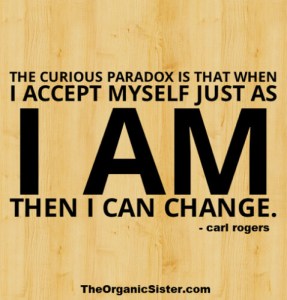
Once you accept that change is needed, and that it is in fact “you” that needs to change, the question becomes WHAT? What is it that needs to change?

Alright, remember how I said that there’s no secret to getting better? Well that’s not entirely true. Here’s the real secret:

Loving yourself is not about your weight, clothes, fitness level, job, relationship, or anything like that.

Sure, making improvements in all of those areas may help, but at their core those are all external items.

It’s like the saying about putting lipstick on a pig – changing those things may make someone feel better temporarily, but it doesn’t change the underlying issue. The temporary high will fade, and you won’t be any happier.

Real change needs to begin within.

love-yourself-15

A lack of self-love if normally accompanied by a number of negative mindsets, and it is those that need to change. Some of the most common are avoidance, all or nothing thinking and rumination (dwelling on the past):

For my buddy Gandalf, learning to love himself was all about changing mindsets.

Once I started seeing a psychologist we worked on three items simultaneously – self-esteem, anxiety, and negativity. Working on all three simultaneously really helped as each one is interlinked and I couldn’t just work on one and not the others.

When I worked on my self-esteem, I had to look at myself with my view, and then from other people’s view. After several sessions, it started to dawn on me that my negativity led to a distorted view of who I was. It also lead to the discovery of “The Critic”, or the little voice in my head that was always telling me that I was no good, or bad, or awful in everything that I tried to do. Once you discover that, you can now start to silence that voice and eventually, eliminate it.

I worked on negativity by writing down the first thought that came into my head about a situation and then examining why I thought like that. These are the automatic thoughts an anxiety suffer has. For example, when I sent an email, I’d expect to receive a reply within 15 minutes, and if I didn’t, I’d get anxious. I found out I had an automatic thought that if I didn’t get an email within 15 minutes, then the other person didn’t like me. What I didn’t realize at first is that this is only the first automatic thought in a series of thoughts that cascade down. I would then think that if that other person didn’t like me, then nobody likes me and that I will never be liked by anybody. This is the “All or nothing” cognitive distortion that anxiety suffers have.

There are others as well, and getting to the heart of them is like peeling the layer off of an onion. To deal with these cognitive distortions, I had to analyze each one and logically determine why it was not true. Once I did this, the automatic thoughts became less frequent and eventually stopped altogether. This also helped with silencing “The Critic” and with my anxiety.

Anxiety was the easiest and most difficult, to deal with. The cure is simple, I just had to face my fears. The problem was *everything* was scary. My psychologist had me expose myself to something I found scary, but not *that* scary. We made a list and evaluated items from 1 to 10 as to how scary it was to me and we started off at the low end of the scale (1 and 2) and then work my way up to the 9s and 10s. Every week I had to go and do at least one of them. The next week, we would talk about why I was scared and if my fears matched reality. It was this talking that helped reduce and eliminate the anxiety, because it lead to the method of logically analyzing and assessing how scared I should be in situations, and the same process used for negativity was used here too as the same automatic thoughts came up again.

There are situations I should still be scared of (like a bear chasing me), but most situations I shouldn’t be (like thinking about being chased by a bear in an upcoming camping trip). The realization that anxiety is all about future items that usually won’t come to pass significant diminished the power anxiety had over me.

One item needed for this is dedication. Without that, I wouldn’t have been able to see this through and continuously try to improve every week. I needed to put lots of effort into getting better, which is where hitting rock bottom helped. I knew the problem was me, and only I could make myself better.

I learned strategies to combat my anxiety instead of just coping with it. I needed to get to the root of my anxiety and fight it instead of cope with it by avoiding or controlling it.

Everything else fell into place after learning these simple strategies, like dominoes. The rest became easy, but still took effort. Things like exercising, eating healthy, sleeping for 7 to 8 hours a night, being more assertive, outgoing, and empathic to others was easier to accomplish once the foundation was built.

One last item is that mindfulness really helped quite the thoughts in my head, and it was the last piece of the puzzle. With that, I can now quiet the thoughts in my mind and relax almost on demand, which I thought was impossible just a short time ago.

So there you have it. The “secret” to love yourself you have to start to learn which behaviors and thinking patterns are toxic to you, so that you can recognize them and start to fight back against them. But secret doesn’t mean shortcut, and none of these things are easy. But they ARE worth it. No matter who you are, YOU are worth it.

self love

Life Without Self-Love – Part 2

inner-peace

Of all the things you can do, loving yourself is perhaps the most important. It is probably THE key to happiness, affecting both personal happiness and happiness in a relationship. Unfortunately we don’t all love ourselves.

Over the next few posts I will be examining a lack of self-love, anxiety and depression with the help of my buddy Gandalf who has been down the rabbit hole of anxiety, depression and self-loathing. He struggled for years with self-love, and found that anxiety was central to his problem (as anxiety disorders break down the very fabric of what is needed for loving both yourself and those around you).

One important note about my buddy’s situation is that at the time he didn’t know he had a problem. For him, this was just how he was, how he behaved and how he viewed the world. It was horribly broken and unhealthy, but it wasn’t until he hit rock bottom and was able to get better that he was able to look back and see how much damage he was doing to both himself and those around him.

In my last post I talked about how the breakdown of self-love impacts day to day life. In this post, I want to focus on how it impacts relationships (like my last post, Gandalf’s thoughts and comments are in blue).

Selfish Love

In relationships, we all start out with a selfish approach. There is always something (or multiple things) we are hoping to get out of the relationship, and when looking for a prospective partner we are interested in finding someone who will meet our needs.

Over time though, for the relationship to succeed and/or flourish, it has to stop being about our own needs and wants. Although our partners are separate and distinct from us, their needs and wants have to be just as important as our own. We need to shift from thinking in terms of “me”, to “we”.

When someone doesn’t love themself this mental shift becomes a challenge, and often love continues to be all about you.

It was early in my therapy and my psychologist had me list out what I thought was the perfect partner. After going through that list with him he said one word that I’ll never forget. It was “selfish”.

My mindset at the time was that I wanted and needed loving, but I didn’t think that I needed to give any love back. It never even occurred to me that I should even give any love back. To me, my thinking was that it was their duty to give me love and that I didn’t have to return anything back because just the act of loving me should be enough for them.

There was no empathy for anybody else. My mind only focused on me. It is known as the Narcissus Paradox, where it appears that I would be thinking of others, but really, my mindset was only focused on me and my needs. I was nice only to the point of where I could get other people to show me affection. My thinking was only on how to get other people to show me love, and not on how to love other people.

This leads to passive aggressive behavior and giving people the silent treatment because I didn’t understand how to deal with conflict or how to get what I wanted from other people.

This focus on “me” is described by Daniel Smith (Monkey Mind: A Memoir of Anxiety) as follows:

An anxiety sufferer can feel as if he too is imprisoned in his own mind, but with the demonic twist that his mind can think of nothing but itself. Anxious thoughts are radically personal thoughts. Their central concern is what affects you, what threatens you, what you need, you regret, you dread, you fear.

Anxiety is a condition of near-total self-absorption, made only worse by the fact that the sufferer typically realizes that he is being self-absorbed and grieves over his sad inability to see past himself.

Relationship Impacts

For my buddy Gandalf, anxiety and a lack of self-love prevented him from being in any romantic relationships for a long time. He’s now in a much better place now, and is in the first real serious relationship of his life. While talking about relationships I asked if he knew “why” he had never been able to be in a relationship. I think his response speaks volumes on how anxiety and a lack of self-love can damage relationships.

For me, there were several factors that prevented me from getting into a romantic relationship:

  1. Fantasies. I didn’t know what being normal was, and that goes for relationships too. My expectations and reality were very far apart. There was no way that reality could match my fantasy, so I would always be disappointed
  2. Avoidance. I avoided anything that was scary, so I’d avoid talking to people. I couldn’t talk to others, unless it was about my interests, in which you just couldn’t shut me up. This all or nothing type of talking really turns people off of talking to you. I would never ask how the other person is doing. Basically I had no empathy for another person
  3. Expectations. I expected that I had to do nothing in a relationship, so I’d do no work in the relationship. Even if there was a woman that I was interested in, I expected her to do all the work, like introducing herself to me and, well, everything else in the relationship. I expected that she do all the work and that I had to do nothing. This came from the avoidance and learned helplessness behaviors, plus my sense of entitlement
  4. Negativity. Not much to say about this except that a negative perspective is not conducive to building a long term and lasting relationship. Also, the constant doubt and insecurity from the negativity didn’t help either
  5. Empathy. When trying to engage a woman in conversation, there was no emotional connection, or empathy, between myself and the woman. It would be just a complete and total physical attraction and the arousal response would take over.
  6. I was also always scanning the other person for emotional displays, but I would only focus on the ones that affected me and I’d usually place negative meanings to it (e.g. “She just yawned, therefore I must be boring her.”)

The end result is the lady would need to do all the work to start the relationship and keep it going. This is not only unrealistic, but the real question is why (would she)? Why would any lady put the time and effort into a guy who didn’t show affection back? This is where I was and why I never had success in relationships.

Even for friends and family relationships, some of the above played into those relationships too. Except I didn’t have the sexual fantasy, and without that, the other items became bearable enough to suppress my anxiety and actually form a friendship. Even then, it was hard.

I would never show who I really was because I hated, or loathed, myself. So I always changed and became what my friends wanted. It was not so much as showing facets of a diamond but burying the diamond in the ground and showing an amethyst instead.

I so desperately wanted to be accepted, receive affection, and be with others that I would suppress who I truly was. The real fear that I had was that if they saw the real me, they would reject me and I’d lose them. So, yeah, it was mostly fear of rejection and loss, and I felt this all the time.

I recently read that people who suffer from anxiety disorders cannot engage the pre-frontal cortex part of their brain, which is where the higher processing functions are (empathy, emotional regulation, etc.) This makes complete sense to me as this is what I felt.

Being with a friend or lover must feel comfortable, safe, secure, welcoming, and relaxed. When I was suffering from anxiety, I felt threatened, insecure, rejected, and stressed when I was with another person. This was all in my mind, as I was the one who made being with another person like this.

Once I changed my perception of being with people to be non-threatening and reduce my anxiety, then I was able to relax, feel comfortable around people and enjoy their presence.

I’m now thinking that anxiety and the related disorders are the number one killer of relationships. I have no proof, but anxiety is completely counter to the personality qualities needed for a long term stable relationship.

Reduction of Intimacy

One of the ways anxiety damages relationships is through the erosion of intimacy.

I found a great article describing how anxiety damages a person’s sex drive. The article states:

when you have anxiety, it’s not uncommon to also have a low libido. Your sex drive is directly affected by the way you feel, and anxiety is the type of condition that can make it hard to find your partner or the idea of lovemaking to be arousing.

Intimacy is one of the things that defines a relationship, so when sexual issues arise they tend to cause tension in other areas of the relationship. When you combine this with avoidance, you have an issue that can quickly grow out of hand, resulting in a growing dissatisfaction with the relationship.

If the anxious person doesn’t recognize that the sexual issues are a direct result of the anxiety, the anxious mind can read meaning into this that can lead to doubts about the relationship itself.

“I don’t feel attractive or attracted to my partner, what does that mean? Does that mean I don’t love him/her? Does that mean there is something wrong with the relationship?”

The Four Step Dance

My buddy Gandalf didn’t have experience with relationships until after he learned to address his anxiety and love himself, so instead of him I will turn to Daniel Smith to describes this pattern of how anxious thought damages relationships.

He describes this as follows:

  1. Mounting Uncertainty. Anxiety leads someone to question the feelings they have for their partner. Maybe it’s not actually love. Maybe it was just infatuation, desperation or loneliness. Maybe this relationships is not what they really want
  2. Withdrawl. Due to doubts about the relationship, you withdraw from the relationship emotionally, and stop putting any effort in. Or worse, you may become outright neglectful or hostile in a passive aggressive way of expressing unhappiness in the relationship.
  3. Blowback. The behavior displayed while withdrawing causes the relationship to start to break down. Arguments start, and the environment starts to become toxic for both partners
  4. Retreat. Realizing the damage that is being done, the anxious partner starts trying to repair the damage.

This process repeats, as the anxiety leads the relationship to continually go through cycles that do more and more damage to the relationships each time.

Healthy Love

My buddy Gandalf had it right when he said:

Being with a friend or lover must feel comfortable, safe, secure, welcoming, and relaxed.

Your relationship should be a safe haven. Sure, you will have your squabbles and your issues – nothing is ever perfect. But if you are in a committed relationship you should know that you will always be there for each other. You should know that your needs and wants in life are important to your partner (as theirs are to you), and that you will always work to get through things together. There is a level of peace and comfort that comes with knowing those things.

Anxiety and a lack of self-love breaks that down. Life becomes living with stress and doubting yourself constantly. Even the strongest of relationships will be challenged by anxiety and a lack of self-love. After all, how can you ever truly let go and love someone else when you don’t even love yourself?

Next up, how my buddy turned his life around and was able to move forward with a healthy sense of self (and in turn be able to build a healthy relationship).

Life Without Self-Love – Part 1

self-acceptance (1)

Of all the things you can do, loving yourself is perhaps the most important. It is probably THE key to happiness, affecting both personal happiness and happiness in a relationship. Unfortunately we don’t all love ourselves.

Over the next few posts I will be examining a lack of self-love, anxiety and depression with the help of my buddy Gandalf who has been down the rabbit hole of anxiety, depression and self-loathing. He struggled for years with self-love, and found that anxiety was central to his problem (as anxiety disorders break down the very fabric of what is needed for loving both yourself and those around you).

One important note about my buddy’s situation is that at the time he didn’t know he had a problem. For him, this was just how he was, how he behaved and how he viewed the world. It was horribly broken and unhealthy, but it wasn’t until he hit rock bottom and was able to get better that he was able to look back and see how much damage he was doing to both himself and those around him.

In my last post I talked about how self-love can break down. Today’s focus is on how it impacts day to day life. It may not be the same for everyone, but I suspect my buddy’s experiences are not uncommon. In this post I’ll introduce different areas, with Gandalf’s insights in blue.

Body Image

One of the biggest ways not loving yourself manifests is in body image. You may be able to build up mechanisms to hide the emotions or deadness that you are feeling inside. But you can never escape yourself.

For people who love themselves, when you look in a mirror you see yourself fairly objectively. Yeah, you may have flaws (we all do), and as you age there may be more grey/wrinkles/sagging skin/whatever then there used to be, but that’s just part of you. For someone who doesn’t love themselves, often when they look in a mirror they don’t see the good. All they see are the flaws, and worse, those flaws are magnified in an unrealistic way.

When I first started therapy, I talked to my psychologist over the phone and I said that I was an obese person and he should expect a fat person when we meet.

To put this into context, I had been exercising for several years, so I was a healthy weight at the time. When we met, he was surprised to see me because he thought I was in good shape, which I was. The problem was that I couldn’t see myself like that because I loathed who I was. That self-loathing not only affects your mental self, but your physical self too.

Now, when I show my girlfriend pictures from when I was really fat, she says, “you don’t look fat at all. You look great”. Part of it is because she loves me, but part is because I really wasn’t that fat, just a bit over weight. She can see me in a more realistic light than I can.

Even now, I’m in better shape and some days I have to fight the thoughts that I’m fat or over weight. But it hasn’t happened since I started doing my mindfulness exercises twice a day.

Similarly I was also camera shy as I thought I’d ruin a picture if I was in it, so I tried to avoid photos. Now, I’ll gladly pose for a picture and be in a photo, either by myself or with others.

A Negative Outlook

One of the main characteristics of people who don’t love themselves is a negative approach to the world, which leads to taking things personally.

We have all been around “negative people” and you can usually tell who they are in a short period of time after meeting them. Negative people often have a negative energy around them that can bring others down.

But not all people are overtly negative. When I met my buddy, I had no idea that he had a negative outlook. He projected a fairly placid exterior, while inside him there was considerable emotional turmoil.

I only looked at the negative side of a situation, and never the good. Because I expected the worst, when there were no negatives I would manufacture one. Gifts always came with a catch, a complement had a hidden meaning that usually was an insult, and anything good that a person did to or for me was explained that they just wanted something from me.

Everything in life was bad, and when something good happened it was a fluke, easily dismissed, or the bad was waiting to happen.

Losing Perspective

In addition to the negative outlook there is a tendency to blow things out of proportion, and turn little things into big issues. Events are misinterpreted through a broken lens, so offense is taken even when none was intended.

My anxiety disorder caused little incidents to become massive life altering events in my mind, and I took every negative action in life as a personal attack.

If the bus started driving away from the stop I arrived, I would think that the bus driver hates me and is laughing at me. If my line at the store is slower than the others, the clerk and customers in front were slowing down the line on purpose just to spite and annoy me.

In my mind the entire universe was out to get me and make my existence miserable every single day.

Avoidance and Blaming

I talked a bit about avoidance in my last post, but it warrants looking at again as it’s one of the key components. Avoidance leads to a refusal to acknowledge and deal the real problems, as it’s easier to blame something else.

Sure, you may not be happy – but it’s because of this, or because of that. If you could only change those things then everything would be better. There is a tendency to look for magic wand solutions to life, or a belief that if you wait things out then problems will magically get better.

When you have anxiety, over time feeling anxious becomes normal and the only thing that changed was the amount of anxiety that I felt. I started to view anything that caused my anxiety to increase as bad. New, changing, or uncomfortable situations caused anxiety, so if I avoided them then my anxiety reduced. In my mind new/change came to be seen as bad.

Any discussion of issues caused my anxiety to rise so I would deflect the conversation to something else instead of the real problem. I came to believe that the events in my life were the problem, and think “If only these events weren’t happening then I wouldn’t be stressed or anxious.” My coping mechanism was to try to avoid a problem (any problem) instead of confronting it.

Anything that I couldn’t avoid, I’d just endure. But I would never take action to reduce my anxiety or improve my situation. I’d just wait, do nothing, and hope it would go away.

Putting in effort either meant something was new or changing, and to me that led to more anxiety. Contributing to my own anxiety was like inflicting pain on myself, and I tried to avoid that at all costs. So I did nothing.

However the real issue was never the event or problem, it was my ability to handle the stress these events caused.

Physiological Impacts and Insomnia

Beyond the negative self-image, there can also be actual physiological effects. People may be more prone to headaches, or constipation. But the most difficult part is hypersensitivity to the world around them. There is a constant state of “alert” which leads the body to be in a constant state of stress, often leading to muscle tension.

Incidentally it is this stress state that often leads to clinical depression, as constant stress can lead to biochemical imbalances.

With my heart racing all the time due to perceived threats, my blood pressure was always elevated. I couldn’t relax even if I wanted to. My mind was always racing, and this led to insomnia as I just couldn’t stop thinking when going to bed. I would keep thinking random thoughts which would lead me to worry and cause my heart to continue racing.

I was so nervous going to bed that my heart was still racing even after going to bed. After about one to two hours, my body would calm down just enough to fall asleep.

The best description that I have is driving a car at 60 km/h then jamming the transmission into Park. That’s what going to bed and trying to sleep was for me.

Weekends were my only reprieve as I was able to sleep until noon, which was 9 to 11 hours of sleep. Every night, sleep was a battle.

Hopelessness

Another common characteristic of people who don’t love themselves is a pervasive sense of hopelessness. This is something often associated with depression, and self-loathing and anxiety commonly lead to depression. But the sense of hopelessness comes first.

I cannot describe the feeling of despair that I woke up to each morning. It was a battle to get out of bed and get to work as I felt to the core of my being that it was totally and completely meaningless to do anything, including work. All personal items and duties seemed equally meaningless. Why clean the house when it would just get dirty again? Why do anything at all in life when in the end, you’re going to die and be forgotten? Yes, I was depressed and only those who have suffered from depression know of the hopelessness and despair that you feel.

Compulsion and Numbing Behaviors

Compulsion and Numbing behaviors are similar in that they both are forms of “escape”. The difference is people turn to compulsions because they provide a positive feeling, or a temporary relief from the sense of hopelessness and self-loathing; while numbing behaviors allow someone to dull the pain, and not feel anything at all.

These behaviors sometimes appear benign or even healthy, such as working out, watching TV or reading books. Or they can be things like turning to alcohol, drugs, gambling, overeating or even sex.

Other than drugs, none of these things are inherently bad (yeah, I consider drugs bad – you’re welcome to disagree). But any behaviors are indicative of a problem when they become compulsive.

This one is the most destructive of them all. Life seemed to have no meaning, so when I found something that I thought made me happy, I held on to it like a dog with a bone. For some, it’s gambling, or work (workaholics), but for me, it was video games. I played games as if my life depended on it. To me, video games WERE my life. They gave me meaning, tasks to accomplish, and recognition for completing a game

I didn’t realize that it was a problem, but in hindsight it was. I couldn’t stay away from video games. I would constantly be thinking of games and wishing that I was playing them. It was my entire life, I felt that my existence was validated when playing, and I couldn’t stop.

I mentioned I had a negative self-image. That led to exercise becoming another compulsion for me. When I was exercising compulsively I remember how I’d get when life interrupted it. I would get *mad* and immediately think that I’d get fatter if I missed just one exercise session, as exercise was linked to my self-image, which was negative at the time.

Now, I’m fine with missing a day or two as I know it won’t cause me to get fat.

Making Choices

Anxiety goes hand in hand with avoidance. Avoidance has a number of negative side effects, but one of the ways it manifests itself is in decision making. Decision making becomes HARD. And often, it’s easier just to not make a decision and force someone else to make the decision for you. That way you don’t have to make it, and you aren’t responsible for it if things don’t work out.

In addition, there is a tendency to second guess decisions that you have made and focus on the past. “What if I had just done this or that differently? Maybe then things would be different today.”

Decision making was hard because I was so scared of making the wrong decision that I would freeze mentally and not make a decision. Every decision that I made felt like the fate of the universe was hanging in the balance and that a wrong decision would be the end of the world. The reason for this was that I would ruminate on every wrong decision that I made, and most seemed wrong as I only looked at the negative side, and mentally beat myself up over it.

As you can see, the impacts are wide and varied, but they all add up to an individual with an unhealthy outlook on the world, themselves, and those around them. Next I’ll be looking at how a lack of self-love impacts relationships.

The Breakdown of Self-Love

Balance_Rocks-500x3461

Of all the things you can do, loving yourself is perhaps the most important. It is probably THE key to happiness, affecting both personal happiness and happiness in a relationship. Unfortunately we don’t all love ourselves.

Over the next few posts I will be examining a lack of self-love, anxiety and depression with the help of my buddy Gandalf who has been down the rabbit hole of anxiety, depression and self-loathing. He struggled for years with self-love, and found that anxiety was central to his problem (as anxiety disorders break down the very fabric of what is needed for loving both yourself and those around you).

One important note about my buddy’s situation is that at the time he didn’t know he had a problem. For him, this was just how he was, how he behaved and how he viewed the world. It was horribly broken and unhealthy, but it wasn’t until he hit rock bottom and was able to get better that he was able to look back and see how much damage he was doing to both himself and those around him.

Issues with self-love usually originate in childhood. I’m a parent, and I’ll admit that although we usually have the best of intentions we rarely have any idea what we are doing. We make mistakes, and can inadvertently harm the very people we care the most about.

Sometimes it’s not showing children sufficient affection, berating them for their faults or continually comparing them to others (why can’t you be more like…). Sometimes it’s because we don’t love ourselves, and without a strong model of love this issue is perpetuated from parent to child.

Although each person is different, there are often commonalities across situations. My buddy didn’t just struggle with self-love, he hated himself.

Trying to understand this, I asked him if he had any idea where this self-loathing originated. From reading on Attachment Theory, my guess was it had something to do with avoidance and anxiety at these traits are closely linked to chronic unhappiness.

Here was his response:

Yes, I know exactly how my self-loathing occurred, and you are correct that there is a relationship between anxiety, attachment, and avoidance. For me to understand, I had to work backwards as I started at the end of the list and uncovered the different steps along the way. Here is how it happened for me:

Stage 1 – Hyper-active arousal

This is the stress arousal, or fear response, that everybody is born with. In about 20% of all babies, this stress reaction is hyper-sensitive and everything causes a stress, or fear, response.

This is how I started. Even as a baby I was fearful. I don’t have memories of this, so I heard this from my mom. But I was hyper-sensitive to any new or novel stimulation (person, place, toy, etc.)

Stage 2 – Poor attachment

For a child where the entire world is scary, you need a place where you feel safe, loved. Parents provide this through unconditional love, and lots of touching, of all things. Touching calms the stress response, provides comfort to the child, and signals that they have a safe haven to explore from.

Without this “safe haven”, the world remains scary, home and parents provide no comfort, and the child is actually more stressed at home than away. It’s ironic that the environment where a child should feel most safe and secure ends up being where the child feels most stressed and scared.

I was never “loved” as a child, and I can’t recall my parents ever hugging me or comforting me. My dad would sit in front of the TV all evening and my mom would make the meals, and clean the house. They were very hands off and fend for yourself parents. I ended up being the teacher’s pet as that was my only outlet for attention and affection. But this did damage as well, as I ended up linking my self-esteem to my school work.

Stage 3 – Anxiety

From here, everything is now scary and induces a stress response that the child cannot control. Going to school is a daily ordeal of stress and fear. Activities are not fun, sports are difficult as the child cannot coordinate themselves properly as they are paralyzed with fear, and making friends is difficult as you are tongue tied and stumble, or stutter, words in the conversation.

The fear response is triggered from new/novel situations and people, and without a “safe haven” to start from, the child does not learn how to control this reaction. This is now full-blown anxiety.

It didn’t start out that I was scared of everything right away. I tried to make friends, and I tried to be involved in school activities, but without a supportive adult helping you, it’s difficult. At first I tried, but eventually, I stopped trying all the time and that’s when I started to avoid life, which is the next stage.

Stage 4 – Avoidance

Avoidance is when you stop doing things. I would think “If I just avoid doing this activity, then I won’t feel stressed”. The issue is eventually you apply it to everything in life, including life itself.

It becomes a natural response to any situation. You don’t explore, take chances, engage with other people, or do activities as all of these are new (and therefore scary). Just avoiding everything that causes discomfort, stress, annoyance, and anxiety become so easy and was the solution to all of my problems. Or so I thought. What I didn’t realize is that I disengaged from life. I was there, existing, but not really living.

Avoidance is the most common coping mechanism for dealing with things, and becomes part of your personality. But there are others. For me, computers and games became that “safe haven” for me where I felt loved, accepted for who I am, and safe. The problem with coping mechanisms is they prevent you from getting at the root cause of the problem and dealing with it.

Stage 5 – Negative thinking, Narcissism, and Self-Loathing

I have lumped these together as they occurred together for me and are linked.

Negative thinking directly comes from the avoidance coping mechanism. As I avoided people and situations, I started to think that I wasn’t good or that I can’t do it, but what I really was doing was rationalizing why I was avoiding people and situation. If I convinced myself I couldn’t do something, then I wasn’t avoiding it out of fear. I built up this negative persona of myself to protect me from my anxiety and to rationalize my avoidance. However from a mental health perspective, this is horrible.

Narcissism is an ironic effect from anxiety and not one most people think is part of it. Anxiety sufferers become hyper-vigilant to try and avoid any conflict as they don’t know how to deal with it. So they constantly scan the environment, including people, for signs of danger or trouble. This means anxiety sufferers are constantly scanning others for signs of anger/unhappiness/sadness/disappointment and evaluating if this will “hurt or affect me”.

This leads to what one book called “Nice Guy Syndrome”. I would try to please everybody all the time and pretend to be happy so nobody would be upset or angry around me. I did this by being hyper-vigilant to the people around me and trying to please them instead of myself. My thinking was that if I did this nobody would have any cause to be upset or angry at me allowing me to avoid conflict. On the outside, it look altruistic, but the motivation is completely self-centered.

As I avoided what I wanted to do and suppressed myself due to Narcissism, I started to hate myself, and I don’t mean just a part, but my entire core being. I really can’t describe how this self-loathing feels, other than to say that

I felt trapped in a prison that I had both designed and built. The worst part is that I knew I did this to myself, but I didn’t know how to get out of it.

Every time I suppressed myself to accommodate somebody else, I hated myself a bit more, but I didn’t connect this to my anxiety. It just became a coping mechanism for avoiding conflict.

Stage 6 – Behaviours

There are three behaviors that come out of Stage 5: Routines, Passive-Aggressiveness, Learned Helplessness, and Depression.

Routines became a way to minimize new situations in life. After all, if you’ve done something before and it didn’t hurt you, then it’s fine. Like an obsessive compulsive I would ensure that I stuck to my set routine every day as much as possible, and any deviation from my routine was met with anger, resistance, and childlike whining or tantrums.

Passive-aggressiveness was my only way to deal with conflict. I won’t say too much here as the article you wrote sums it up well, but I do want to say is that its roots are in avoidance. Passive-aggressive behavior is the mechanism that anxiety sufferers use to avoid conflict. When an argument can’t be avoided, then I would just avoid communicating to avoid further conflict.

Another part to passive-aggressive behavior is a belief on how other people should treat you. From my routines, I developed very strict and ridged rules on how people should interact and please me, but I never communicated them to other people. Instead of asking for what I wanted I would drop hints, like, “I really enjoy X”, which meant I wanted someone to got get or do X for me. I never clearly stated what I wanted, but if I didn’t get it I would still be upset with someone for a short time and then carry on like nothing happened.

Learned Helplessness became a way of life for me. The more I avoided, the more helpless I became. Eventually, it became my default behavior as I would say, “I can’t do it. Here, you do it.” I actually would not do anything new unless I was with somebody else to be there with me.

Eventually depression set in. The more you suppress, the more you loath yourself, the more I avoided, the more I deferred to others as I thought I was helpless, eventually leads to hopelessness. This hopelessness caused the depression. I saw all my dreams disappearing one by one as I did nothing to pursue them because I was helpless to do anything. Life became meaningless and all I did was go through the motions of my daily routine.

As a kid I had linked my self-worth to my school work. As an adult it was my job. My core self-worth and self-esteem was completely dependent and linked to my academic and career performance. Without being in school or in a meaningful job, my depression deepened as there was nothing to fill the emptiness inside. I was looking for external validation for my existence and self-worth, when it can only come from inside. The end result was a hopelessness and despair that I can’t explain. My life had no meaning, and there was no point to anything.

scars

Stage 7 – Acceptance

This step means that you have accepted the anxiety as a part of your core being. This is the final stage in the process. I really can’t say much of this stage as I didn’t reach this stage, but I’ve seen it in other people, and the result is that the person stops trying to fight the previous six stages, and gives up. They become set in their ways, and won’t, or can’t change.


I’m not sure I agree that it’s ever too late, but all of these stages led to a chronic unhappiness and a sense of self-loathing. Next I will look at the broken thinking patterns and toxic behaviors that arose from this, and how they impacted his life and relationships.

Do You Love Yourself?

i-heart-me

Do you love yourself?

As I’ve learned more about interpersonal dynamics and relationships, I’ve come to the conclusion that there are three things which significantly impact a persons ability to have a happy relationship.

  1. Your mindset. This is whether you believe your base traits and characteristics are largely fixed, or whether you believe they can change over time. I’ve touched on this in the past (and will deal with it in more depth in the future), but essentially EVERYTHING can change and everything can improve over time. When you don’t believe it can, then it becomes a self-fulfilling prophecy.
  2. Your ability to let your partner in. I recently wrote on this in a post on Emotional Walls. When we wall ourselves off from our partners, we create barriers to the intimacy or closeness we can have. Without closeness relationships suffer.
  3. How much you love yourself. This is about self-acceptance, and a sense of self-worth.

Of these, the ability to love ourselves is THE most important. And I suspect it’s related to the other two. If you don’t love yourself, you are less inclined to let your partner in. After all, if you don’t like you, and your partner were to see you as you see yourself, then perhaps they wouldn’t accept you or love you either. So why would you let them in? Instead people build facades and present the version of themself they believe their partner wants.

The problem is, when they do this they aren’t being authentic or true to themselves, and over time this will invariably lead to unhappiness (and potentially resentment).

Loving Yourself

What exactly does it mean to say you “love yourself”? At it’s core, I think self-love is about acceptance. You accept yourself for who you are. That doesn’t mean you can’t change, and can’t improve. You definitely can. It simply means that you don’t believe you have to as you are fine the way you are. Self-love means you believe in yourself and the person you are. You have self-confidence, and a positive self-image.

selfacceptance

This is not to be mistaken with arrogance, of being cocky. It also is not “self-love” in a narcissistic way. Loving yourself is healthy. Being in love with yourself of being full of yourself is not healthy.

Allow me to let you in on a little secret. The people who seem to love themselves most are often the ones who love themselves the least. When someone seems to love them-self it is because they are adept at self-promotion. They draw attention to themselves because they need external validation.

Self-love doesn’t require external validation, as it comes from within.

A Point of Reference

So I’ll ask again, do you love yourself? This can be a difficult question to answer.

A few years ago I went on a trip with a buddy and we shared a hotel room. Going in I knew he snored, but I had no idea how bad it was. His snoring kept me up at night, but worse than the snoring was the fact that it was broken up by long stretches where it seemed like he stopped breathing. After seconds (that felt like minutes) there were large gasps for air, and he would start snoring again.

I’m no doctor, but it was pretty alarming. I told my buddy that he should get it checked out and he insisted he was fine. I asked him if he always found himself tired or rundown, and he said no (even though he fell asleep when he was supposed to be navigating for me on the trip. Very helpful). To him, he was perfectly fine.

A while later I related this story to a co-worker who has sleep apnea, and he told me that it sounded familiar. When I mentioned that the guy insisted he was fine, my co-worker laughed and said that’s because it’s his normal state. He’s always tired, he’s always exhausted. And because of that he doesn’t understand how it feels to be rested.

He believes he’s not tired because he has no point of reference to compare himself to.

I see self-love as being similar. It’s not something you “know”. Sometimes people believe that they love themselves when they really don’t. We can’t get into other people’s heads, so if you have negative thoughts about yourself then you might think it’s normal. After all, it’s what you know.

Incidentally it’s been almost two years since that trip, and my buddy STILL hasn’t seen a doctor (and of course insists he’s fine). He’s not. Sadly the people who need the most help are often the last ones to see it as to them it’s just “the way they are”.

Signs You Don’t Love Yourself

To help understand self-love, let’s start with a looks at some signs and characteristics of people who don’t love themselves.

  • You are critical of yourself. This is one of the big ones. You second guess your decisions (or believe you made the wrong ones), your behavior, and you are unhappy with your body.
  • You spend a lot of time in the past thinking “what if…”. What if I had done this differently, or what if I had done that differently.
  • You become angry at yourself when you make mistakes
  • You don’t have dreams, or your dreams feel out of reach and you don’t see a way to make them happen.
  • You commonly operate out of guilt, or shame.
  • You worry about how you are perceived, or “what others will think”.
  • You believe things would be better or you would be happier if “X” were to happen. Maybe if you lost 10 lbs, got a better job, found a different relationship, etc…
  • You procrastinate.

It’s normal to feel all of these things occasionally. But when they are a pattern of thinking for you, then they are signs that you may not love yourself.

Signs You Do Love Yourself

So what do people who DO love themselves look like? The easy answer is, the opposite of the above characteristics. But as I mentioned earlier, if someone truly loves themselves (and has self acceptance) then it’s not easy to see.

One characteristic is that they tend to have a sense of calm. They are comfortable with who they are, and in their own skin.

They aren’t perfect, and they both know and accept that. They are also able to handle criticism fairly well, as they realize it’s not a reflection on them.

People who loves themselves tend to have a sense of personal accountability and a belief that they have control over their own lives.

They also can look at themselves naked in the mirror without thinking *too many* negative thoughts (regardless of body type).

Filling a Hole

One of the big problems with self-love is that it has to come from within. However, for people who don’t love themselves they often don’t see that. They know there is something wrong, but they can’t identify what it is. Because they don’t understand (or won’t accept) that the issues comes from within they start looking outside of themselves.

When acceptance and self-worth doesn’t come from within, they start looking for external validation. The problem is, validation from outside will never be enough.

self_acceptance_quotes

Everyone enjoys being complimented – it feels good to know that someone finds you attractive, or thinks you are good at something. But for people who stuggle with self love, often compliments are needed. But all the compliments in the world won’t help. If someone doesn’t believe it themselves that self-doubt shows through, and there is a continuous need for external validation.

This can result in all sorts of messed up behavior.

The Explanatory Gap

I’ll be the first to admit, I don’t understand what it’s like to not love yourself. I’ve tried, but I can’t. Loving myself is just part of who I am. See, I like me. I don’t think I’m cocky or arrogant, but I am confident in myself. Most importantly, I know I’m in control of my own life. Things don’t always work out, but they often do. And when things don’t I can always adjust accordingly and find a new path. I make decisions, and they may not always be the right ones. But that’s fine, because they seemed right at the time. When I screw up I try to use it as a learning experience, and a way to do better “next time”.

Understanding what it’s like to not love yourself is as foreign to me as it is to understand what it’s like to be a woman on her period. As a guy, it’s impossible for me to understand that. Yeah, I know the biology – the lining of the uterine wall has thickened in preparation of a fertilized egg, it doesn’t happen so the extra stuff (pretty sure that’s the scientific term) breaks down and is released. It’s accompanied by hormonal changes that can impact mood and how someone feels. Intellectually I get it (kind of). But I don’t understand, and I never will.

This lack of understanding is often referred to as an explanatory gap. Understanding the mechanics of something doesn’t mean I can understand how it feels. In the case of a menstrual cycle, I’m fairly confident I will never understand that. Likewise for self-love.

So to help me understand this a bit better and start to close that explanatory gap I turned to a buddy who has lived this. Someone who has been through the fires, and come out a stronger person for it. We’ll call him Gandalf (as his experiences have made him quite wise).

Because I believe self-love is an important component of happy relationships I had the idea that he could help me understand the mindset a bit better.

When I first approached him on the idea the exchange went something like this:

Me: I’m thinking about writing on self-love, and thought you might be able to help me with a post.
Gandalf: Errr, me? Self-love? Umm, how do you know… (starts blushing and looking at his feet)
Me: Huh? Oooohhh. Dude, I’m talking about self-love, as in “do you love yourself”. Not self-pleasuring!!!
*Awkward silence *
Gandalf: So, how about that ball game last night…

Alright, that never happened. Well in my head it did, and it make me laugh. And since it’s a fairly serious topic I figured it would be good to start with at least a smile.

My buddy Gandalf was unhappy for a longtime and he spent years blaming his unhappiness on everything around him, pushing away the people who loved him the most in the process. He eventually had a breakdown that led to him being diagnosed with an anxiety disorder that led to him falling into clinical depression.

Anxiety disorders are the most common form of mental disorder, and there is a strong correlation between anxiety and a lack of self-love. In the grips of anxiety, my buddy hated himself and it almost destroyed his life. But instead of accepting that this was just “the way he was” and allowing his anxiety to control him, my buddy decided to educate himself, learn as much as he could about it and try to regain control of his life.

Over the next few posts I will be doing something a little different. He will be my co-author, sharing his story. I think his story is at once fascinating and inspiring. Whether you love yourself or not, his experiences are ones that I believe we can all learn from.

You Only Live Once

yolo-board

When we are young we tend to think of ourselves as invincible. Or perhaps it’s more accurate to say we have no concept of mortality. Eventually however, this changes.

There can be any number of triggers. Midlife (and the realization that we are statistically closer to death than birth), serious injury or illness, or perhaps the death of a loved one. Anything can happen to make you realize that your time on this earth is limited.

YOLO

One of the relatively recent catch phrases/acronyms (whatever you want to call it) is YOLO, or “you only live once”. This has become a mantra for a whole generation, and it carries with it the following connotations:

  • Do what you want
  • Do whatever makes you happy
  • Live for today
  • Don’t worry about the future
  • Don’t care what others think about you, live the way you want

Do you notice a trend in those? Kind of like my post What’s in it for Me?, it’s all about you. It’s all about your own pleasure, happiness, and instant gratification.

Often when you hear people use the term YOLO it’s in response to behavior that most would consider immature. Calling in sick for work because you were out drinking with buddies during the week? YOLO. Cheating on your partner because a “better opportunity came along”? YOLO. Going into debt to live a lifestyle you can’t afford? YOLO.

In fact Urban Dictionary refers to YOLO as “The dumbass’s excuse for something stupid that they did”. That description seems a bit harsh, but when you see the way YOLO is used it’s actually a fairly accurate definition. The way many people use YOLO, it has become an excuse for a lack of personal responsibility.

What is Freedom?

In the YOLO mindset, freedom is the unstated goal. The freedom to do what you want, when you want, with who you want and how you want. “Responsibility” is treated as a bad thing, because it is viewed as the antithesis of “freedom”.

I struggle to understand how responsibility is a bad thing. Yeah, I’ll admit that it would be nice to not have to worry about a mortgage and bills. But guess what, that’s part of life. Unless you are living as a gypsy and living off the land, you kind of need some form of income.

When you’re 20 it’s fine to live at home with mom and dad. Maybe even when you’re 30 (depending on the situation). But when you’re much older than that, it’s probably a good thing if you are able to handle responsibility and support yourself. I don’t know about you, but I fail to see how living paycheck to paycheck while living with mom and dad, or just living day to day with no plans or direction for the future is a sign of “freedom”.

I would think real freedom comes from having some sort of control over your own life. You may not be able to do things on a whim, but if you set priorities and make plans you are often able to accomplish almost anything. How is that a bad thing? I see that as empowering, not restricting.

Living In The Moment

Another problem with YOLO is that it focuses on instant gratification. All that matters is the here and now. You only worry about the future when it comes. But that sort of short term thinking often means you don’t have a future. Or it means your future is much more limited than the one you hoped for. Impulsive decisions tend to have consequences, and some of those consequences aren’t pleasant.

Oh, I’m pregnant!!! Hey look, an STD!!! Oh snap, I killed someone while driving drunk. Ah well, it’s no big deal, I was living in the moment!!!

Yolo

Balancing the Future and Present

Short term thinking can cause all sorts of issues for people.

From a financial standpoint, it can lead people to spend their money on things they want (not necessarily need), or spend more than they have and go into debt. Credit cards and loans may seem a great way to get something, but they are less appealing when you are struggling to make payments.

It can also damage your future emotionally. This doesn’t always apply, but often affairs happen because someone is looking for something missing in their relationship, and the affair is easier than putting in the work to address the problems in the relationship. Often the thing people are looking for is something they could have had in their relationships, and they are just as guilty as their partner for the breakdown of whatever they feel is missing.

Some people go the opposite route and focus too much on the future at the expense of the present. I’ve been guilty of that, and I recognize it. I’m now making it a point to do enjoy today a bit more, and not worry as much about the future. Neither approach is healthy. You need to balance today with tomorrow.

I get that it’s easy to focus on today. What you need or want now seems immediate, and it is hard to make sacrifices today for a future that may seem out of reach; especially when there are no guarantees of the future. But although the future isn’t guaranteed you still need to prepare for it.

For me, setting goals for the future is something that gives me hope, and gives me something to strive towards. It gives meaning to the grind of the routines of day to day life.

Setting Priorities

Where YOLO does get things right is that it is true that you only get one life. Even if you believe in an afterlife, the life we have and know is finite – once its gone, its gone. But that doesn’t mean you should focus on yourself. I don’t think that’s what life is really about.

A family member was recently diagnosed with terminal cancer, and it’s been a reminder of my own mortality. My response has not been to go out and spend all my money on “wants”, or to feel that I need to accomplish all my goals “today”. I haven’t spent my days in a drug and alcohol induced haze and gone off seeking pleasure wherever I can find it.

Rather, I have re-examined my own life and looked at my own priorities and what is important to me. The most important things to me are my wife and my children. My family. The people who matter to me. They are infinitely more important than the car I drive, the house I live in, or what I did last night.

Sure I have goals and dreams. I have things that I want to accomplish in my life. For example, I love travelling. I love seeing new places, trying new foods and experiencing new cultures. There are a number of places in the world that I hope to see during my life. But to me, the experience means more when I share it with someone I love. What is the point of doing any of that if I lose the things that matter to me in the process?

ThinkingAboutPriorities

When I look at YOLO, I have a different approach. To me it means:

  • Do something that matters
  • Live how you want to be remembered
  • Make the most of it

I’m just one person and I have limited influence. But I still hope to leave the world a better place than I found it. The thing I can influence the most is my children, and hopefully raise them to live their lives with integrity. I try to involve myself somewhat in my community. Nothing major, but enough that I feel I have made some sort of mark.

Even this blog. I don’t know who reads it or if my words resonate with anyone. But if I can make one person actually think or give them some sort of hope, then I have accomplished something (though I will likely never know it).

That’s what YOLO is about to me. Its not about doing what I want when I want. Its not about avoiding responsibility. I only have one life, and I want to live it in a way that I can be proud of.

the-concept-of-yolo

Your Last Day

What if today was your last day? What would matter to you?

If today was my last day, I wouldn’t spend it getting drunk, getting high, or looking for a quick thrill.

I would want to spend it surrounded by the people I love, and the people who matter to me. I would want to play with my children, read to them and draw pictures with them.

I would want to spend the day outdoors with my family. I would take the time to enjoy the feel of the grass under my feet, and the warmth of the sun on my skin (well, not if it’s winter. I hate winter. I can’t say I enjoy the feel of my skin freezing).

Maybe I would have a dinner party with my closest friends and family, where we could enjoy a good meal, tell stories and just enjoy good company.

After I would put my kids to bed, and tell them I love them. Then I would spend my last hours with my wife, reminiscing about all the good we have had in our life, and trying to laugh about the times that weren’t so good. I would hold her, tell her that I love her, and we would make love one last time before drifting off to sleep in each other’s arms.

In retrospect that would probably be pretty traumatic for her to wake up with me dead, but hey, I’m assuming it’s my last day not hers. But that’s what my last day would look like.

You only live once. So make the most of it.