Fitting the Mold

CookieCutterMold

When I started this blog, I was trying to come up with possible answers to the following:

Everyone who gets married wants and expects it to last.  So why do so many fail?  And for those that don’t fail, why do so many people end up unhappy or in a marriage that isn’t satisfying?  What are we doing wrong?


As I’ve explored these ideas, I’ve come to the conclusion that there is no “magic reason” that causes them to fail; however there ARE a lot of common contributors.

One or more of the following show up in most struggling relationships:

  • Not making time for the relationship
  • Taking each other for granted (hedonic adaptation)
  • Focusing on the negative instead of appreciating the positives
  • Confusion over the relationship when “feelings” fade
  • A lack of empathy

But another, less talked about area that I feel is a significant contributor to relationships problems is “fitting the mold” (yeah the term sucks, but bear with me and hopefully it will make sense).


The Process of “Growing Up”

If you are married or in a long term relationship and living with someone, why did you do it?  If you have kids, why did you do it?

Did you ever even think about it?  Of it is just something you “knew you always wanted”?  And if you knew you always wanted it, how did you know?


Often, it’s something we always knew we wanted because it’s what we saw modeled to us growing up.  Through parents, friends parents, grandparent, media etc; we see this template of what it looks like to “be an adult”.

We’re supposed to finish high school, and probably get a post-secondary education.  After that it’s off to a career.  While we’re doing this we date a few people (with the intent of finding the person we can see building a life with).  Marriage, maybe a couple of kids (not necessarily in that order), we probably buy a house, and hope we have enough money to go on vacation every once in a while.  We raise the kids, see them move out on their own, retire, and shift from parent mode to grandparent.

Oh yeah, then we get old and die.

Overall, it’s not a bad story.


There is one fairly important thing that gets lost in this story though.

Who exactly am I?

In media, we are constantly bombarded with messaging telling us we need to be different, be unique, and be who you want to be.  And the underlying message here is that “normal” is bad.

So if we’re all more or less following the template, what makes us “us”?


Losing (and Finding) Yourself

When I was a kid I thought midlife crisis was a bit of a joke.  I would see it in movies, and it was usually portrayed as a man (usually a fairly pathetic one) trying to recapture his youth.  He would divorce his wife, get the red sports car and a girlfriend half his age.

As I’ve aged, and hit these supposed midlife years my perception has changed somewhat.  Now I think midlife crisis is a real thing, but it’s not the way Hollywood portrays it.  Yeah, sometimes there’s the sports car and the girlfriend.  But those are the extreme cases.  More commonly I see that at anywhere from 35-45 years of age men and women seem to hit a point where they take stock of their lives.

Some find themselves generally content, and continue on happily.

Others find that marriage, parenting and simply being an adult isn’t quite what they were expecting; and they find themselves asking is this all there is?

Lastly I see a group of people who seem to come to the conclusion that they have been living the life they thought they were supposed to live.  They’ve been following the template, and fitting the mold.  And suddenly they aren’t sure if the life they have is actually the one they want. 

To outside appearances, they may have a pretty good life, and find that the people around them are unable to understand why they aren’t happy with it.  Hell, THEY may not even be able to understand why they aren’t happy with their life.

When this happens it often has very little to do with the actual conditions of their life.  Rather, this discontent with their life is about choice, and belief.


Making Choices

In life some people actively make choices.  They get a job because they wanted that job.  They pursue that guy/girl because they were interested in that person.  They get married because the want to build a life with that other person.

Other people are more passive.  They aren’t sure of what they want, so life just kind of happens around them.  They get a job because the job was available.  They are in a relationship because they don’t want to be alone, and the other person seems like a pretty good option.

I believe your enjoyment and satisfaction level in life is directly related to whether or not you have actively made choices.  People who actively make choices tend to be happier overall then people who are just along for the ride.


If someone hasn’t actively chosen their path, it’s understandable they would experience discontent, and question whether the life they have is actually the one they want.

Sometimes people take a look at their life and decide it’s not what they actually want.  So they go in search of something different.  Sometimes people find it and are happier.  Other times people spend many years in search of something they can’t even define, thinking they may not know what they want but they will know it when they find it.

Another approach is to try and make some changes and grow as an individual.  When someone either isn’t sure what they want or has been living the life they thought they were supposed to live, this can be a time to try and find what they actually want.

And this doesn’t have to mean throwing away the life they currently have, as personal growth can often bring back a sense of fulfillment that has been missing.  By making a few changes and growing, some people are ultimately able to re-embrace the life they had.

A degree of caution should be taken though, as life doesn’t stop while someone tries to find themselves.  And there’s a risk that during their search the life they had is now gone.


Making Your Own Road

In life, there is no one right path.  Getting an education doesn’t guarantee a job.  Getting a job doesn’t mean you’ll enjoy it.  Some people are happier staying single, and being a parent is much, much harder than anyone ever tells you.

So instead of fitting the mold, it’s best to find what works for you.

That’s not always easy though.

Personally, I think the mold exists because it does have a number of strengths and advantages, and for many people it provides a good path for finding happiness in life.

Even if you embrace it though, you shouldn’t go through life just checking off the boxes in a soulless way (got the job, yup.  Got the girl, yup…).

Maybe it’s best to think of it as a guide instead of a map.  You still need to put your own mark on things, and do the little things to make your life “yours”.

The “Secret” to Happiness

top-secret
Have you ever received a raise?

Let’s say you get a $1200 raise. Not bad, right? Well if you’re paid twice a month that’s around $50 per cheque before deductions; so let’s say it’s an extra $30 per pay period.

It’s an increase, but it’s not really that much. It’s not like you’ll be buying a new car or taking that vacation you wanted with an additional $30 every few weeks.

Now let’s change this up a bit and imagine you received a 10k raise. That would probably turn into around a $250-$300 increase per pay period, which is fairly significant. When that happens, you definitely notice it.

At first.

Here’s the thing. After a few months (and at most a year) you won’t even notice the increase; no matter how big the increase is.


This happens in all aspects of life. We get that new car we’ve been wanting and there are all these new features we didn’t have before. We get that new house, and it has more space or more rooms.

The new stuff is pretty cool, and pretty great.

But over a fairly short period of time, it stops being new. We become used to it. And it becomes our new “normal”.

Once something has become our new norm, we start to notice flaws we didn’t see at first (or flaws that didn’t seem important).  And more importantly, we stop appreciating the positives these new things have provided.

This is part of the human condition. We are hard-wired to take the positive things in our life for granted.


Hedonic Adaptation

I’ve been writing about happiness being negatively impacted by taking things for granted for a long time now, but it’s only recently that I found out there is a name for it. This phenomenon is known as Hedonic Adaptation (thanks Matt for pointing me to this).

Here’s a brief description from Wikipedia:

The hedonic treadmill, also known as hedonic adaptation, is the observed tendency of humans to quickly return to a relatively stable level of happiness despite major positive or negative events or life changes. According to this theory, as a person makes more money, expectations and desires rise in tandem, which results in no permanent gain in happiness.

Most of my writing is about relationships, and the implications of this for relationships are HUGE. I’ve often challenged the concept of soul mates, or “the one”. It’s a terrible concept that removes any personal accountability for building and maintaining healthy working relationships. After all, when things get tough why would you want to work on things? And why would you look at your own role in the breakdown of a relationship? It’s easier just to tell ourselves that this other person wasn’t the right one for us.

Hedonic adaptation tells us it doesn’t matter how amazing the person we find is. They can be “a perfect match” for us, and it STILL won’t matter. Because no matter how great they are, after a while that greatness will simply be the norm.

When you see it day after day, year after year is ceases to have any impacts on us. It will just be who they are, and we will stop seeing and appreciating the good.

Thing is, everyone has at least some flaws. And when we stop seeing and appreciating the good those flaws start to stand out.

CalvinComplain

Making Comparisons

This becomes an even bigger issue when it’s coupled this with another problem with human nature – comparison.

As people, we have an inability to judge something based on its own merits. Instead, we judge the value of something by comparing it to a similar item.

And when comparing, we almost always compare the flaws of the thing we are comparing to those characteristics in something else. But when we do this, due to hedonic adaptation we aren’t also comparing the positives, because we no longer see them.


I’ve got a pretty good career, and a pretty good job. It’s not what I initially wanted, but it provides a reasonably good life for my family without requiring long hours or high levels of stress.

Sometimes though I compare myself to others, to people I’ve known through school or through work. I see people I’ve known over the years that seem to have greater levels of career success then me, and in many cases they are people who aren’t any better than me.

In those moments I often feel like a failure, and question what I’ve done wrong.

In a vacuum, I have a lot to be grateful for. It’s only through comparison that I start to feel like things are lacking, or feel like a failure.

These moments usually pass quickly, because am aware that I am doing this, and I realize I am making selective comparisons.

First, there are different measurements of success. And looking selectively at someone’s title or salary doesn’t take into account all the other factors that I have no visibility on.

Secondly, in those moments I am picking and choosing WHO I compare myself to. There are a lot of people out there who I have known that haven’t had the same level of success I have had. During my personal self-pity parties I conveniently exclude those people from my comparisons, and only look at those people I perceive as doing better than me.

Falling Out of Love

I recently asked someone about the concept of falling out of love with your partner, and what was described to me was a perfect example of these concepts.

We meet someone, and there’s a pretty good chance there are good qualities that draw us to them. Over time though, things break down and we are left feeling tired, frustrated and not feeling valued. These items on their own cause the relationship to break down, and resentment to start to grow.

When the relationship has hit this stage, hedonic adaptation is one of the big culprits. Chances are, the good qualities of the other person haven’t really gone away. They are still there, but we no longer see them. Instead all we see is the flaws, and the problems. And when those flaws are no longer being offset by good (because we no longer see the good), it’s easy to question is it still worth it?

I don’t think that alone is usually the killer though. The REAL killer is once we add comparison.

In the description of falling out of love, a comment was made that when the relationship has hit a bad spot you start to think something like “maybe I should have married my college sweetheart instead”. Sometimes the comparison is to an old relationship. Sometimes you hear positive stories about things other people’s partners are doing (oh look, they just went on a trip, or had a romantic night out) and that creates a perception that other people’s partners are better than your own. Or sometimes you meet someone that “seems to have more in common with you” and start focusing your energy there (while reducing the effort in your relationship) because it makes you feel more alive.

None of these are positive, productive, or realistic (especially the last one). In all cases, you are comparing the issues and flaws of your current partner to strengths of someone else, while simultaneously ignoring the good parts of your partner that you have taken for granted and not seeing the flaws of the other person.

They are broken comparisons, rigged to make our partners look even worse than they really are.

What This Means for Happiness

So what does all this mean, and what does it have to do with happiness? Well, hopefully that’s fairly clear.

There’s no real surefire way to “be happy”, and we shouldn’t want that anyhow. I have always seen happiness as a journey, and not a destination. To me it’s not something we can achieve.  Rather, it’s a byproduct of the way we live and our outlook on life. And on any journey there will good and bad, happiness and sadness. Joy and pain.

But although we can’t make ourselves happy, human nature will cause us to do things that will minimize our potential happiness.
Hedonic adaptation tells us that over time the good in our life becomes our norm, and when that happens we stop seeing the good and we take it for granted.

Being aware of this phenomenon allows us to guard against it. And to guard against it we need to try to approach life with more of a sense of appreciation. We should regularly take stock of the good in our life, and the good qualities of our partner. When we do this, the flaws (which will always be there) often don’t seem as bad.

The second thing we can guard against is making comparisons. Stop comparing our partners to someone else (past relationships and potential partners) and stop comparing ourselves to other people.

The way we make comparisons is broken. We tend to only make comparisons when we see flaws in the thing we are comparing (ourselves or our partners), and we tend to compare those flaws (while overlooking the good) to an imaginary state that is usually only focused on the good in the other thing.

Hedonic adaptation and comparison can be fatal to us appreciating what we have in the here and now, and understanding them allows us to reduce their effects, maximizing our happiness. So the secret to happiness isn’t so much about searching for happiness. Instead it’s about not losing the happiness we already have.

I found this nicely stated on psychologytoday.com:

Human beings spend a lot of time trying to figure out what will make them happy, but not nearly enough time trying to hang on to the happiness they already have. In a way, this is like focusing all your energy on making more money, without giving any thought to what you’ll do with the money you’ve already earned. The key to wealth, like the key to happiness, is to not only look for new opportunities, but to make the most of the ones you’ve been given.

Your Most Important Relationship

When you think of all the roles we play in life, we have different relationships with many different people.

All these different relationships make up different facets of our life, and have varying degrees of importance. Often the most important relationships in our lives are the ones we have with our children, our partner, our parents/siblings and our closest friends.

These relationships are all important, and shape us in different ways. Because they all affect is, is it fair to say that any of them is more important than others? If you had to pick one relationship in your life and say it was the most important one, what would it be? Your partner? Your children?

In some ways it’s an impossible question. But at the same time, I do think there is only one correct answer.

The most important relationship you will ever have in your life is the one you have with…

You.

Who are You?

When thinking about relationships, the one we have with ourselves is often ignored. But it’s very important because it sets the tone for virtually everything in your life.

Think of the following:

    • How well do you know yourself?
    • How well do you understand yourself?
    • How honest are you with yourself on your strengths, weaknesses, and insecurities?
    • Do you love, and value yourself?
    • Do you believe in yourself?

In many ways I believe your success in life (however you define that) and even your own happiness depends on the answer to these questions.

In the past I’ve asked do you love yourself?, but in this post I want to approach this in a different way.

Knowing who you are, being honest with yourself about your strengths, weaknesses and insecurities but still accepting and loving yourself in spite of them is perhaps the most important thing you can do.

A Distorted Lens

One of my core beliefs is that we are the sum of our experiences. Everything we go through in life affects us. Sometimes in small ways, and other times in larger ways. And as a result of this, we are incapable of seeing things objectively. Everything we see is filtered through the lens of our own beliefs and experiences.

what we see

That’s not to say that the same experiences will affect two different people in the same way.

Take an affair for example. When people have affairs, common reasons are that they weren’t happy, or they were looking for something that was “missing” in their relationship (At least that’s what they say.  To their partners it usually seems like they are narcissists who don’t care if they hurt others in pursuit of their own hedonistic urges).

I’ll acknowledge that there are a narcissists out there, but I would like to think that for most affairs people really were unhappy and trying to fill a gap of some sort – just in a very selfish and unhealthy way.

However many people aren’t as happy as they could be, and feel they are missing things in their relationships – and they don’t all have affairs.

So what will cause one person to do this and another person not to?

Psychologists say that affairs (and other behaviors like this) aren’t really about what is wrong with the relationship or their partner. Sure, there are likely issues that contributed. But really they are all about the person who engages in the activity, and what they are lacking inside.

I truly believe this comes down to a person’s relationship with themselves. We often can’t control the things that happen to us in life. But we DO have control over how we respond to these things.

So when you accept yourself (flaws and all) and are at peace with who you are, you are better equipped to deal with adversity. When you can’t accept yourself, then you look for that acceptance through validation from others.

needingValidation


Self-Acceptance and Happiness

Why is this relevant? Because it has everything to do with your relationship with yourself.

When you can’t accept yourself for who you are and instead need to find validation of your worth from others, it leads to unhappiness. And when you can’t accept yourself, it is easy to look for reasons why you are unhappy.

But when someone is chronically unhappy it has more to do with them then it does with anything external.

We all have fears and insecurities, and it’s natural to build up walls and try to hide them.
To be truly happy and authentic to ourselves, we need to be willing to face the mirror and accept all of ourselves, both good and bad.

That’s not to say we have to accept the parts of ourselves that we don’t like. Change may not be easy, but it IS possible. However it’s impossible to change when we hide our insecurities and blame others for our own problems. It’s only when we can accept who we actually are that we can truly change.

ChangeParadox


Impacts on Relationships

I usually write about relationships, and I think the success or failure of relationships is greatly impacted by a persons identity, or sense of self.

The idea that you have to love yourself before you can love someone else is very true, as how you treat others is often a direct reflection of how you feel about yourself.

treatingothers

I have heard countless stories where a relationship fails not just because because of an incompatibility between the couple. But because one person never really knew who they were or loved themselves.

So they sublimated who they were and presented the “self” they believed was expected of them.

Over time this causes strain, as they aren’t being true to themselves and may come to resent playing a role.

Their partner has never seen their authentic self; but that’s not the partners fault, it’s because of walls they have built and what they have allowed them to see. And those walls were built out of fear. In some ways it’s due to fear of being rejected by that other person. But that fear is truly driven because they were unable to accept themselves.

Facing the Mirror

I think the strongest relationships are ones that are built on truth and authenticity. Where you have allowed yourself to become vulnerable and let the other person in. Where you have allowed them to see all of you – good and bad; and you know that they accept you and love you all the same.

That involves allowing them to truly see the authentic you, and for that to happen until you must first accept and love yourself.

self love

Letting Go

handsLettingGo

When feelings are gone, how do you (and your partner) convince yourself to like one another again?

This question was posed to me recently by a buddy, it’s a loaded one.

He’s married, and longs for the “old days” when there was love and passion and the time they had together was special.

He and his wife have been together for many years, and one day he woke up and realized things weren’t the same. They were friends, and companions; and although there was a lot of good in the relationship still, his feelings for her just weren’t there anymore.

This lack of “feeling” led him to question what was wrong, and to start distancing himself from her (which in turn just increased tension in the relationship). He felt they had become a couple who were just going through the motions of day to day life; and although he felt it *could* get better, his heart wasn’t really in it.

And that recognition hurt.

I wish I could help him, I really do.

I wish there was a surefire answer that could solve his problems and make him fall in love with his wife again (and she with him if she’s feeling the same way).

Of course if I knew the answer to his problem, it’s a pretty safe bet I wouldn’t be writing this blog anymore. Or maybe I would be but it would look a lot more professional, and be full of product placement for my “revitalize your marriage with these quick steps” self-help program.

How Do We Get There?

My buddy’s problem isn’t unusual. He’s in a spot I think many, many people find themselves in. And often these people wish things were different, but don’t know what to do. They don’t necessarily want out of the relationship. But they aren’t happy in the spot that they are in, and they don’t know how to make it better.

I’ve spent a lot of time over the past few years thinking and writing about this type of thing, and although there is no “one size fits all” explanation for how people get there I think there are some common patterns that emerge.

Unrealistic view of love

I believe part of the problem comes from an unrealistic view of love. Love as depicted in the movies/media is all about passion; and when people remember back to the “old days” there’s a pretty good chance they are remembering those passionate times.

Here’s the thing though – excitement is based on unpredictability. When you are still learning each other there’s naturally more of a sense of excitement, because everything is new. One of the strengths of long term relationships is a sense of security, of knowing the other person will be there. There is comfort in knowing the other person completely, but comfort often comes at the cost of excitement.

That’s not to say anyone should ever accept the loss of passion. It should never completely go away in long term relationships, but it changes. And it’s up to both people to keep it alive.

More than a Feeling

Related to the above point, another problem people face is searching for a feeling.

I’ve always hated this one, because to me thinking of love as a feeling is saying that love is a passive thing. It’s something that just happens to us (or doesn’t). So if it fades, you are left feeling lost. After all, what can you do if you have no control over it?

I’ve never viewed love as just a feeling. Yeah you start with feelings, but it’s your actions that determine how well your love will be sustained. It helps when you partner is kind, caring and shows affection. But ultimately, staying in love is your own responsibility. Love isn’t passive, and keeping it alive is based on our actions.

ChoosingFeelings

Learning to Love

I’m a big believer in continuous improvement, and I think that’s another area where people get love wrong. Love isn’t just a feeling or a choice. It’s also a skill. We may have some inherent capacity to love, but we can always improve on it. We can always strive to understand each other better, and learn new ways to show and express that love to each other.

Learning to love each other is important, and we should never think that because we’ve been together for a while, we “get it”.

When I think back to what I though “love” was at 18, 20, 25, I’m struck by how little I understood it. I’m not saying I get it now, but I definitely have a better understanding of love now than I did a few years ago. And most importantly, I accept that I still have a lot to learn, and I can be better tomorrow than I am today.

Making Time

A huge issue relationships face is taking each other for granted. I think every couple probably goes through this, and some never get out of it.

Repeat the following after me:

Your relationship is important.

Seriously, it should be. And if it isn’t, why are you in one? Yet couples continually find ways to take their relationship (and each other) for granted. And we do this by not spending enough time on it, and not making it a priority.

Life will always get busy. There are always other stresses that can get in the way of taking time to focus on each other if you let them. And because they know their partner “will always be there”, many couples let their relationship slide while other things take precedence.

And then they end up surprised and saddened when they start to realize the connection has broken down. I mean, really? What do you expect?

If your relationship is truly important to you, show it. Make it a priority and put in a bit of time each and every day.

Not Accepting Each Other

In my mind, a relationship should be a partnership. Both people should feel valued, and appreciated, and feel like they are contributing to something larger then themselves.

But behind the scenes there are often power struggles. People often need to be right, or to have things work “their way”. After all, their way is clearly the best. So they put their opinions and beliefs above those of their partner.

Here’s the thing though – we’re all different. We all have different backgrounds and experiences. And what works for one person necessarily work for the other.
It’s possible for two people to walk away from the same experience with completely different understandings of it, and when that happens it’s also possible that both people are right.

Power and control have no place in a relationship, and insisting things need to be a certain way is guaranteed to cause conflict.

All of these issues contribute to couples finding themselves in a bad spot. And like my buddy, many one day wake up and ask themselves what went wrong, and where the love they once felt has gone.

Where Do We Go From Here?

One of my core beliefs is we are the sum of our experiences. If your relationship is currently in a bad spot, it is there because of whatever has come before.

Maybe you’re hurting. Maybe you’ve felt ignored and not valued for a long time. Maybe bad things have happened – apathy, cruelty, cheating, whatever.

No matter what the past is, if you want to move forward you need to let go.

lettingGo

When people talk about letting go they often talk about letting go of the relationship. Walking away, and starting fresh.

That’s one option. And truly, sometimes it’s the best one.

But it’s not the only one.

Accepting Who You Are Today

My buddy longs for the old days, when he and his wife were younger and everything was better. He needs to accept that those days are gone. Things will never be the same as they were when they first met. He’s not the person he was then, and neither is his wife. They are the people they are now, today. A little older, and perhaps a little more disillusioned.

That’s not to say he needs to accept the emotional disconnect between them and say it’s just part of getting older. They can rebuild closeness and connection. But it’s only when they accept their current reality that they can truly move forward.

Letting Go of Past Hurts

A big part of moving forward is allowing your past to remain in the past. Couples go through a lot of different things, and often they hurt each other very badly, and do things that break down trust. Sometimes those things cause relationships to fail, and I totally understand that.

But if someone truly wants the relationship to work out, no matter has happened they need to let it go. Holding onto anger and resentment will never allow a couple to heal, and move forward.

Think of your past hurt like a physical wound. The human body is an amazing thing, and left alone it will try to heal. Over time it will form a scab, and eventually that scab will fall away leaving a scar as a reminder of what happened.

Holding onto anger and resentment is like picking at the scab. When you pick at it, it can never truly heal. And worse, the constant irritation can cause the wound to fester and become infected, making the problem worse.

resentmentquote

Letting People Back In

A while back I came across an interesting study that found one of the biggest roadblocks for couples in trying to rebuild their relationship came not from a lack of effort or desire to rebuild. Rather, it came from an unwillingness to recognize and trust genuine attempts at rebuilding.

When you’ve been hurt, it’s natural to try and protect yourself from being hurt again. And if your trust has been broken, rebuilding that trust is something that takes time. But putting up walls and not letting your partner back in ensures that any attempts to improve the relationship will fail.

Accepting Differences

Another way to let go is to accepting that you (and your partner) are both different, and that’s alright. Your partner will likely have traits you don’t like, and they will likely do things differently than you would.

Maybe you’re a neat freak and they are a slob (to you). Maybe they like to live for today while you like to plan for the future. There are countless ways that people are different.

Accepting differences is about letting go of control. Accepting that “your way” is not the only way, and that different doesn’t mean less or worse. In fact sometimes differences are complementary, and accepting them can allow each of you to grow in different ways.

Holding On by Letting Go

My buddy believes he has lost the feelings of love for his wife. My guess is, he probably still loves her but his love is buried under feelings of hurt, resentment and neglect that have built up over years.

He needs to decide if he wants to make it work, or if he wants to move on. Every situation is different, and there is no right or wrong answer. Well, other than waffling forever and trying to avoid making a decision – that’s not fair to anyone.
If he decides he truly wants the relationship to work, then he’ll have let go in order to give it a fair chance.

For anyone in a bad spot, the past may be what brought you to where you are today and there may be a lot of hurt. But to truly move forward you need to let go.

The past can’t be changed. Learn from the past, but don’t let it define your present.

What Do You Want?

Wishlist
Every day businesses undertake projects that are intended to guide and shape their futures. Considerable effort is put into these projects – countless person hours and dollars.
But studies show that these projects often fail. And for those that don’t fail, a relatively small percentage can truly be considered a success.

Most projects fall into this “other” category where they aren’t outright failures; but they didn’t really achieve what they had set out to do. For these projects, their success is measured in relative terms.

Because of the costs involved, a lot of time and effort has been spent trying to understand this problem.

Why do projects not have a higher level of success? Is it due to shortcomings in the people involved? Is it the approach organizations take? And what can we do to try and improve the level of success in the future.

Often the failure of projects can be boiled down to one basic problem:

The business didn’t know what it wanted, or what it was trying to accomplish. It had a pretty good idea of what it wanted; but it didn’t truly understand its own needs, or requirements.

What exactly is a “Requirement”?

A requirement can be thought of as an action or property that something must have in order to have perceived value.

This definition of a requirement came from a business book. But really, it applies to anything.

When you buy a car you expect certain things from it. There’s an assumption that at the very least you will be able to start, stop and steer a car. If it doesn’t meet these criteria, then it doesn’t perform the activities we expect and therefore you wouldn’t buy it (it doesn’t have perceived value).

Of course you may buy a broken car as a hobby project or as a collector. But if either of those are your intent then you come in with a specific set of requirements for what you are looking for.

Going back to the business world, it is estimated that as much as 60% of (business) problems come from incorrectly identifying requirements. From not truly knowing what it is that a business wants, or is trying to accomplish.

See, businesses often don’t actually know what they want. And to actually achieve success in getting to what you want, having a *pretty good idea* isn’t nearly enough.

Can You Describe What You Want?

Not knowing what you want is a common business problem, but it’s also a common people problem.

I see this as something we all face, in all aspects of our lives. And like business projects, this is probably one of the main causes of failure people have in their personal relationships.

Not knowing what you want happens in a few different ways.

First, like businesses people often only have a general idea of what they want but they don’t really understand the specifics of it.  To a degree this is understandable, but it makes it very difficult to know if something has actually achieved its requirements. How can we determine if something is successful if we don’t even know the criteria we are measuring something against?

In relationships people often use “happiness” as their measure of success, and I constantly see/hear things like “I just want to be happy”, or “people deserve to be happy”.

Fair enough. But what does that mean?

Saying you want happiness is like saying you want to go on vacation somewhere; and then jumping in your car and driving randomly figuring you’ll see where you end up. You could do it, and it might even be kind of fun. You’ll definitely end up “somewhere” and will probably have some new experiences along the way (of course, some of them may be experiences you later wish you never had).

Something like happiness can be elusive if you don’t know what it means to you.  People seem to figure they will know it when they find it; but that’s kind of like driving randomly without a map and expecting to get where you want.

It *may* happen. But if it does it’s probably more luck than anything.

One problem is, it’s very difficult to say what constitutes happiness.  It’s not status, beauty or wealth – as many who seem to have everything are miserable while many who seem to have nothing profess to be happy. And it’s not just something you can “feel”, as there are a number of things and conditions that can make people depressed and struggle with the feeling of happiness.

So chasing happiness doesn’t work.

But you can have other things you want out of life. You can try to accomplish things for yourself, and for those around you (such as wanting to support your loved ones in the things they do).

To truly be happy in life and in love, you need to have a pretty good idea of what you are looking for.  And you need to be able to articulate those things.  Because if you can’t, how will you ever know if you find them?


A second problem is that sometimes people believe they know what they want. But once they get it, they realize it’s not actually what they were looking for.

This happens all the time, and I think it is an important and valuable experience. It happens when people think they understand their problem, while in reality they have come up with a possible solution. And it turns out not to be the solution to the right problem.

There are countless stories where someone wasn’t happy, and they attribute this unhappiness to *something*.  Maybe their job, or their appearance, or their relationship, or…

…the list can go on.

So they change things. And often find they aren’t any happier. In fact, sometimes they are even less happy, because they threw out one of the positives in their life in an attempt to find what was wrong.

When this happens, they thought they knew the solution to their problem.  But they were searching for a solution to a problem they didn’t truly understand.

Knowing Yourself

I titled this post “What Do You Want?”

We all have things we want out of life and love; and if we don’t, we should. But often, we aren’t really sure what those things are.  And when we do, it’s sometimes viewed as a negative thing.

It’s easy to say you have goals in life.  But love involves two people (generally). So wanting something out of love means that you actually have expectations of the other person.

And this can cause resentment.

Often I see people saying things like:

Why can’t someone just love me without expecting anything in return?

We seem to live in a world that thinks it’s bad to expect things from people. There are all sorts of sayings like “the best way to avoid disappointment is to not expect anything from anyone”, or “true love begins when nothing is looked for in return.” I understand the sentiment behind these sorts of statements, but feel it is a dangerous way of thinking.

Love has expectations. To me that’s a simple truth.

If it didn’t, people could marry and be happy with anyone, and clearly that’s not the case. Somehow it’s alright to say that people can have standards, but expectations are “bad”. Is there really a difference?  Expectation is an important aspect of any healthy relationship, as they are simply a way of articulating your requirements – the actions and properties you feel you need as part of the relationship.

Of course it is important that expectations are realistic, and there is a difference between expectations and entitlement.

We all have things we need from our friends, our families, our careers, and yes – even our partners.  And understanding yourself and what you want is extremely important for your own happiness.

Often the people who are chronically unhappy are people who just kind of slide through life, rarely making decisions, and rarely having goals. They’re like the person driving randomly, hoping to find a place to end up.

Personally, I don’t want to be happy. I mean I do, but I don’t see it as a goal.  Happiness is really part of an experience, or a process.  But the journey is the important part.

There are things I want out of life, and out of love, and I have expectations for all the people I care about. My parents, siblings, friends, children, and my partner. And I think it’s only fair that they in turn have expectations of me. But most importantly, I have expectations of myself.

The people in my life won’t always be able to meet my expectations, so yes at times I will be disappointed in them. And I’m sure there will be times that they will be disappointed in me.

That’s life though.

I won’t always be happy, and that’s alright. When I’m not, it’s not necessarily a reflection on the quality of my life, or of the people around me.

Instead of happiness, I want a life where I can be both happy and sad. Joyful, and angry. Curious and afraid. I want to live a life that combines the mundane aspects of day to day life with the bigger experiences, those moments you look back on and remember.

Sadness is part of that. So is anger, hurt and disappointment.  I’m not saying I look forward to them, but I accept them as part of my journey.

In the end, all I hope is that the good moments outweigh the bad.

Communication Is Hard

In life, communication is probably one of the most important skills we can learn.

But it’s also one of the hardest.

I recently had a bit of a back and forth with my sister, and it became clear that we were not “getting” each other. The communication was through email, and while written communication allows people an opportunity to get their thoughts out in an organized fashion, it is also prone to misinterpretation.

See, we all have our own triggers and filters. So no matter how clear one person *thinks* they are being, they can’t control how the other person will receive the message. This idea is summed up pretty well here:

what we see

It’s true, we don’t see things as they are presented. We see things as we interpret them. These interpretations are based on our own experiences, and sometimes they can be quite different from the initial intent.

This concept was definitely played out in our interaction.

She had some thoughts and ideas she wanted to share, I received them, interpreted them in a different way then what was intended, and responded accordingly. Sadly, this sort of thing happens all the time.

What makes matters worse though is that when she saw my response, she thought she had offended me. And because she thought she had offended me, she felt it was best to apologize and not address the issue any further.

How We Can Help

Maybe it’s just me, and my own poor communication skills – but I see this everywhere. We all have moments where we are scared to say the wrong thing, or do the wrong thing, and hurt someone we care about. So often, we say or do nothing.

It’s natural, and understandable. But I feel this approach is very broken.

When you care about someone, you will hurt them sometimes. You will piss them off sometimes.

And that should be alright.  That’s part of what a relationship is about.

When you genuinely care about someone, you care when you see them hurting. And you want to support them and help them however you can. Thing is, you can’t actually “do” anything. With the people we love, we can be there to listen and support them. And we can try to make suggestions and advise them. But that’s about it.

Incidentally, this is one area that guys seem to get themselves in trouble. Guys are “fixers”. We have a hard time listening without thinking solution. Not sure why, but it seems to be something that’s hardwired into us. And from what I read/hear/see, women don’t actually like that. Sometimes they want to talk and have us guys just listen and not say anything. Ladies, I have to tell you – sometimes it’s really freaking hard to do that.

In any case, everyone has their own battles to face, and only they can face them. So even when someone you care about is hurting, or you think they are making poor decisions, or you think you can help them – you can’t actually do anything more than listen, support and advise.

It’s the advising part that gets us in trouble though.


Dealing with Advice

When offering advice, how you do it is very important. It always has to be done in a way that is about the issue or behavior at hand, and not the person. No matter how careful you are though, you still have no control over how the other person will interpret what you say.

And sometimes the recipient will not to be receptive to what you have to say.

People don’t like being criticized, told they are wrong, or feel they are being told what to do.  And advice can often feel like all of those things.

It’s important to remember advice is often an attempt at constructive criticism, and not the same as being critical of the other person. It’s only when it is poorly presented or when we are oversensitive that they things can appear the same.

If you are someone who can’t take criticism (constructive or not), consider this. People often provide advice for two different reasons:

  • they feel they know everything, and they are more than happy to share their opinions (solicited or not). Often trying to force their ideas on someone else
  • they feel they may have experiences/knowledge that gives them insight into what someone is going through, and they want to share that to try and help the other person

These are two very different approaches. And when in doubt, it’s probably a good idea to assume that someone is giving advice because they do actually care, and want the best for you.

Learning to accept criticism is very important.

Everyone’s experiences are different, and no two situations are exactly the same. Even if they were, we are all different so what works for one person won’t necessarily work for another. But we can still try to learn from each other. Learning is all about doing things, seeing flaws in our approaches and learning from them.

We can’t learn unless we accept the flaws and limitations in how we do things. And sometimes we are blind to those flaws, and need some guidance from the people who care about us.

criticismImprovement

If someone can’t take criticism, often this is more an issue with them and their own insecurities.  But it means they often remain stuck, and unable to improve on where they are.


Afraid to Offend

When people care about each other, they shouldn’t be worried about hurting each other. They should be careful about what they say and not hurt the other person intentionally, but hurting each other is part of caring about the other person. They tend to go together.

It’s only when you do care about someone that they have the capability to hurt you.

I think good communication is about being able to say what you feel is right without fear of how the other person will interpret it. And also being able to accept that your thoughts may or may not be accepted the way you want, and that’s alright.

A big issue with communication is that people worry too much, and end up scared to say the important things because they feel the other person will not see it as information/advice, and will instead take it as an attack.
So instead they say nothing.

When it comes to the people we love and the people we care about, I think one of the most important things we can do is learn to say “no”, or to say “I disagree”. If I’m being selfish, a jerk, or an idiot – I WANT the people I care about to call me out, to tell me that how I am acting or what I am doing is not acceptable.

It may hurt, and it may piss me off. But that’s alright.

To my sis, I know she cares. We won’t always see eye to eye, and that’s alright. If there’s something she wants to say, I don’t want her to ever be scared to say it. If I think she’s out of line I will tell her. But I’ll also listen, and consider what she has said.

And to me, that’s a big part of what relationships are about.

avoidingCriticism

A New Beginning

2016 is almost here – the start of a new year.

Often, this changing of the calendar year is seen as a clean slate and a time for change. People make new years resolutions (often around exercise and diet). This will be the year that they get in better shape, take that course, quit smoking/drinking, get that promotion or find that special someone. Whatever it is, this will be the year that things change, with the perception that these changes will bring improvements in their life.

And people do make changes.

For a while.

For many years I was a regular at a local gym, and the first few weeks after new years were the busiest times of year. The number of attendees would jump by 20-30% in those first few weeks, and then would start to taper off again. And by February the new group of “regulars” looked pretty similar to the group that was there before the new year began.

See, making changes is easy.

Sustaining them on the other hand? Now that’s another story.

Real, sustainable change requires commitment, dedication, and effort. But as much as people often talk about wanting changes, we don’t want to have to work for it. We’re looking for instant gratification. The easy button, and magic wand solutions. We are looking for the best of both worlds – ways to get the changes we want without having to sacrifice or change what we do now.

The thing is, why are we actually looking for change? Will those changes really improve our life? Will they really make us happier?

I won’t deny that many changes have benefits. For example, getting into better shape is generally a good thing. Often though, we don’t really need to make changes. Often what we are actually looking for is right there in front of us and has been the whole time. We have just become blind to it.

What we really need isn’t always change, but a change in perspective.

I’ve told this story before, but there are two events I can point to in my life that changed my perspective.

When I was in my early 20’s I spent a month in a poor country, staying with people who lived there. That month, I realized just how much I truly had back home, not only in terms of material items but also in terms of opportunity. Growing up middle class in Canada I knew there were some that were better off than me, and others that were worse off. But my life was my norm, and because of that I never appreciated it. Taking that trip allowed me to see my world in a new light.

Another moment was one of the first walks in the neighborhood that I took my first child on when we was learning to walk. It took us around an hour just to make it a few houses away, as he was fascinated by everything around him. Cracks in the sidewalk, bugs, the texture of trees and grass. Everything was new and magical for him. And allowing him to explore while doing that walk at his speed allowed me to appreciate just how much beauty I failed to notice each and every day.

January 1st does mark a new year. And it can be a time for change.

But instead of just making changes to ourselves and those things around us, also think about the things we already have. The world we know is our norm, and it’s very easy to take for granted.

So try to slow down, and see your existing world with new eyes. See the good and the beauty in what you already have instead of focusing on flaws and the things that are missing. When we are more appreciative and thankful for what we have, we are more satisfied in life.

To any readers out there, I wish you a happy close to 2015 and a wonderful start to the new year.

No matter where you are and what your situation, it is a magical world – if we let it be.

Dealing with Emotions

Anger

Of the many roles I play in life, one of the most important is that I’m the father of two young boys. Being a parent is hard, harder than I ever imagined. And one of the hardest parts (in my opinion) is trying to teach my children to manage and regulate their emotions.

It’s easy to say that emotions are normal when we are dealing with positive emotions. Joy, laughter, curiosity, excitement, anticipation etc. But you can’t have positive emotions without also accepting the negative ones – things like anger, fear, guilt, despair, grief, shame and apathy.

We aren’t all one thing. We can’t always be happy, and we can’t always be positive. We need to accept all parts of ourselves, and be able to express them.

Recently I came across the following quote about anger:

AngerAristotle

I think this quote is perfect. Everyone gets angry sometimes. Anger is a normal and natural response to some sort of external stimuli. But having your level of anger be appropriate for the situation at hand? That’s a lot harder. And directing your anger at the right person, to the right degree, for the right reason? Much, much harder.

Emotions and Mental Health

A while back I came across this video, and it’s probably one of the most powerful 3 minutes you can spend (seriously, if you haven’t seen it check it out). It’s described as an exploration of masculinity, but to me it’s really about emotion, trying to learn and conform to what is considered “acceptable” emotion; and the problems people encounter when they try to suppress emotions and feeling that aren’t seen as acceptable.

Emotions are natural responses to external stimuli. When we try to suppress them, we are trying to deny part of what makes us who we are. And when we suppress them over an extended period of time, we do considerable harm to ourselves. The result of trying to suppress emotion is found in pain, misdirected anger, fear and loneliness. Over time this can even lead to depression.

So no, we should never try to repress emotions. Crying, anger, sadness – these are all normal, and acceptable. Going back to the Aristotle quote, the key is to be able to have an appropriate level of response.

The video above is focused on boys and men and notions of masculinity, so it applies to me as a father of two boys. But the suppression of emotions or treating emotions as “bad thing” is a wider problem. One that affects everyone – man or woman, young or old.

Emotions and Relationships

Which brings me back to my normal topic – relationships. Relationships are supposed to be a place of safety – both physically and emotionally, and emotions are also a big part of what brings us together initially. One of the key aspects of a relationship is how the other person makes us “feel”, and how we feel about ourselves around them.

I believe that when relationships struggle and/or fail often it is not due to a lack of love, but rather because of an inability to regulate emotions.

Our physical and emotional health are linked. Most people are more irritable when they are feeling stressed, or even if they are just tired or hungry. And I suspect we all know that when we are irritable we are prone to take out our emotions on others.

When this happens, our response is no longer in line with the event.

We are all human, so at least at some level we get it, and are normally willing to accept it from our partners. But it becomes an issue when it is a pattern of behavior. When the other person is frequently irritable, easily angered, and directs the anger at other people, or at inappropriate levels for the issue at hand.

We need to recognize when this is happening, recognize when it has become a problem, and take steps to prevent it.

Some people will claim “This is just how I am”, but that is absolutely the wrong approach. Yes people are different. Some are more sensitive than others, and yes we change over time.

But when your ability to regulate emotions is affecting your life and spilling out into your relationship, it’s a problem.

Often people have excuses. Yes, I lashed out – but I was having a bad day. But the baby was crying, but I was hungry, but…

There is always a reason, and taken individually they are usually valid. It’s not about specific incidents though, it’s about patterns of behavior.

Even the best of people have times when their tempers are short, and they take that out on someone they shouldn’t. The question is, how frequently does it happen (better not be often), and after it does what is the response. Does someone own the action and show remorse? Or do they just try and pretend it never happened?

Patterns of negative emotions or patterns of anger where we take out our frustrations at the wrong person or to the wrong degree over a period of time has a name.

Emotional Abuse.

Emotional Abuse

Everyone has moments where they say things they “didn’t mean to”. Guess what, when you lash out at someone, whether you meant to or not doesn’t change what has happened. It’s one thing when these are rare moments that are out of character for someone, and they are genuinely apologetic or embarrassed afterwards. Then perhaps you can chalk it up as a poor response to external stress. But when outbursts become more common, all the apologies in the world don’t matter. It is the behavior that matters, not the words.

brokenPlate

To put this in perspective, in physically abusive situations the abuser will often claim they “didn’t mean” to hit their partner. And maybe they didn’t. Commonly they will say (or think) it happened because “you made me do it”. They believe that they wouldn’t have hit the other person if their partner hadn’t done something to make them angry enough to do it. In truth, there probably was some incident – but the response was completely unacceptable and out of line with the actual issue.

Emotional abuse is based on the same premise. But the scars that it leaves aren’t as easily seen.

Letting Emotion In

I don’t profess any expertise here, but I suspect in cases of physical and emotional abuse, the abuser is like the boys from the video. They are people who have never learned to accept their emotions, and as a result they have never learned to regulate them.

Maybe they were told “not to cry” because crying is for sissies. Maybe they were punished for showing emotions, or they felt that emotions made them weak.

As father of two young children, I will admit to moments of frustration when my children are having tantrums, or crying over “silly things”. I try to teach them that all emotions are fine, and acceptable.

I don’t want them thinking that it’s wrong to cry, or that they have to “be strong” all the time. I want them to express life the way that is right for them. To love, laugh, and cry. To accept that anger is natural, but to not let it poison them and their relationships. And to not be ashamed of who they are.

I have no idea how I’m doing, and I probably won’t know for many years to come. But that’s my goal, and it’s something I will always strive towards.

Misdirected Anger

As I said above, we all have moments that we inadvertently (hopefully) take our anger and frustration out on those we love. If you are someone who struggles with anger, and find that this has become a pattern I have one question for you.

Why?

Why would someone stay with me if I was always irritable or angry? And more importantly, if I frequently direct anger towards them with inappropriate levels or at inappropriate times?

In relationships, conflict happens. It’s natural, and can actually be very healthy. After all, if there is no conflict how are you learning? How are you growing as a couple? Encountering and overcoming obstacles together is probably one of the greatest ways to bond as a couple.

So don’t try to suppress conflict. Accept it, and allow it in. And allow all the emotions that comes with it to come in as well. But try to do this in a healthy way.
Although anger is natural and should not be held in, it needs to be directed at the right person, and at the right level. In accepting our emotions we still need to be respectful of those around us. And learning to do this consistently is something that can take a lifetime.

The Power of Belief

belief_heading

Belief.

It’s a simple and very powerful concept. Yet it’s also one many people don’t seem to buy into (or “believe”, if you prefer).

Does belief really matter? Can we truly accomplish things simply by believing enough? Or is belief just something people use to delude themselves; a form of false hope?

What is the “truth” behind belief?

For me, I believe belief is one of the most important things we can possibly have. If fact, I feel the core of happiness is being able to believe in all the things around me – my partner, my children, my family, my friends, my dreams, even my job.

Some people talk about love being one of the most powerful forces in the world, others feel faith is. Both of those are founded on belief.

However, belief isn’t some magical thing. As my 9 year old recently put it:

Daddy, believing something won’t make it happen.

If I believe I can fly and jump off a building, I’ll still be dead.

Umm, yeah. I guess it depends on the height of the building, but for the most part he’s right.

Just to be clear, we can’t defy the laws of physics and there are varying degrees of probability in the world. There’s a difference between belief and stupidity.

Belief is really important though. It allows us to imagine things that we haven’t imagined before, and is a requirement for any sort of changes in our lives.

So while simply believing in something doesn’t mean it “will” happen, it does give it a chance.

When You Don’t Believe

The reason belief is so important is because of what it means when we don’t have it. A lack of belief can be seen as doubt. When you doubt, you question things. You question if something is likely, or even possible. Doubt causes people to hesitate, or to remain passive when they should be taking action.

Even worse than doubt is negative belief – a sense that you *can’t* do something. That something is impossible. Or perhaps a sense that although it may be possible, you could never do it.

Doubting something, believing it’s impossible, or believing that it’s impossible for you ensures failure. It causes people to discount the possibility of something without giving it a chance. Or maybe they do give it a chance, but the doubt causes them to sabotage their own efforts, ensuring their own failure.

doubt

Why do people do this? Why don’t people give themselves or their dreams a fair chance?

At its root I think doubt comes down to fear – a fear of failure. We fear failure and we want to avoid the negative feelings that come with it – embarrassment, shame and guilt. So instead, we tell ourselves that something can’t be done, or that “we” can’t do it. After all, if we don’t try then we can’t fail. And if we do decide to try, then telling ourselves this cushions us from disappointment. At some level we *knew* we weren’t going to succeed, so we get the expected result.

We see this all the time with sayings like the following:

expectnothing

I think this line of thinking is so wrong, and runs completely counter to the idea of belief. This thinking involves lowering (or eliminating) expectations on yourself and on those around you. Sorry, I expect more than that out of life – from myself, and from those around me. If you lower expectations, how can you ever achieve anything? Expectations are important, and belief and expectation go hand in hand.

I will acknowledge that expectation opens you up to failure and disappointment, but that’s alright. In fact, it’s necessary. If we don’t allow ourselves to fail, how can we ever learn?

If we don’t suffer disappointment how can we ever grow?

Believe in Yourself

Most of my writing is about relationships, and I truly believe that your most important relationship is the one you have with yourself. To be happy you need to have a sense of purpose. You need goals, and dreams. Simply having goes and dreams isn’t enough though, you need to be willing to act on them. And to do that, you have to believe in yourself.

I read a lot of blogs, and it is clear to me that many people out there don’t believe in themselves. Many people look at the world and see what they can’t do, instead of what they can. Many people seem to believe that they aren’t good enough.

I’m not sure where this comes from, but I suspect a lot of it comes down to what we learn when we are young. I’m a father of two young boys, and I believe as a parent one of the worst things you can do it tells your kids they can’t do something, or try to do too much for our children – doing things for them instead of letting them try. Over time, I believe these sorts of things cause people to believe that they can’t do something. That they aren’t good enough and that they’ll just mess it up.

As parents, we need to let our children try things. We need to be able to let them fail. Our job isn’t to do things for them – that’s not how they learn. Our job is to support them, help them feel good about themselves, and give them the courage to try again.

We need to let them know that we believe in them, and teach them to believe in themselves.

Buying In

Sometimes things can seem hopeless, and it can seem hard to believe. Sometimes all we can ever see is failure, and there can be a sense that there’s no point. After all, why put in any effort if you’re just going to fail anyway.

But I never said belief was easy. Belief takes courage, and a willingness to see the best in things and see what is possible in life.

My son is right, belief is not a magic wand. Simply believing I can fly won’t help me if I decide to jump off a building. However that doesn’t mean I can’t fly. A belief that I CAN fly may give me the motivation that allows me to put in the work and effort to find ways to fly.

Many of the things we take for granted today are things that seemed impossible to prior generations. Flight, computers, cars, electricity. There are countless things that would never have happened if someone simply accepted what was possible. For many of the people who impacted the world, belief is what allowed them to keep going through failure after failure.

Most of us won’t change the world. But we CAN change our worlds. We can impact many people around us – our friends, families, and most importantly ourselves.

So have dreams, set goals, and don’t be afraid to expect more from yourself and those around you. Sure you’ll be disappointed sometimes, but that’s alright.

There are no magic wands in the world. Life is what you make it. And to make it what you want you need to put in effort, and you need to be willing to believe in your dreams.

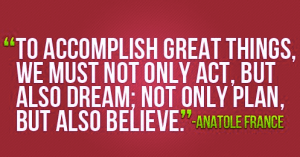
ActAndBelieve

Learning to Love

Learning-to-love
Love. We all use the word, but there is no real consensus on what it is or what it means.

One of my first posts was my attempt at figuring out what love is, and looking back on it now I think I had a lot of things right, but at the same time it seems somewhat lacking.

Some say love is a feeling. Others say love is a choice. I think it’s probably a mix of both.

Maybe it’s best to say that love is a feeling that comes with certain choices, and the ability to maintain love (and feelings of love) over a long period is a result of continuing to make loving choices towards your partner.

I don’t think love just happens. Attraction may just happen, but you still have to choose to get to know the other person. To look at them, to listen to them, and to be with them. When you make those little choices, you are letting yourself allow love to develop.

And once love has developed, it needs to be maintained. I’ve talked before about whose responsibility love is. I truly believe that it’s not your partners responsibility to keep you feeling in love with them – it’s yours. You need to nurture your love every day, in countless little ways.

And if you choose not to express love? To turn away from love and not let it in? Or to not accept it when it’s given? They you only have yourself to blame if feelings of love fade away.

Deep Roots

I like to think of love like a tree. Trees need nurturing (sunlight, water, soil) to stay alive. When they are young they are fragile, and need more attention and care. As trees age their roots start to run deep, and they no longer need the same sort of care.

Even when their roots are established though, they still need nurturing. They still need sunlight, water and nutrients in the soil to stay alive. Established trees are strong, and can weather difficult periods. Trees can even be cut down. But as long as the roots are alive, the tree can survive, and come back. It may look a bit different, but that doesn’t make it any less beautiful.

Other times the tree can start to die from the roots, and although the tree may still appear healthy at first it has started to rot from within.

The key is the roots, and keeping those roots alive and healthy.

sapling photo

Nurturing Love

So how do we nurture love?

How do we ensure our roots run deep, to allow us to weather the storms of life?

And how do we keep the roots of our love alive?

It seems obvious to me that love requires nurturing. And this nurturing comes in the form of action.

But what actions are needed, to not only maintain but also to grow our love?

A while back I came across a great article on the characteristics of love. Look at the following quote:

Loving involves being in a relationship with another. In a functional loving relationship there are mutual expectations. If I love you and you don’t accept my love then the relationship is dysfunctional because the primary purpose of love is not easily accomplished. If you don’t let me love you, then my love will be squandered on you.

As such, to be in love is to be engaged in an activity that can be done well or not so well. One can be good at loving or poor at it depending on how good (or bad) one is at accomplishing the purpose or goal of loving someone. The statement, “I love you very much” may sometimes be a deep expression of a feeling that comes with being in love; but it can also be uttered by people who do not know the first thing about how to love another. This is because this statement, if it is meaningful, is not simply a report about a subjective feeling going on at the time that it is uttered.

To be meaningful, you must put your actions where your mouth is. This means doing things that promote the other’s happiness, welfare, and safety

So how do we nurture our love? What actions do we need to take? This article talks about love as being shown with the following core actions:

  • Being there
  • Being beneficent
  • Being considerate/non-maleficent
  • Making a commitment
  • Being loyal
  • Being consistent
  • Being candid
  • Being trustworthy
  • Being empathetic
  • Being tolerant

Let’s look at each of these…

The Actions of Love

Being there. This means you are there for the person in times of need. They know they can count on you, and they can rely on you. Sometimes they may need you at times that aren’t convenient to you, but that’s fine. Some sacrifice may be required, and you may not always be able to be there. But you should always want to.

Being beneficent. This goes one step further than just being there. This means you want to do things FOR them. You want to see them happy (in fact, I think true happiness comes not just from the things that make you happy, but from deriving happiness from seeing your actions bring happiness to someone you love). You value their welfare, and want what’s best for them.

Being considerate/non-maleficent. This is about not wanting to do things that are harmful towards the other person. Trying not to hurt them, or embarrass them. It’s about taking them, and how your actions impact them into account. Over the long term, we all screw this up occasionally. Everyone has moments that they are selfish in their actions, and they end up hurting those they love. But those sort of things should be exceptions, and should be accompanied by remorse when we realize we have hurt the other person.

Making a commitment. This is pretty obvious – you are committed to the relationship.

Being loyal. This involves being loyal and faithful to the person you love. As the article says, “loyalty is not optional if one is to enjoy a happy relationship”.

Being consistent. Consistency is very important. Love and relationships aren’t something that you only engage in when it’s convenient to you. They aren’t a part time job, and you can’t just take time off when things get tough. This goes hand in hand with commitment – and means that acting in a loving way is the normal behavior.

Being candid. Love requires openness and honesty. Lying and deception damages relationships, while honesty (even about difficult things) tends to bring people closer together. It’s important to be careful how you word things though – there’s a difference between honesty and being rude.

Being trustworthy. In loving relationships, you need to be able to confide in the other person and know that they are able to confide in you.

Being empathetic. This is about trying to see things from your partners perspective. We are all different, and “my way” isn’t necessarily the best or the only way. You need to be able to value your partners perspective an opinion even when it doesn’t line up with your own. Relationships require meeting halfway sometimes, and that requires empathy.

Being tolerant. Relationships also require patience, and the ability to let things go, forgive, and move on. Insisting things need to be “your way”, or holding on to grudges and resentment is one of the quickest ways to poison a relationship.

All of these are important characteristics in a loving relationship. And more importantly, all of them are things that can be developed and improved.

Choosing Love

I think it is these actions that people talk about when they say love is a choice. Yes, there are feelings associated with love. But these feelings need to be shown, and we show them through the actions we take and the way we treat our partner.

If you say you love your partner but you strike them out of anger, are you showing love?

If you say you love your partner but you are having an affair, are you showing love?

If you have no interest in spending time with them and connecting with them on an emotional level, are you showing love?

How does your partner know you love them? Should they “just know”? Or do they know because of the way you treat them and interact with them?

Love may involve feelings, but it is more than that. Love is actions.

It may not always be declarations of undying love and passion, but love still needs to be present in all our interactions. We can learn to love, and we can get better at it each and every day.

still learning to love