What is an Affair?

redribbon

What is an affair? When does an affair become an affair?

In the past I’ve talked about how commonly people seem to consider an affair occurring only when you have had sex with the other person.

To me, that interpretation is really broken.

Sex seems like a level that affairs hit when they have reached “the point of no return”, but it has always seemed to me that the “affair” started long before that.

Affairs don’t just happen. There are any number of choices made by both parties that lead to an affair. But at what point does a relationship cross that line?

I’ve been searching for a better way of describing and identifying an affair, and recently came across it in the form of a Ted Talk video by Esther Perel. If you haven’t seen it, it’s truly a great video and well worth spending 20 mins on.

In this, she defines an affair as a relationship with three characteristics:

  1. A secretive relationship
  2. With an emotional connection
  3. And sexual alchemy

Let’s look at each of these characteristics in turn.

A Secretive Relationship

First, the relationship is secretive. That doesn’t mean the betrayed partner doesn’t know about the person. In fact, in the VAST majority of affairs the betrayed partner does know the “other person”. Often they know them quite well, and may even consider them a friend or at least an acquaintance.

Statistically, men are most likely to have an affair with a co-worker while women are most likely to have an affair with a friend. So it’s not as if the people are unknown. And often the betrayer will even talk about them and mention them in conversation.

What is secretive about the relationship is the nature of it.

Even if the affair has not progressed to a sexual stage (and some never do), the betrayer keeps a lot of details away from their partner. How often they are seeing the person, the sorts of things they talk about, etc.

So while the betrayed partner likely knows about the other person, they have no idea what’s actually going on. They think it’s just a co-worker, or an acquaintance. What they don’t realize is just how much time and energy their partner is expending on this other person. How invested their partner is in this new relationship, usually at the expense of their own.

The betrayer may claim “it’s just a friendship, it’s nothing” – and maybe part of them even believes that. But if that were true, then why hide it? The fact that they are hiding details from their partner indicates that at least at some level, they know they are doing something wrong.

In one case I know of, the husband had a very close friendship with a co-worker. They talked/texted all the time outside of work, and sometimes the husband would go meet this person without telling his wife where he was going or who he was going with.

When the wife found out about the relationship she confronted her husband on it. He insisted it was nothing, and that they were “just friends”. When she asked why, if they were just friends, was he so secretive and evasive about the “friendship” his response was “because I knew you wouldn’t like it”.

Ummm, alright. So if he knew she wouldn’t like it, then that would seem to indicate he knew at some level that there was something wrong. And he chose to pursue the relationship in spite of that.

Maybe there truly was nothing more than friendship. But the fact that he kept it going in spite of knowing how his wife would feel about it indicates at the very least a lack of empathy, and putting himself and what he wanted ahead of the good of the relationship.

The secretive nature of the relationship destroyed trust, and once broken trust is very hard to regain.

An Emotional Connection

Next is an emotional connection, and to me this is where the real affair begins. Maybe it starts out as a friendship, or a co-worker at work. But as you get to know the other person better you start to open up more, and discuss increasingly personal details about your life.

This type of discussion builds closeness. But this closeness is a huge danger sign for someone in a relationship.

If you think back to how your existing relationship began, it was probably exactly like this. How someone looks may be the characteristic that caused you to initially notice them, but it was likely long talks and “getting to know them” that caused feelings to form.

Once an emotional connection starts to form with someone else? Well, that’s not really a great sign for your existing relationship.

In many affairs the cheating partners fall in love (or at least believe they have). Incidentally, women are more likely to believe they have fallen in love while men tend to see the affair as “harmless fun”, and something that is filling a gap that is missing in their current relationship.

But whether or not they have fallen in love, they have allowed themselves to open up to the other person in a way that has created an emotional connection, and allowed it to grow.
A while back I had a post called Can guys and girls just be friends? (when they are already in relationships), where I suggest that no, they can’t.

That’s not entirely true. Guys and girls CAN be friends, but if you are in a relationship it changes the nature of the friendship. You aren’t single – and you shouldn’t act like you are. Certain topics shouldn’t be discussed, and the biggest one of all is you should NEVER discuss any problems you are having in your relationship with the other person.

Sexual Alchemy

Lastly is sexual alchemy. See, you don’t need to have had sex for things to be an affair. You don’t even need to have kissed. But you feel *something*, and when you do you KNOW you feel it. A cheating partner may tell the betrayed partner that “nothing happened”, or “they are just a friend”. Well, they can lie to their partner but they can’t lie to themselves. They know they felt something. And even if they didn’t act on it, they know they’ve thought about it.

If they are starting to feel good about themselves when they are around the other person and find themselves looking forward to the next time they see them, then these are HUGE red flags that the nature of their feelings are changing. When that happens, if they are already in a relationship they owe it to both themselves and the other person to stop. Cut off contact with the other person, and figure out what they really want.

I think Esther Perels definition of an affair is perfect. A secretive relationship with an emotional connection where you feel *something*.

If someone is pursuing a “friendship” like this while they are already in a relationship, then whether or not it goes any further than this it’s an affair.

Plain and simple.

Is This All There Is?

Driving off

Is this all there is? This is a question everyone asks themselves eventually.

Is the life I have right now the one I want?

Is there more to life?

Growing up, we have a bit of a romanticized notion of what “being an adult” will be, and what life will look like.

We will be free. We won’t have to live under the rules of our parents. We won’t have to go to school every day. We will be adults – we will be our own person and be able to live our lives how we want!!!

And then we get there.

Once out “on our own” we need a place to live, and we need to eat. So we get a job. Maybe we find one we like, and maybe we just find one that will pay us. But that’s alright, because it pays enough of the bills to let us get by. If we want more “stuff”, we need a better job.

But the job is just a job. Sure we may make some friends at work, but our job is just there to help us finance our life; and our life is the important part.

In our personal life we have friends and family. Often we have a spouse or a partner, and maybe we have kids. THOSE are a greater source of happiness than our job.

But our friends and family have their own lives too. And as much as we may love our spouse and kids, they can be sources of stress and conflict almost as much as they are sources of joy.

We live our lives, and although there may be a lot of joy, life becomes routine. We need to work to pay the bills, and hopefully put away a bit of money to be able to go on a vacation once in a while. Or get a nicer car, or a nicer house.

So we find ourselves in this cycle, going through the motions of life day after day, month after month, and year after year.

Eventually though, *something* triggers you to take a look at your life.

And you come to the realization that being an adult is not what you expected. Careers aren’t what we expected. Marriage is not what you expected. And being a parent is not what you expected.

And you find yourself asking, is this it?

Is this all there is?

Midlife “Crisis”

I think this stage of taking a hard look at your life is what is often referred to as a midlife crisis.

As a kid, I thought a midlife crisis was a bit of a joke. When I heard the term I had visions of an older guy who would divorce his wife, get a sports car and a girlfriend at least 10 years younger (probably a yoga instructor).

It was the sort of thing you saw in movies and on TV, but I didn’t think it really happened.

Of course as a kid I also thought that marriages lasted forever, people would always love their partners and affairs only happened in soap operas. Ha!!!

Now that I’m at midlife myself I read peoples stories on blogs, and I look around at friends and acquaintances and I see that midlife crisis is actually quite real.

It’s just not quite what I thought, and the idea of the sports car and the yoga instructor isn’t often that accurate.

More commonly, instead of a “crisis” people have a period of midlife reflection and transformation.

Sure, some people respond badly, act selfishly and do some really stupid things (and those are the ones we most frequently hear about). But that doesn’t have to be what it’s about.

And in fact, this period in life can also be very healthy.

What Causes Midlife Crisis?

If midlife crisis is a period of reflection and transformation, what causes it?

I think mid-life crisis is really about recognition of our own mortality. It happens anywhere from some ones late 30’s to early 50’s (around “mid”-life). And if you hear enough stories you start to see that there is usually some sort of trigger.

The person going through it often has lost someone close to them, or perhaps they or someone close to them has been impacted by a serious illness.

Sometimes the trigger is just age, and with it the realization that statistically their time on this earth is moving into its second half; and we are closer to our death than our birth.

Why do People Handle it Differently?

To me, the biggest question is why do people handle it so differently? At this time of reflection, some people don’t seem affected at all. Others take stock of their lives and decide to take up a new hobby. And then we have those who dump their partner, buy a sports car and start dating the yoga instructor.

It’s clear that not all approaches are equal, and some have much more significant long term repercussions than others.

Each person is doing what seems right to them at the time, but in the cases that are “newsworthy” to friends and loved ones it often seems like they are watching a car crash. They are watching a loved one engage in what appear to be self-destructive actions and decisions.

So what causes this difference in behavior?

I think it’s primarily due to two things:

  • The size of the gap between where you hoped/wanted to be and where you feel you are
  • The degree of control you feel you have had over how you got to your current situation

The first one seems obvious. You sit back and look at your life, and it’s not what you expected. Maybe a big part of that is due to a romanticized notion of what life “should” look like, but if your life doesn’t look like the one you wanted and you believe that your time is running out, it makes sense to want to make changes.

I think the second reason is actually MUCH more important though.

I write about relationships, but the main underlying theme in my writing is choice and accountability. I feel that choice, and the belief that you have the ability to make choices is one of the biggest keys to happiness.

When I hear stories about midlife crisis, the people who make the biggest changes are usually people who have been living the life they thought they “had” to, or the life they felt was expected of them. Commonly they didn’t assert themselves, and instead just went with the flow.

And now they don’t want to do that anymore. Instead, they decide to live the life they “want” to live – usually acting very impulsively and with little thought about consequences. It’s at once a rebellion and an assertion of individuality; a way of taking control of their own life – with either very little thought given to the damage being done in the process or a belief that they have “sacrificed” for long enough and they don’t want to anymore.

I truly believe this element of choice and control is much more important than the actual gap between where someone is and where they want to be.

If the gap is large but it’s a result of your own choices? Well, there’s no one to blame but yourself. You may not have what you want but you’ve done the best with what you had.

If you feel that you have been living the live that was expected of you though?

People can have what from all outward appearances are great lives. Great families, jobs, partners that truly care about them and support them. It doesn’t matter how “great” a persons life is though if they don’t feel they “choose it”.

No matter how much good there is, if they feel they have been living the life that others expected of them then it lays the groundwork for considerable resentment.

What is the Crisis?

When this midlife time of reflection becomes a crisis, there are a few common areas. These include the following:

Loss of Identity

This is probably the biggest one. In life we play a number of different roles. And in the process of growing and changing it’s easy to find that in all the roles we have “lost ourselves”.

We have become the parent, the partner, the co-worker, the child. We are all these different things to different people. But who are we?

I think we are the sum of all these things. Each of them makes up a part of us that is part of who we truly are.

When there is a sense of lost identity, maybe people never actually knew who they really were. This realization can be painful, but also powerful.

And midlife becomes a time of finding yourself again, and perhaps finally accepting yourself for who you are, instead of looking at who you are not.

Loss of Freedom

At midlife people often talk about “wanting to be free”. There is often sadness at lost youth, and a yearning for the freedom that came with it.

But the sad truth is, as much as we may try there is no going back. We were “free” because we were kids. We had adults to take care of us and look after us.

Once you are an adult? Freedom doesn’t really exist – at least not in the way it did when we were kids. You pretty much have to go to work. You have to have shelter, you have to eat. If you have kids, you have to take care of them. And if you want a relationship, you have to put effort in.

All of these things definitely DO put restrictions on you.

You absolutely CAN choose to walk away from those restrictions, and some do. Some hit a point that they find the stress too high and they just walk away one or all of these parts of their lives – their partner, their job, and even their children.

However when people do that they are looking for a freedom that they will never truly find. And that type of freedom not only comes at great cost, but is also usually not quite what someone expects.

Feeling Stuck

Another issue that can cause midlife to be a time of crisis is the sense of being “stuck”. Life has become mundane and routine. You feel like you are just going through the motions. Alive, but not truly living.

The advertising world tells us that “normal” is bad. It tells us that we are special, we aren’t like all the “other people”. We deserve more.

Then we look over and see the kids. And the mortgage. And the bills. And the pile of laundry.

And over time a sense of sadness and hopelessness builds, which in time can turn to depression.

I think this is probably the leading cause of affairs and divorce. People are looking for some sort of change to shake them out of the rut they are in, and finding comfort in the arms of another is an easy (and temporary) way out. People who have affairs often say that they wanted “to feel alive again”, and that they had lost that feeling.

Affairs are a quick fix though, and they don’t address the underlying issues. I talk about this as it applies to relationships in Losing the Spark. But even individually we all need goals. We need things to strive towards (both individually and as a couple) in order to allow us to get through day to day life.

Truthfully, we all could probably do with a bit more excitement our lives. But it doesn’t just happen, we need to build it in.

A Time for Change

Midlife is a time for reflection. Even if you have been living the life you felt you had to, or the one you felt was expected of you – sometimes when you take a good look at it you realize hey, it’s not so bad.

Maybe there are a few changes you can make, a few goals to pursue, a bit of improvement in communication with people you care about.

And sometimes improving a few little things can make a world of difference. We don’t necessarily have to wipe the board clean and start our life over again.

Last year I hit 40. Mid-life.

There was a bit of turmoil in my life at the time, but I can truly say I never entertained thoughts of the sports car and the yoga instructor.

I did reflect on my life, and I do on a fairly regular basis. But every time I do, I come to the same conclusions.

Yes, life could have been different. There are any number of choices I made which, had I chosen differently would have resulted in a different “me” today.

But I have no regrets. All of my choices were mine, and all of them helped shape me into the person I am today.

And honestly? I like me. Hell, I love me.

And I love my life.

My life is not perfect and it never will be. And things won’t always work out the way I want. But I have a lot of things to be thankful for.

And I ALWAYS have choice.

Others matter to me, and I care about their opinions. They may even influence some of my choices in the way I live my life. But they were still my choices.

I can always choose to improve the things I don’t like, accept them as they are, or change them.

And so can you.

It Will Never Be The Same

NotTheSame

A lot of people who write blogs on relationships write because *something* has happened or gone wrong in their relationship. So they turn to writing to help make sense out of their world, and as an outlet for the pain they are feeling. A lot of people write about the loss of a relationship they didn’t want to lose. Others write as a way of working through their emotions while holding on (or at least trying to hold on) to a relationship that has been altered by whatever has gone wrong.

For the people who are trying to hold on and rebuild love, a common theme that I come across is both a fear and a sense of sadness that due to whatever has happened, things will never be the same. The relationship that they once had seems irrevocably altered, and accompanying this belief is a sense of loss.

My Story

I write about life and love, but although I cite examples and experiences from my life, I don’t talk much about “me”. This was never intended to be an online diary, but rather is a way of developing and expressing my philosophies about life and love. I believe in love, and long term relationships. And my goal with this blog has been to try and give hope to people who may be feeling lost, and remind them that we all go through the same struggles.

In this case however I feel my experiences are very relevant.

Like many others I came to blogging when my relationships was in crisis. Although I try to stay away from talking about my relationship any many of the topics I cover don’t really apply to me, my own personal crisis was the catalyst for my writing.

My wife and I had been together for many years, and I thought life was pretty good. Then I found out she wasn’t sure if she wanted to be married anymore. She wasn’t sure if she loved me. In my mind, she gave up on our marriage. I won’t pretend to understand what was going through her head at that time. That’s her story. But I do know how it impacted me.

It destroyed me.

See, I believed.

I believed marriage was for life. I knew she and I would always be together, and we would always support each other. I knew that no matter what challenges life presented us with, we would get through them. Together.

For years she was my one true certainty in life. My safe haven, and my shelter in the storm of life.

And suddenly she wasn’t.

She didn’t believe what I did.

I knew life came with challenges, but I never expected the challenge to come from her. I never expected her to question something that (to me at least) was the best part of my life.

I waited to wake up one day and find out it was all a bad dream. To find out that it was just some cruel joke. But weeks turned into months, and the reality of my situation hit home.

When I say it destroyed me, that isn’t drama or exaggeration. It messed me up worse than anything I had ever experienced before. The world I felt I “knew” crumbled around me, and that led me to question absolutely everything. For her to feel the way she was feeling, she obviously didn’t feel the same things I did – the things I thought she felt.

And if I was wrong about that?

Well, what else was I wrong about?

Had she ever truly loved me? If so, when had it changed? Why had it changed?

Looking at our life, what was real? Was anything real?

I had always believed in myself, and even that belief was now shaken.

I guess a lot of people have been there, but even after all this time it’s hard to articulate just how fundamentally my world was shaken by the experience.

We were on a dark path for a long time, and the only thing that allowed me to keep my head above water was belief. My belief in “us” was now shattered, and my self-confidence and belief in my self was badly damaged. But I still believed I had done my best. I still believed I had always tried (and would continue) to do the right thing – whatever that was. I just hoped my belief in the good we had and the good that could still be would be enough.

Lost Innocence

We all start innocent, and growing up you believe in different things. You believe in Santa Claus, the Easter Bunny, maybe even the tooth fairy. You believe mommy and daddy love each other, and will always be able to keep you safe. Actually you probably don’t even understand “safe”, because you don’t know threats, you don’t know fear, and you don’t know pain. You only see the light and good in the world, and not the darkness.

Over time, this innocence fades. You find out Santa is just a man in a suit, and there is no Easter Bunny (the tooth fairy IS real though, I’m pretty sure about that one). You start to find out that the world isn’t quite as safe as you thought. Bad things happen to good people sometimes. People get hurt. Tragedies happen. Relationships fail.

In early relationships we experience heartache firsthand, and we hear the rather sobering stats on divorce.

But that early heartache we experienced was simply to prepare us for the person we would be with forever. And divorce only happens to people who give up, and stop loving each other. We know that won’t ever apply to us, because we are different. We believe.

Sure, Santa wasn’t real. And yes, bad things happen in the world. Maybe the world around us had lost it’s magic and wonder.

But for me? My marriage one of the last pieces of magic left in the world.

It was my fairy tale. It was my love story.

And now that magic was broken too.

I believe for me, and many others, this is where things will never be the same again.

That magic.

That belief that no matter what, you will always be there for each other. That your love is somehow special, and different.

When you experience heartache with the person you truly committed your heart and soul to, to the person you believed you would always be with; that changes you forever.

Shifting Landscapes

I watched a video on relationships recently where the speaker made a comment I found particularly poignant. She said (paraphrasing here):

In todays world many people will have more than one marriage in their lifetime.

And in some cases, that marriage is to the same person.

I suppose she could have been talking about splitting up and eventually remarrying. But I saw the comment as a recognition that the nature of relationships change.

If you think about it, you aren’t the same person you were at 20, or 30. You change, you mature. Your life situation changes, and your needs change. Sometimes you have a better job and more money, other times less. You go from single and on your own, where you can do things how you want when you want, to having someone in your life. And now you need to fit that other person in and they are impacted by all the little decisions you make.

And in a relationships you not only see your partner at their best, but also at their worst. And likewise them with you.

Situations change. Maybe you add kids to the mix. Or a promotion, or a loss of a job, serious illness, the loss of a close loved one. There are any number of things that can happen that affect us. Some in small ways, and some in large. Life is all about change.

One of the most common mistakes people make (and I include myself in this) is not realizing or understanding that. We meet someone, we are happy with them, so we get married. We think “great, we are married” and now we will be together forever. Time goes by, life happens, and we continue to mature and change. But we lose sight of the fact that our loved one is changing too. Their needs aren’t the same as they were, yet we continue to treat them the same way, and they do the same with us.

The changes are subtle, so we don’t even see them at first. We “think” things are fine, but over time a number of little changes add up. This causes a distance to start to develop between a couple, as they have become so caught up in day to day life that they fail to see the changes that have happened right in front of their eyes.

everyonechanges

Sometimes we catch it in time, and we are able to accept that the person we are with is not the same one we married, but that’s alright because neither are we. Other times people fight the change, and spend their time resenting that the person isn’t the same.

I haven’t really figured this stuff out yet, but it seems imperative to me that a couple keeps the lines of communication open, continues to communicate their needs, and accepts that change is part of life and will be one of the few constants. If we want to stay together we need to keep growing and learning each other as we change both as individuals and as couple.

Accepting Change

It’s true, things WILL never be “the same”.

But that doesn’t have to be a bad thing. If your relationship has been challenged, then there is something about the way “it was” got people into trouble. Even if one person was happy, obviously the other wasn’t. Relationships involve two people, so you need to find a new path, one that works better for both people. You have to find a way that you can both be happy with the path you are on.

My wife and I are still together.

I wish with all my heart our marriage never been challenged. I wish “happily ever after” meant our love was never tested or challenged.

The experience sucked. I hated it, and wish it had never happened. I wish I could turn back the hands of time and change things. Somehow fix things before they went wrong.

But I can’t. All I can do is determine how to move forward. Ask myself what can I learn, and how I can use the issues we faced to make our relationships stronger.

And I HAVE learned, a lot. I’ve learned about myself and what I want and need out of life. I’ve learned a better understanding and appreciation about love. And hopefully I’ve learned more about my wife.

I still believe in “us”, but it’s different now. Now I believe we CAN make it, not that we necessarily will.

I wish I was still that person who knew we WOULD make it, instead of just knowing we CAN make it. And that distinction saddens me. I mourn that loss of innocence.

But I was faced with a choice. I could either hold onto the image of what I believed we had, and likely end up bitter and alone. Or I could embrace the fact that life goes through phases, and people and relationships change.

I choose the latter.

Maybe the loss of innocence was actually good. I’ve said before that I don’t believe in perfection, and I don’t believe in “meant to be”. I believe life presents us with opportunities, and it’s up to us to determine what we want to do with them.

We almost squandered our opportunity, and hopefully we will never do that again.

I recognize now that love is fragile. I believe that as long as we prioritize time for each other and ensure we focus on our relationship, we will make it through. I believe we need to continue to learn each other, and hope that we both grow and change in ways that allows our love to survive.

If we don’t do that? If we take each other for granted and lose sight of being a couple?

Then our relationship will fail.

It’s that simple.

Before I “knew” we would be together forever. Now doubt is there, and I hate it. But I know we have a chance. We have an opportunity, and it’s up to us to determine what to do with it.

So yeah, maybe things will never be the same. But then again, things will always change.

And I still believe.


Now paranoia’s setting in and I’m falling from these stars again
While every part of me screams, “hold on”
Cause if you can’t learn to bend then you break
Oh my God, how long does it take?
Every lesson we learned took so long
But it made us strong

I-I-I-I’m still standing, I-I-I-I’m still climbing
Even when the rest are falling, the rest are falling
The rest are falling

From Watch Me Rise by Mikky Ekko

Killing with Kindness

smilingApple

Best intentions.

Ideally when we act, we are acting with best intentions. But sometimes our best intentions don’t work out the way we had hoped. Sometimes the question of “best for who” can be raised, as there can be conflicting interests. And sometimes our understanding of what is best is skewed.

I see two different ways that we can inadvertently do harm with best intentions. First is trying to do (or help) too much, and the second is by trying to avoid conflict and never saying “no”.

Becoming a Parent

I first started to understand the complexity behind intentions and motivations when I became a parent. As a parent, we have a few different roles.

One of those roles is to provide for our children. We provide them with a safe environment. A home full of love and caring. It’s easy to get caught up in being a provider and try to provide every “thing” and every opportunity for our children.

It’s easy to understand why we do it though. Maybe we want to give our children an opportunity we always wanted but never had; and so it becomes important to us to ensure our children have those opportunities.

Because we love our children we try to give them everything and do everything for them. But in the process, we are doing considerable harm.

Attachment Theory

A while back I wrote about attachment theory. One of the main ideas behind attachment theory is that healthy attachment is all about establishing boundaries.

As young children everything is about us, and our needs. When we don’t believe our needs are being met we respond with stress, anxiety and fear. As babies this may be crying, as toddlers it becomes tantrums.

With healthy attachment children learn that needs not being met doesn’t indicate a lack of care or love. Further, they learn that not all needs will be met, and that’s alright.

In unhealthy attachment however, not having their needs met continues to result in stress, anxiety and fear.

Any parent knows that kids can be masters at manipulation. As parents we try setting boundaries, and our children continually push them. They push while exploring and trying to understand the world around them. As parents we need to get them to understand and accept “no”. But have them understand that “no” doesn’t mean we love them any less.

When we fail to establish boundaries, we are actually crippling our children. We are teaching them that they can do whatever they want, and that rules either don’t matter or only apply sometimes. By doing this, we are giving them a sense of entitlement.

Provider and Teacher

In addition to being a provider for our children we are also teachers; and this is the harder role. It’s relatively easy to provide food and put a roof over our children’s heads. It’s MUCH harder to teach.

Think about how you learn. You learn by failing. By making mistakes, seeing where things went wrong, and trying something different next time.

As a parent, the hardest thing to do is watch your child fail. So sometimes we try to make decisions for them. We try to prevent them from making the same mistakes we may have made.

But our children need to learn on their own.

This is where boundaries come in. We need to set boundaries, but let our children explore and learn within those boundaries. We need to be able to watch them fail. We need to know when to let them pick themselves up and when to help them. And that’s a VERY hard balance, and a difficult thing to do.
It hurts to watch your child fail, so sometimes we try and help them to prevent them from failing. We are doing it because we care, but we do too much.

doingtoomuch

This conflicts with our role as a teacher. As a teacher, our real role is to prepare our children for life on their own. To mold them into independent beings, who can make the right choices when they need to. But when we do too much, instead of “helping” our children we are creating dependence.

Adulthood

Societally we have this notion of adulthood. People reach some magical age (18 or 21) where they are now “legally adults”, and they are now deemed responsible. This doesn’t mean we actually ARE responsible (look at college life for ample proof of that), it simply means we are now responsible for our own decisions.

We start relationships, maybe even start a family of our own. And hey, we’re adults, so we’ve got everything figured out now. But in many ways not much has changed since we were children. In many cases we are still that child pushing boundaries in order to understand the world around us and our place in it.

Dealing with Conflict

I’ve touched on this in the past, but one of the biggest failings we have in our development is most people grow up with the notion that conflict is bad (I know I did). A logical conclusion that can be made is, if the presence of conflict is bad, then avoiding conflict means things are good – right?

Yeah, not so much.

Because we want to avoid conflict, we fail to establish boundaries in our relationships. Your partner is doing something that hurts you, and often we don’t want to say anything. It’s “not a big deal”, so we let it go in order to avoid conflict. And in the process we set ourselves up for larger, more serious conflicts in the future.

I’ve got a buddy who is really into sports. He has a wife and a young family, but most of the year he’s out 3-4 nights a week with his buddies playing various sports and then going for drinks after. According to him she’s fine with that. I’ve often wondered, is she really fine with that? Or does she just not want to say no?

If I were her I think I’d be more than just a wee bit resentful.

Establishing Boundaries

Establishing boundaries in relationships is difficult. I think part of the reason we don’t want to do it is because we don’t feel we should have to. Our partners should “know” when they are pushing boundaries too far. They should “know” when they are hurting us. But honestly, unless we say something they probably don’t.

It makes me think of contract negotiations in sports. Often you hear about players who are horribly overpaid. When you think about it though, who’s fault is that? I would argue it’s the fault of the person paying them (team owners). Players may often overvalue their worth, but the owner has to be the one to agree to it. They can always say no, or offer less. If a player is offered more than they are worth, of course they will accept it.

Relationships are the same. Just as the authors of books need editors, sometimes we need our partners to reel us in and keep us in line. Sometimes our partners need to tell us “no”, or say “you can choose to do that, but be aware that I’m not fine with it”.

For my buddy who’s out almost every night, maybe his wife IS fine with it. I’m sure she’s fine with him going out once a week, maybe even twice. Supporting your partner in their interests is important. But I would guess she would also like some help at home, and some additional time spent with her husband.

He probably started with one or two nights, and then added more. And if she never said anything, he probably thought the silence was consent. He pushed boundaries, and she never established where they were.

My guess? This turns into a significant issue for them sometime in the future. And he’ll be stunned, because he always thought she was fine with it.

My buddies scenario is just an example, but I think we all run into cases like this. We want to be “the good partner”. We want to be supportive. We also want to avoid conflict. So we put ourselves in situations where we give and give. We want our partners to establish boundaries on their own, and usually they do. But we are all different, so where they establish the boundary may be different from where we believe it should be.

When this happens, instead of being resentful with our partners we need to take a look at ourselves. We need to learn to say “no”. To say “hey, I matter here too”. I like to think the best of people, and I believe that in most relationships both partners truly do love each other. So done right, I think most partners will understand and adjust their behavior accordingly.

Being an adult doesn’t mean we have things figured out. Relationships are complex, and we should always be growing and learning. Just as a parent plays a dual role of provider and teacher, in a way we do the same in our relationships.

A common complaint I see is that relationships become one sided. One person feels they are giving and giving while the other person just takes. That’s not a relationship.

For the person who feels they are “giving”, ask yourself what are you asking for in return? Are you allowing yourself to be taken advantage of? Kindness and caring doesn’t mean always doing something for the other person and not asking for anything for yourself in return.

It’s not about being petty and withholding stuff until you get what you want (that’s about power and control, and is bad news). It’s simply knowing your value and saying “I’m worth your time. I’m worth your attention. My needs matter in this relationship too.”

Your partner matters, and you matter. For the relationship to be successful and happy you need to find a balance where both people feel valued and appreciated. And establishing boundaries is essential to that, and to happy relationships.

You Can Have Anything (Just Not Everything)

i-want-it-all

I’ve mentioned before that I spend my days in the world of business and that I see parallels between what it takes to succeed in business and in relationships. One of the business concepts that I always have in the back of my head is something known as the triple constraint.

The Triple Constraint

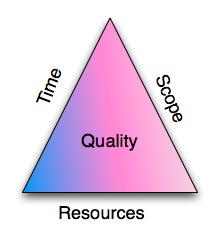
The triple constraint is based on the idea that we are restricted in what we do by three different things; time, resources and scope. Each of these are interrelated, meaning you can’t change one without impacting the others. In the center of the triangle you see quality, indicating that the quality of what we are doing is dependent on finding a balance between these three things.

Triple-Constraint

To illustrate this concept, let’s look at building a fence.

Scope is the extent or area that something deals with. You can also think of it as the range, breadth, span or reach of something. Basically it’s “what” something is. If you want to build a fence, your scope involves a lot of things. What is the fence around? Is it your whole yard? Only once side? How many feet of fence do you need to build? How tall does it need to be? What materials do you want to use? All of these details about what you are trying to accomplish are the scope of the fence.

Time is the duration of building a fence. This isn’t the time in terms of effort, but is the amount of time from start to finish. Do you want to build it in a day? A week?

Lastly you have resources. This is what you put into building the fence in terms of both money and personal effort (your time invested).

To see how these different sides of the triple constraint are related, picture a specific fence (a fixed scope). If you want to build it yourself, your resources will be the cost of materials and your effort in building it. How fast you can build it will depend on the time you have available. If you are on holidays maybe you can build it in a few days. If you are working and have other responsibilities it will take a lot longer to complete.

If you want it built faster, you can always get friends to help or hire someone – but that means it will increase your costs. If you don’t want to increase your costs (maybe you can’t afford it) you may change the design of the fence somewhat (the scope), to reduce your costs. Likewise if you want a fancier fence, or something using different materials it will impact the costs.

At some level, we have all seen this principle at play. There is a sense of “value” behind items. For example, we understand that a burger from a fast food restaurant generally costs less than a burger at a sit down restaurant. Inherent in that cost there is a sense that a higher price indicates a better burger. Maybe it’s larger, or has better ingredients, or the restaurant has better service. Similarly we expect “fast food” to be ready in a few minutes, while at a sit down restaurant we expect to have to wait a while.

good_cheap_fast_sign

Competing Priorities

In life, it’s possible to have or do almost anything if you put in enough time and effort. We’ll do better at some things than others, but you can still do anything.

However everything we do is constrained by limits on money, energy and the number of hours in a day. We only have so much of each of them. So while it IS possible to do almost anything, we can’t have everything. Working towards one thing sometimes means we can’t work towards another thing at the same time. We have to pick what is really important to us, and focus our energies on that.

Remember, the triple constraint says the quality of something is dependent on finding a balance between scope, time and resources. When we try doing too many things at once, we lose that balance. We end up burning ourselves out and the quality of ALL the things we are trying to do will suffer.

Prioritizing Love

The triple constraint is easy to see when looking at things like building a fence, but it also applies to our relationships.

In the early days of building a relationship, you are often putting considerable time and resources (both energy and money) into the other person. You may be figuring out what the “scope” of the relationship is (are we just going out once in a while? Are we exclusive? Are we a couple?), but because of the investment of time and effort you are building a level of quality into the relationship.

So where do we go wrong with long term relationships? One of the main reasons long term relationships become stagnant is because we stop prioritizing them. We stop putting in the time and effort needed to both maintain and grow our relationships.

After a while we start to feel “safe”, and believe our partner will always be there. In many ways this is a good thing. The problem is, due to this belief that our partner will always be there, when life starts to get in the way it’s our relationship that we let slide.

We have jobs, and friendships to maintain. We have hobbies, and we want to take care of ourselves both physically and mentally. Kids come, and they become the primary focus for a long time (I’ll admit kids have to be the focus, and they take a tremendous amount of energy.

But these things become reasons to neglect the relationship. It may not happen intentionally, but it happens all the same. We may “say” that our relationship is a priority to us, but when you look at how we prioritize our time our actions often don’t back up our words.

The triple constraint says there is a relationship between time (duration), energy (resources) and scope. For committed relationships we hope to spend a lifetime together, so the duration we are looking for is pretty large –it’s the rest of our life. If our duration is fixed, then that leaves scope and resources.

When we stop focusing on our relationship by spending less time with our partners and putting less energy into the relationship, the only outcome is to impact the scope and/or the quality of the relationship. Instead of having a close loving relationship, we end up as roommates.

One day we realize that, and instead of looking at WHY, we mourn the loss of the relationship.
Some people accept this reduced scope, and largely live separate lives. Others are roommates who have sex sometimes and maybe go on the occasional trip together. And others walk away because “the relationship has failed”.

Garbage In, Garbage Out

What we get out of something is dependent on what we put into it. What is it that you put into a relationship? Think of the resources side of the triple constraint – what you put in is time and energy (effort). Well, money too I suppose. But buying your partner things as a sign of affection without putting time and effort into the relationship is meaningless.

So ask yourself, what exactly are we doing when we let our relationship slide because life has become “too busy”? When we stop making time focused on being a couple?

When we do this we are taking our relationship and our partner for granted. We may say they are important, and they probably truly are. But actions speak louder than words. If we aren’t finding a way to prioritize our partner in our life, then we aren’t showing they matter to us.

This is when resentment and apathy starts to creep in, and relationships start to break down. Usually people know they are letting their relationship slide. They realize it, but with all the other things going on in life they can’t find a balance and they can’t find a way to make time.

Think of the triple constraint. If you can’t find a balance between time, scope and resources the quality of things suffers. Maybe you are taking on too much. Maybe as much as you want to do everything, you have to let something go.

Maybe you actually need to do everything that you are currently doing. If so, maybe you can get help from your partner to reduce the load and free up more time for each other.

People often say “I can’t find the time”. When you look at the damage done to a relationship by not finding the time, I think it’s more accurate to say you can’t afford not to.

Depending on what is happening in life (and especially if there are kids) I don’t think anyone is really expecting the amount of time and effort spent on the relationship that there was in the early days. That’s likely not realistic. But it’s important to recognize that your level of closeness in the relationship is like your scope. So when you have less time and effort to put into the relationship, your closeness will be impacted. That doesn’t mean you are falling out of love – it’s simply the triple constraint at work.

So think about what is truly important to you, and then look at how your time is spent. Do the two things line up?

ThinkingAboutPriorities

Sometimes it is hard to make time for your relationship, and I think both partners understand this. But the effort has to always be there. With the triple constraint quality is in the middle. You can’t control the number of hours in the day and you can’t control the amount of money you have.

But you CAN take advantage of the moments you do have to focus on each other. In the process, you may find that you are building quality and closeness back in.

When Hope Fails

Feeling Alone

In the past I have talked about how it is natural for passion to wane in long term relationships. There are things couples can do to prevent it, and there are ways couples can try to rebuild passion once it has been lost. In order to rebuild a relationship you need to make it a priority again. But you also have to believe change is possible, and you have to put in effort.

I’m a cheerleader for long term relationships. I believe in them, and believe that as long as people love each other they can get through anything. I believe with a little bit of effort on both parts, each day can be better than the last. Couples can work to better understand each other and build a deep enduring love. I believe forever can be real, and couples can “grow old together” still very much in love.

Belief for me is the easy part, and part of my goal with this site has been a hope that my belief can be infectious and I can inspire others to believe when they are having a hard time doing so on their own.

But I recognize that isn’t the case for everyone. Sometimes it’s hard to believe, and hold onto hope. Sometimes you try focusing on the positive, but a little part of your brain keeps insisting that things will never get better. What if you do truly want things to get better, but you just can’t bring yourself to put in the energy or the effort?

What do you do when hope fails?

If hope has failed, it may be that your brain and heart are telling you your relationship is beyond saving. But what if it’s something else entirely?

If you look up “sense of hopelessness” you will find it is one of the major signs of anxiety and depression. In my last post I talked a little bit about mental illness. What I didn’t talk about was how mental health has a direct impact on relationships.

According to statistics, mental illness will directly impact roughly 20% of people at some point in time in their life (though some stats show this as high as 25%). Relationships involve two people, so according to my math 40%-50% of couples will deal with a mental illness at some point in time, adding an additional layer of challenge to the normal trials and tribulations relationships go through.

Impacts on Relationships

Stats from counselors indicate that more than 80% of couples who come in for counseling show signs of mental illness (predominantly in the form of anxiety or depression). This is not surprising, as the nature of mental illnesses often break down the very characteristics required for a strong, healthy relationship. They can impact a persons ability to feel love and affection, while also making it harder to cope with the regular stresses of a relationship and day to day life. This in turn puts additional stress on the relationship.

When a relationship is struggling and there is the presence of something like depression and/or anxiety, a question that can be asked is “does the mental illness contribute to the relationship issues, or do the relationship issues lead to the mental illness”. Honestly, that’s a valid question. But I would argue that the answer doesn’t really matter. Allow me to explain…

depression vs. Depression

We all have had bad days and days that we feel depressed. When you’re depressed, you’re generally feeling down, or in a funk. You probably feel listless and a bit tired, and you really don’t want to do much. Everyone has days like that, and they are usually triggered by something that has happened.

When I first heard about depression, I thought this is what people were talking about. As a result, I didn’t understand what the big deal was. After all, feeling depressed is a normal thing that everyone experiences. In my mind depressed people just needed to cheer up, and they would feel better soon enough.

The reality of depression isn’t so simple. Depression as an illness (also known as clinical depression or a major depressive episode) is different. It may start the same as the “normal” funks that people go through, and that’s probably a big part of why most people don’t get help for it. I suspect that many sufferers think it’s just something they can wait out. Or they think they are feeling “down” because of something in their life, and if they just changed that thing they would start to feel better. But as time goes by it just deepens and worsens. Clinical depression is only partially understood, but it causes changes in brain chemistry that can make it very difficult for people to get out without help.

In a similar fashion everyone experiences anxiety from time to time, but when anxiety becomes a common part of daily life then anxiety may be a disorder. I recently wrote on the impacts of stress on relationships. People with anxiety disorders are constantly dealing with elevated levels of stress. The symptoms of anxiety disorders are very similar to those of depression, and these extended periods of stress often result in anxiety disorders causing depression.

Trusting Emotions

Who are you? What makes you “you”? Some people talk about the separation between the body and the soul, and the idea is usually that the soul is the essence of what makes you who you are. It’s your thoughts, feelings, emotions and memories. These are what make us who we are, and what makes us human.

That’s a problem with changes to moods and emotions. It’s easy to see these things as “who we are”, or “how we truly feel” about things. But what if we can’t trust them?

One problem about moods, feelings and emotions is that they are affected by our mental state. At some level we know this happens. I suspect everyone would admit that they have had days where they are frustrated and irritable, and as a result inadvertently lashed out at someone (displacing anger and frustration from something else).

With mental health issues such as depression or anxiety, these “bad days” can become the norm. Moods change and emotions change.

Some of the main symptoms are irritability and bouts of anger. Difficulty sleeping (which likely contributes to irritability and emotional volatility). There’s also tiredness and a lack of energy, a feeling of hopelessness or being trapped, and issues dealing with stress.

Impacts on Relationships

Anxiety and Depression can be devastating for the person who is suffering from them. But they also take a considerable toll for both members of a relationship.

For the person who is suffering, the illness can break down feelings of love, and lead them to question whether or not they actually do love their partner. We are taught to trust our feelings. So when the “feeling” isn’t there, it’s easy to conclude that the reason is because the love has broken down. Often the affected person doesn’t understand why the feelings are gone. They may not be able to identify why they don’t feel affection any more. They may want to, and they may mourn the loss. But because of the chemical changes in their brain, they are unable to feel for their partner.

Ironically, although they find it hard to maintain feelings of long term love they are still able to feel the oxytocin fueled feelings of “new love” – which can act as “proof” or validation that something was wrong with the initial relationship. Research on depression shows that someone suffering from depression has an increased probability of having an affair, as a way of trying to fill the feelings of emptiness inside and “feel alive” again.

For the partner who isn’t suffering, it can be difficult to watch the person you love withdraw. There is a sense of walking on eggshells, as you aren’t sure what to do to help. And the relationship often becomes characterized by cycles of withdrawal and anger. It causes immense stress, and often the “healthy” partner ends up falling into a depression themselves.

There are a lot of books on depression and how it impacts people, but for a look at the ways depression can impact relationships I recommend reading Depression Fallout by Anne Sheffield. She has lived both sides of depression, and has some valuable insights into it.

Making Decisions

Earlier I said it didn’t matter whether a relationship is damaged by a mental illness or the whether the depression was caused by relationship issues. This is because most literature on illnesses like depression say that you should never make significant life choices (such as changes in jobs and relationships) while depressed because of the way illnesses can impact feelings of love and closeness.

When feelings and emotions are impaired, making significant decisions is similar to getting behind the wheel of a car while drunk. You may “get by” safely. But you may also do significant damage, to both yourself, your loved ones and your future. It’s important to try to address the illness first.

Mental illnesses such as depression and anxiety can be treated effectively, but unfortunately only around half of the people dealing with a mental illness ever seek help.

If you are having problems in your relationship, and struggling with putting in the effort needed to turn things around because you believe things will never get better, keep in mind that it may not just be an issue with the relationship. Especially if you are having a hard time pinpointing what is “wrong” with the relationship, it may be a sign of something else.

If so, talk to your doctor and tell them exactly how you are feeling. You might just be able to save your relationship, or prevent it from breaking down unnecessarily.

Coping with Stress in Relationships

stress

Sunday nights are usually family movie night in my household, and this past weekend we watched Angel in the Home (aka Foster).

The movie was sweet, but also dealt with a fairly dark topic. It’s about a couple who have experienced a tragedy in the past, and they are unable to conceive. They decide to foster a child who is wise beyond his years, and in the process of fitting this child into their lives they realize that their relationship has broken down, and they learn to rebuild the love that has been lost. It had some pretty powerful moments, and I think presented an honest look at the breakdown of love.

Watching the movie tied in to some of the things I’ve been thinking about lately. Namely the idea that stress (either in the form of a single traumatic event or extended periods of stress) will damage and can potentially destroy relationships.

Stress in Relationships

When I was younger I remember hearing about a local family whose child was killed in an accident, and how the tragedy caused the couple to split apart. I didn’t understand it at the time. There were other children in the family, and in my mind the other children would need their parents even more after the loss. I also thought that as a couple, one of the biggest roles we play is to be there for each other. Couples are supposed to be safe havens for each other, where no matter what the world throws at them, they will always be there for each other.

Naively I thought that a tragedy like that would be a time that the couple would depend upon each other even more, and that somehow it would bring a couple closer together. But all the evidence shows that is not the case.

It doesn’t even have to be a specific tragedy. Even without a specific trigger, extended periods of stress commonly cause relationships to break down. An article on stress in relationships describes this as follows:

When you are stressed you can become less-than-careful with the person you love. You concentrate on your own situation and forget how it affects your partner. Soon you have a vast gulf in understanding, and ultimately this could lead to the breakdown of the relationship.

The Stress Management Society’s relationship experts have seen stress cause divorce. Their advice is to make your relationship a priority.

Only The Strong Survive?

What does it mean when stress causes a relationship to break down? Is that perhaps a reflection on the relationship itself? Maybe it just means the couple wasn’t “meant to be”, or their love wasn’t strong enough to survive.

Any longtime readers know that I don’t believe in “meant to be”. I think life gives us opportunities for things, and it’s up to us to determine what we want to do with those opportunities. We can make the most of them, or we can squander them.

But even for couples with strong “couples skills” that are doing their best at focusing on the relationship, extreme stress can be a killer:

It would nice to think that the stronger the relationship is, the more likely it will survive if one of both partners is suffering from the effects of severe stress, but sadly the reality is very different. A study carried out by Neff, L.A. and Karney in 2009 and published in the Journal of Personality and Social Psychology found that relationships exposed to high levels of stress over a long period of time faltered, irrespective of how good they were.

Even when each person had good relationship skills, exposure to stress changed their perception of the relationship. Ultimately, this led to a breakdown in communication, anxiety, arguments, and all kinds of other relationship problems.

One important thing to note is that it doesn’t matter what the actual source of the stress is. The stress may be completely external to the relationship, and it is still liable to spill over into the relationship.

In discussing the same 2009 study, Dr. John Grohol states that in times of stress:

In times of stress we are more likely to see the relationship as being negative, not realizing the impact the stress is having in the validity of our evaluation — it colors our perception of the relationship itself. Remove the stress, and people’s positive relationship skills can once again — and usually do — take over.
The take-away for couples is simple — each individual needs to learn to deal with stress in positive ways outside of the relationship (through activities to minimize the buildup of stress in the first place, regular exercise, and other stress-relief activities). No matter how well you function in everyday life, all the skills in the world may go to hell in a hand-basket when stressed out.

The Stress Curve

We all manage stress differently. Some people have a higher tolerance level for stress than others, but no matter where your tolerance level lies we all have a point that it starts to take a toll.
Look at the following “stress chart”:

stress-curve

We may have different thresholds, but no matter where your threshold is there are physiological affects once you have hit it. Exhaustion, irritability, anger, and eventually breakdown.

I’m sure we’ve all experienced this on some scale. Maybe it’s a hard day at work, a struggle with the kids, or even a bad experience while driving. Whatever it is, the stress of the situation has put us near or past our threshold line, and as a result we are irritable.

Who do we take it out on? Interestingly, we can usually “keep it together” when we need to such as at work or in a public setting. Instead it’s at home that our frustrations come out, so the person on the receiving end is often our partner or our children. Maybe they do something to set us off and our response is out of proportion with what they have done. Maybe they don’t even do anything.

Psychologists say we do this at home because it is there that we can let our defenses down. It is our place of safety. But as a result, we are taking out our frustrations on the people we are supposed to love the most.

Stress and Intimacy

One of the side effects of stress is that it breaks down intimacy. It’s important to understand this link, because often a breakdown of intimacy is seen as a sign of issues in the relationship. From the article above:

When life gets tough, stress can cause communication to break down and intimacy levels to suffer. Stress can also affect our libido and, unfortunately, stress and sex drive issues may eventually cause a relationship meltdown, particularly if neither partner is willing to address the issue. So before your relationship hits the buffers due to chronic stress, it is essential that you understand the link between stress and relationship problems.

When one partner is suffering from the effects of extreme stress, a diminished sex drive can be the end result. No two people are the same, but men and women often react differently to stress. Women are more likely to lose their desire to have sex when stressed, but chronic stress is just as likely to affect the male libido, too. And when one partner is continually being given the cold shoulder in bed, it will not be long before the relationship begins to suffer.

Dealing with Stress

Due to the effects of stress on relationship, it seems obvious that in order to preserve the health of a relationship a couple has to pay attention to their levels of stress.

At their core relationships are based on empathy, and stress breaks that down. So when experiencing stress it’s very important not to lose sight of the relationship. It’s very easy to get caught up in how the stress affects you and makes you feel, and lose sight of your partner – their needs and how the stress is affecting them.

Highly stressful situations should be avoided where possible. However it’s not always possible to change stress levels, so it’s also important for a couple to try and develop mechanisms for dealing with stress (both individually and as a couple).

No matter what is happening, it’s important that communication remains part of the relationship. Stressful times and situations often can’t be avoided, so keeping communication strong is the key to surviving difficult times.

Once communication breaks down, the relationship often follows.

Who’s Responsibility is Love?

Holding-on-to-a-Relationship

Recently I’ve talked a bit about losing the spark. Losing the spark is all too common in long term relationships. Due to any number of reasons, over time many couples get to a point where they still love the person, but they are no longer IN love.

I recently read a blog written by a woman who “lost the spark” in her marriage. She ended up having an affair, and was in the process of a divorce. Interestingly her husband still wanted things to work out, but she didn’t. She had an affair. To her this act was proof that something was wrong in her relationship, and after that her heart wasn’t in her marriage anymore. She wasn’t interested in rebuilding.

Now, I don’t know anything about her situation other than what she wrote. Maybe the relationship was terrible. Maybe she didn’t understand what love really is, and as a result was disappointed in her marriage. Maybe there were other issues such as addictions, mental health or abuse. Who knows.

The only thing I do know is that if her heart wasn’t in rebuilding, then any efforts to rebuild were doomed to failure before they even began. Relationships require effort. If you don’t truly WANT it, you will never be willing to compromise and put in the effort required to be happy. As they say, garbage in, garbage out. If you don’t put effort in, then you shouldn’t be surprised if things don’t work out very well.

But this story and others like it got me thinking:

Who’s responsibility is it to maintain feelings of love? And what do you do if those feelings fade?

Holding On To Love

One of the mistakes I think many people make is the belief that love is something you “feel”. Something that’s either there, or it’s not. Seen this way, love is a passive thing, or something you receive.

I don’t think love should ever be passive. And the feeling of being “in love” is only a small part of love. When you think of love as a feeling or something you just receive, you all but ensure that love will fail. You need to actively work to maintain love, or over time that “feeling” goes away.

Maintaining these feelings of being in love is the responsibility of each of us. Love requires effort on the part of both people. It is not your partners responsibility to keep you feeling “in love”.

Yes, your partner should treat you well. They should show you affection and make you feel valued and loved. And those actions make you more likely to return gestures of love and affection, after all, we all like to feel valued and appreciated.

But love isn’t just something you receive. Ultimately your feelings for your partner are YOUR responsibility. And in order to maintain love, these feelings need to be nurtured.

It is up to you to make your partner a priority in your thoughts and in your life. It is up to you to value and appreciate your partner. It’s up to you to focus on the positives in your life together instead of the negatives.

If you don’t and the feelings of being “in love” start to fade? Well, that’s as much your fault as it is your partners (probably more actually).

holdingOnIsTough

Focus on Each Other

To keep love strong you have to focus on each other, and focus on the positives.

I’m not suggesting you ignore the negatives. Perfection doesn’t exist. Everyone has flaws, and everyone makes mistakes. It’s important to ensure you are communicating about those and not ignoring them, but you also need to accept them and not allow anger or resentment to poison your relationship.

Look at the good things both in your life together and about your partner them self. What are the thing that make them who they are to you? What are the traits that you love? Personality, intelligence, compassion, quirks. Whatever they are make sure they are about your partner as a person.

From a guys perspective, the absolute LAST thing you want to hear is about how great a provider you are, or how great a father you are to the kids. If that’s all you can think of you may as well just ask us to stand up and then repeatedly kick us in the groin – because that’s how it feels. Yeah, it’s important that we are good at those things. But that’s not what we want.

There’s a stereotype of (shallow) guys wanting a woman because she’s young and hot; and (shallow) women being gold diggers and wanting men for their bank account. Women don’t want to feel like a receptacle for sperm? Well men don’t want to feel like you are only there for the utility we provide.

We ALL want to feel valued for who we are.

Always Do Your Best

In the blog I read, the woman gave up on her marriage. When a relationship has negative momentum, it is easy to get caught up in that negativity and feel that things will never get better.

I’m a cheerleader for long-term relationships, and I think that short of abusive situations most relationship can be not only saved, but can be amazing. Yes people change, but part of relationships is growing and changing together.

There is no “magic person” out there who everything would be perfect with. Love isn’t just received. The success or failure of a relationship is up to both people and what they put in to the relationship – not just what they are getting out of it.

Sometimes things don’t work out though, and that’s fine. At the end of the day the most important thing is to be able to truly tell yourself that you tried. That you put yourself 100% into it and you did your best.

TryYourBest

It’s Not About The Sex

holding-hands-1

I read a number of relationship blogs, and a while back I ran across something written by a woman commenting she didn’t want to just be a “receptacle for her partners sperm”. I have to admit, it made me laugh. It was kind of crude, but funny. And it got across the point of what she felt her role had been reduced to in the relationship.

I recently read another blog by someone talking about what she wants in a man. It was something along the lines of wanting a man who will love her for who she is. For her mind and her soul, being someone who would be willing to support her and grow with her, and not just want her for sex or her body.

I agree. Any man worth being with should want her for all of her, and want to be there for all of her. But guess what? He’ll still want her physically, and he’ll still want sex. And that should never be a bad thing. Actually, she would probably be upset if he didn’t want her.

Reading other blogs, this sentiment seems fairly common. There seem to be lots of women out there feeling some variation on the receptacle idea.

Somehow, somewhere along the way sex seems to go from being this special thing a couple shares that happens to feel good to almost being something bad. It seems to have become a chore or a duty for many women.

If that’s the case, it seems clear that there is some sort of a disconnect between how men and women are expressing our sexual needs as well as our understanding each of other.

Generally I don’t buy into gender differences. I think there are a lot of guys out there with “female” traits and vice versa. But maybe this is one area where we ARE fundamentally different. After all, if you think of the very act – we experience it in a completely different way. I know how it feels as a guy, but as a woman? I have no clue, and never will.

I’ve written in the past about the benefits sex has for a relationship, so I won’t rehash them here.

But here are a few facts:

  • Sex provides many benefits to a relationship
  • Sex drives between partners vary, and are not constant over time
  • Sexual problems can spill over into the rest of the relationship
  • Sexual issues are cited among the leading causes of divorce

How is it that something that should bring us together drives us apart? Some guys may be jerks, but I think most truly do care. So how can any guy make their partner feel like a receptacle for sperm?

Speaking Different Languages

My thought, maybe we just don’t understand each other. And maybe if we can understand each other better we can start to break down these walls of resentment that take what should be a special act and turn it into a cause of conflict. I don’t pretend to represent all guys here, but these my thoughts on the subject…

Sex is not about sex.

Huh? What?

Let me explain…

Who do you have sex with? Random strangers? Unlikely. Your parents? If so, first – too much information. Second, ewww. Your buddies? Some people have “friends with benefits”, but generally that’s because they are not in a relationship and are looking for a regular outlet. In that case, yeah, I guess it’s about the act. But it still has a tendency to run into complications.

No, generally it’s reserved for a couple in a relationship. Why? And why is it that having sex with someone else while in a relationship is often defined as an affair, instead of having dinner with someone else or going for coffee with them? (Incidentally, I think it’s a huge misconception when people draw the line for affairs at sex. The line for affairs should be drawn LONG before that, and could potentially be extended to something as “simple” as dinner. But that’s a topic for another day).

No, sex is clearly different. There’s something special about it. But what?

Being Naked

Years ago one of my buddies caught me off guard when he started talking about his girlfriend and how beautiful and sexy she was when he saw her naked. There are all sorts of stereotypes of guys talking in the locker room about their “conquests”, or constantly talking about women. Maybe it’s just my peer group but we REALLY don’t do that, so it was a bit disconcerting to me when he mentioned this.

First, there’s the unwritten bro-code. You don’t look at or think about a buddies girlfriend/wife/whatever in a sexual way. That’s just not cool. So having him talk about her naked was awkward, as of course it meant my mind instantly imagined her naked.

Ahh!!! Brain what are you doing? Noooooo!!!

As my traitorous brain was processing these unwanted images, I was also thinking “dude, ummm, your girlfriend’s really not that attractive” (I didn’t say that of course). Everyone has their preferences, but for me? Even trying to be objective she didn’t do much for me.

But here’s a secret about sex and desire. Being sexy and beautiful has very little to do with your physical appearance – it’s mostly mental. Is it only young attractive people who desire each other? No (at least, it shouldn’t be).

Being naked with someone you love isn’t about admiring their “naughty bits”. It’s about vulnerability. You are being open with each other. It’s about safety, closeness and trust.

For years I thought sex was about sex. But it’s not. It’s about that feeling, that sense of complete vulnerability and openness. That feeling is intoxicating, and arousing, and will likely lead to sex. But I don’t think it’s the sex that we want, it’s the sense of connection.

The physical act is just insert A into B. The emotional act is one of wanting to connect with and give pleasure to someone you love in a way that is only shared by the two of you.

Because of this I actually believe sex in a long term committed relationship can be better than any other sex. “New love” may have sex more frequently, but it’s more lust than love at that point.

love

Different Drives

Young guys may hope they will be having sex all the time. As you get a bit older, you realize that it doesn’t work that way. It doesn’t mean you wouldn’t be happy to be having sex more frequently, but sex is just part of the relationship and the relationship is more important.

Drives fluctuate. It may be frustrating at times, but we get that. What really matters is that we feel valued, and feel as though our needs in the relationship still matter. There has to be a middle ground where the lower drive person isn’t constantly being pressured, but the higher drive person isn’t left feeling unfulfilled.

If you say no one day, that’s fine. But when one person is consistently rejecting the other and shutting them down sexually then there is a problem.

For anyone who isn’t having sex with some regularity, I ask you this – what is the general level of non-sexual touching and affection like in the relationship. If sex isn’t happening, I’ll guess affection is at a shortage too. How about communication? How easy is it to talk to your partner? Can you tell them anything? Do you? When you are unhappy in parts of your relationship do you tell them? Or do you hold things in? Do you still tell them that you love them?

When there is limited to no sex, the affection and communication has also usually broken down. If affection and communication were still there, the lack of sex would probably be bearable. But then, if the affection and communication were there, chances are the sex would be too. They go together. Sex is simply the natural extension of that affection and communication.

As such, sex is about much more than the physical act. It is symbolic of all the closeness and affection that makes a couple a couple.

A Symbol of the Relationship

Guys see sex as symbolic of the relationship, and because of this a lack of sex can REALLY start to mess with them.

First, they start to question themselves:

  • Is there something wrong with me?
  • I desire my partner, what is wrong? Am I terrible at sex?
  • Does my partner no longer find me attractive?
  • Does my partner not desire me?

There’s a good chance that the lack of sex is at least partially because their partner isn’t feeling good about themselves. But this lack of sex results in both people feeling bad about themselves, and can start a downward spiral of negative momentum.

If the problem persists for any length of time, guys start to question the relationship itself:

  • The person I committed to won’t touch me, do they not care about me anymore?
  • Do they not love me?
  • Is our relationship failing?
  • My needs are being ignored here, what about me? Don’t my needs matter?

At this point, the sexual drought is spilling over and affecting the rest of the relationships. Chances are you got here due to poor communication. Unfortunately improved communication is what you need to get out, as over time this will do considerable damage threatening the relationship itself.

People say that they don’t want to be bothered for sex. But someone pestering you for sex isn’t a problem. It becomes a problem when they have stopped asking, because when that happens resentment has set in and they have given up hope.

All About Sex

I opened with the idea that guys seem to be making women feel like they are only wanted for their bodies, and that things are “all about sex”.

I’m pretty sure that’s not the intent. Making your partner feel that way is simply going to cause any sexual rift to deepen, and that’s not something anyone wants. So why in the world do guys do it?

Here’s my theory:

One of the biggest issues that couples face is they get to a point where they feel they have lost “the spark”. They feel like roommates, and maybe feel taken for granted. They no longer feel special when they are around their partner. And likely they ARE being taken for granted somewhat. It’s easy to get caught up in day to day life and let the relationship suffer, but it doesn’t mean someone loves their partner any less.

I think this is the stage where some people start to resent sex.

For guys, sex is symbolic of the relationship. They need it on a fairly regular basis (“regular” being different from person to person) in order to feel that things are alright. But without enough focus on each other, to the woman it starts to feel as though all they are wanted for is sex. After all, if you aren’t taking time to nurture the relationship (which is usually the fault of both members) but still want sex, then it does start to seem like you are roommates who happen to have sex sometime. No one wants that.

I’ve heard it said that women need connection for sex, and men need sex for connection. I don’t think that’s quite accurate. Instead, I think maybe for women sex goes along with connection while for men sex is symbolic of connection. But even for the guys it’s not actually about sex. It’s still about connection.

I think maybe men and women are both actually looking for the same thing. We both want connection, and to feel valued in the relationship. We are just speaking different languages, and becoming resentful as a result.

Keeping Love Alive

The worst feeling in a relationship is the sense that you have become just roommates, and the sense of being lovers is gone. When this happens, men often seem to think that sex is the way to rebuild the connection, while women want the connection before the sex.

Both approaches are probably wrong. Sex without connection will feel devaluing for both parties. But going long periods without sex while trying to rebuild connection will undermine your ability to rebuild connection. The relationship has to be the focus, but sex needs to be included as part of that.

For any ladies out there who are feeling like they are just wanted for sex, chances are your partner is not just looking for the act (alright, maybe sometimes but not usually). Instead he’s looking for everything it means to him. He’s looking for connection, and a feeling of closeness. He doesn’t want just anyone, and he’s not looking for a repository for his sperm. He wants YOU. He’s looking for feeling loved, and valued by you.

And he sees sex as a way of expressing all of that.

I don’t know if this makes any sense, or helps anything. But to any ladies out there who are feeling used solely for their bodies, please be open to the possibility that there is a lot more to us than just that.

You may drive us crazy sometimes (just as we do to you). But we do love you for who you are. We love your personality, your quirks. The way you can make us laugh and how just thinking about you sometimes can bring a smile to our faces. We want to be there for you emotionally as best we can (which admittedly isn’t always the way you want). And we do want to grow with you and have a life with you. We just need sex to be a part of it.

Losing the Spark

dimmingflame

I spend my days in the world of business, and increasingly I see parallels between what it takes to succeed in business and what it takes to succeed in long term relationships (and life in general actually).

Two of the central concepts in business are Operations and Projects. Any business has *something* that they do, and the operational side of a business is the day to day tasks that allow the business to function in the here and now. This is the stuff that keeps money coming in, and sometimes you’ll hear this referred to as the things a business needs to do to “keep the lights on”.

A business can’t only worry about today though. They also need to keep their eye on the future and plan where they want to be tomorrow. See, even if they have a great business, markets change. New products appear (potentially reducing interest in existing ones) and new competitors appear with fresh ideas and approaches.

In addition to worrying about today, businesses have at least part of their energy and resources dedicated to ensuring there is a tomorrow. At the very least, they need to monitor the ongoing health of the business. This side of business where there is long term visioning is referred to as projects.

Operations may keep a business running and alive today, but the future still matters. A business needs to grow, or at least ensure that they aren’t becoming obsolete. It can be tough balancing both of these things, but it’s necessary to stay alive.

Those who don’t balance the present and the future tend to fail.

The Operations of Relationships

Think of the progression of a relationship.

The early days of relationships are all about building. You meet, and spend time together learning each other. It’s exciting, and it’s new. When you get together it’s an event. Even if all you do is rent a movie or watch some TV, you still made plans to get together. Think of this as your “business start-up”.

Then the relationship gets to another level, and you move in together or get married (and then move in together). What happens? We are no longer building the relationship, we have already built it. We know each other, and although there is still more to learn the pace at which this happens slows considerably.

We now start worrying about day to day life. Our “planned” time together gets taken up with things like grocery shopping, laundry and dishes. Then maybe we have kids, and for a number of years they become the priority. Life becomes all about feeing and changing the baby. It’s about teaching them, raising them. Helping with homework, and shipping the kids off to various events.

These things are all important, and we have to do them. And hey, maybe we even enjoy doing them. But all the while the energy we were once expending on our partner and our relationship is slowly diminishing.

If you talk to couples who are having problems, one of the biggest issues they face is they get to a point where they feel they have lost “the spark”. When this happens, couples will often say things like “they feel like roommates”, or “they feel taken for granted”.

I think this is the biggest killer of relationship, but what exactly is it that has happened here?

The couple has gotten caught up in “operations”. They have lost sight of the future (the fact that they need to have one). They aren’t monitoring the health of the relationship.

Instead, they are simply living life day to day, doing the things to keep the lights on. They haven’t focused on each other enough and spent enough time growing the relationships – or even just ensuring that they aren’t falling apart.

Part of it is “comfort”. Life gets busy, and when you *know* that the other person will be there it’s easy to let them slide. After all, when all the chores are done and the kids have been put to bed both of you are often tired. But over time this takes a considerable toll.

Some couples wake up one day and realize they no longer know the person sleeping next to them. And chances are both of them have a bit of resentment and a sense of loss for where they once were, and what they have become.

Look at your interactions with your partner. Look at the hours you spend together. How much of it is actually focused on them? How much time are you investing in being a couple? Now look at how much of it is time where you simply happen to be occupying the same space, but you are really focused on the kids, the chores, whatever.

Yes, all the “stuff” of day to day life has to happen. But you need to nurture the relationship too.

Signs of Distress

In long term relationships, I think all couples go through some sort of variation on “losing the spark”. Eventually we realize we have got caught up in running a household and raising a family (the world of operations), and we have lost sight of each other as a couple.

What matters is how far things are gone before we really notice, and what we do about it.

People talk about how communication forms the foundation for any relationship, and that becomes especially true when we recognize problems. People are different, so often one person will be the first to really notice “a problem”.

When this happens the biggest mistake people can make is to do nothing.

From reading books and other blogs, often women are the first to get the sense that something has gone wrong (us guys tend to be oblivious). It’s not always women noticing first, and the relationship may not even be a woman and a man – but let’s assume it is for this example.

She notices *something* has gone wrong by realizing that she isn’t really happy.

Maybe she says something to her partner, but he doesn’t get it. He hears her, but doesn’t understand. He thinks, “I love you, I’m providing for my family and I’m a good parent, I don’t understand what the problem is. I’m being a good partner here.”

He is stuck in the world of operations. Those things are important for keeping the relationship going, but not for keeping it ALIVE.

When she says something another response is to get defensive. Having his partner say “I’m not happy here” become misinterpreted, and in his head it becomes “you aren’t a good partner” causing him to start to withdraw (hey, we are emotional creatures and can be a bit sensitive sometimes).

A worse situation is when she doesn’t say anything at all. Rather, she pretends she’s happy and tries figuring out what is wrong on her own. All the while resentment towards her partner is growing, and he doesn’t even know anything is wrong.

Actually guys may be dumb, but we’re not stupid (mostly). So he has picked up on the fact that something is wrong, but he thinks it’s just a phase that will pass, or he completely misreads the severity of things. After all, they’re a couple and they’re committed to a life together, right?

Hah. Unfortunately life isn’t that simple.

Accepting a Problem

When it comes to relationships people REALLY don’t like to accept the existence of problems, so they deny it for as long as they possibly can. People are stubborn, and our natural response to things is to look for things to blame reasons, and we really don’t like change.

Eventually though, we accept that there’s some kind of problem.

I once read that most couples get to a counselor about 2 years later than they should have, and I believe it.

For the person who “caught on” late, they’re hurt and a little scared, so they do what they can to try and make things better. But by now the relationship is caught up in the resentment that comes with negative momentum, so there is a risk that the partner who noticed things first has withdrawn from the relationship, and ignores the efforts to improve things. They think it feels forced, and not genuine.

The couple is now in a downward spiral that does not have a happy ending unless they can both buy in that they want things to improve. And if they do, they need to realize that yeah, things will seem a bit forced at first – but that doesn’t make it any less real.

Digging Out

A LOT of relationships fail at this point. And a lot more stay together, accepting the “truth” that this is normal and long term relationships are simply doomed to a loss of love. Some are fine with a somewhat happy existence, and others stay together in name only – basically living separate lives.

I think there’s more to life than that. I think your relationship should be a source of joy. You should WANT to spent time with your partner whenever you can. After a long day at work, you should look forward to getting home and seeing their face. You should want to share experiences with them. And no matter how long you have been together, nothing should feel as good as being with your partner, holding each other and knowing you’ll never let each other go.

To get back to that spot, you need to focus on the relationship. Day to day life will always be there, but that can’t be your only interactions. You can’t use that as an excuse to not nurture the relationship.

Like a business that monitors it’s day to day health while having a plan for the future, the relationship HAS to become a priority. You need time focused on each other. You need to not only maintain the relationship, but build it.

Do things together.

I don’t think couples intentionally take each other for granted. Most couples will SAY “of course the relationship is a priority. Of course my partner is a priority”.

But actions speak louder than words.

Think back to my earlier question:

Look at your interactions with your partner. Look at the hours you spend together. How much of it is actually focused on them? How much time are you investing in being a couple?

Now ask yourself how much time you think you should be spending on being a couple. Everything needs some sort of sustenance and maintenance to survive, and relationships are no different in this regard.

If you feel the spark has been lost, rest assured that you aren’t alone. Many, many couples go through the same thing. But as long as there is still a flicker, no matter how faint, you can rebuild a flame.

But it’s up to you to do it. If your relationship is a priority, don’t let that only be in words. Back your words with action, and focus on it again. And this time, don’t let it go.