Making Changes

change_banner

I’ve mentioned before that I’m a big fan of basketball. Well I’ll let you in on a little secret – I can’t shoot. I’ve had days that I will hit 10 in a row, but those are rare, and tend to be followed by stretches where I won’t hit at all. If you meet me on a day that I happen to be hitting you may think I’m a good shooter. However if you play with me for long enough, it becomes apparent that I can’t.

Shooting is only part of the game and I would like to think I can get by with some of the other things that I do well (or at least better). But still, it would help my team if I was able to hit shots more consistently.

I have never been coached. As an uncoordinated youth, I started playing late and learned basketball largely through observation, then by trying to recreate what I saw. In the process I came up with a shooting mechanic that “worked for me”. Through the years I’ve recognized that my shot is a weakness in my game, so I try to listen to other people and get pointers when I can. I’ve made some adjustments over the years, but the only consistent thing about my shot is its inconsistency.

Last summer my son was at a basketball camp and there was a “shot doctor” who came in and taught the kids the proper mechanics of shooting. I’ve read books, watched videos etc, but this was the first time I had ever had someone really break down the mechanics of a shot into their components. As he taught the kids, I listened intently.

After the camp, when I came home from work I tried to put what I had learned into practice.

My “old” shot had been internalized. It was reactive, meaning I didn’t have to think about it. And that made it really hard to change. Here’s the thing, when you have YEARS of “bad habits” built up, it becomes really hard to change them.

To make changes you need to really slow down, think about what you are doing, and go back to the basics. It took me a while to get the feel for the “new” shot mechanic, but once I did it was amazing. I was hitting shots at a much higher rate, and more importantly with greater consistency over time.
slow-changes

This improvement had me looking forward to the start of my mens league season, and I believed that this year I would have more confidence in my shooting.

The season started, and guess what – the speed of an actual game is quite a bit different from shooting on your driveway with no defender. I didn’t have time to think about the shot mechanics, and in the pressure of the moment I found myself reverting to my “old” (you can also read that as bad) form.

You see, its one thing to understand what you have to do to change. It’s something entirely different to put it into practice on a regular basis and in a “real life” situation.

Putting in Effort

For me basketball is just a pastime. I love it, but it’s really not that important to my life. So I haven’t put in the hours needed to really internalize the improved mechanics so I can use them in a “real life” situation. I realize that true change takes effort, and that applies to any changes in life.

In a recent post my buddy Gandalf talked about changing his life. As he said:

One item needed for this is dedication. Without that, I wouldn’t have been able to see this through and continuously try to improve every week. I needed to put lots of effort into getting better, which is where hitting rock bottom helped. I knew the problem was me, and only I could make myself better.

Learning to Cope

Over our lifetime we develop coping mechanisms for getting by in life. Similar to how I learned to shoot in basketball, we find something that “works for us”, no matter how broken or ineffective these coping mechanisms may be. As long as we are able to get by, that’s good enough for us.

When times are good it’s not a problem. But life isn’t always easy, and times aren’t always good.

How do you react when life gets tough? My buddy’s approach was to run away. Well, not literally. But his avoidance was such that his way of dealing with things was to not deal with them at all. He would withdraw, not make decisions, and retreat into his comfort zone. And it worked for him – kind of. Unfortunately he wasn’t happy. In fact, he was miserable, and he hated himself. For years he blamed his unhappiness on external things. The reality was, his coping mechanisms were broken and they were causing him to spiral further and further down into unhappiness.

Even though his coping mechanisms were at the root of his problems, they were still safe, and they were what he knew.

It’s unfortunate that people seem to need to hit rock bottom before they can get better. But I guess until they do, their coping mechanisms are still “working” for them, no matter how much damage they are doing. It’s only when they fail completely that someone is forced to face themselves, and see the need for change.

It’s only then that someone will WANT change badly enough to make it happen.

The Need For Change

I think maybe rock bottom is needed because until then, people don’t NEED change. They may want it, and they may realize at an intellectual level that it would benefit them. But change is scary.

Until someone has hit rock bottom, they don’t want change badly enough to dedicate themselves to it. So they say they are trying, but their attempts are half-hearted. Because the effort isn’t truly there, the change doesn’t work or is ineffective, so they revert back to their old ways.

Then they can tell themselves “hey, I tried”. But in reality all they ever did was set themselves up for failure.

When you look around, it’s amazing how much effort people actually seem to put into avoiding change. I think it’s due to fear. People fear change, and so even when they know change is needed, they will half-heartedly attempt it. Then when it doesn’t work, they retreat back to the old ways. But giving up on change causes it to fail before it even has a chance. And this failure becomes proof that they didn’t really need to change after all, allowing someone to slip back into the comfort of their broken coping mechanisms.

It’s kind of like when I tried adapting my new basketball shooting mechanic in a game situation. I hadn’t put enough effort in to make the change sustainable, and the stress of a real game caused me to retreat back to my old form.

Baby Steps

My buddy Gandalf had a lot of changes he needed to make. And looking at all those changes was daunting. So to move forward, he had to do it gradually.

With his doctor, he identified different levels of change, and he started with the easy changes and steadily progressed forward. There was a vision of where they wanted to be at the end, and they made a plan to get there.

Big changes are always made up of a number of smaller steps. But even for small changes, the desire and the effort has to be there. There has to be momentum. You have to WANT it, and you have to be willing to work at it.
make-big-changes-in-small-steps

Take a look at your coping mechanisms and ask yourself, are they really working? Or are you just “getting by”? If you tell yourself “that’s just the way I am”, guess what – you’re just like my buddy Gandalf used to be. That’s what he told himself. He expected other people to conform to him, after all, *he* couldn’t change.

As a result, he hit what for him was rock bottom. There’s a problem with rock bottom though. Depending on how far you have to fall, sometimes the climb back up is really hard. And sometimes you need to find a new path, because you’ve destroyed your old one in the process.

So ask yourself, are your coping mechanisms actually working? Or are you just getting by?

Change is hard, and it can be scary. But sometimes it’s needed for a happier future.

If Only Things Were Perfect

Cinderella-and-Prince-Charming-disney-couples

In a previous post I talked about a broken thinking pattern that is common in depression and anxiety known as “all or nothing” thinking (to learn more on broken thinking patterns found in depression and anxiety check this summary from Wikipedia).

All or nothing thinking is a mindset where someone tends to see things as black and white. Someone can be a wonderful person and do a bunch of great things, but as soon as they do something wrong or make a mistake, that mistake becomes magnified and somehow undoes all the good.

This thinking causes all sorts of problems in relationships, as all people have strengths and weaknesses, good sides and bad sides. In all relationships mistakes will invariably be made. But for someone with all or nothing thinking, any mistakes or flaws by their partner become magnified, and become “proof” that there is something wrong with the relationship or that their partner is not “the one”. A persons own mistakes and flaws also become magnified, leading to issues with self-love (but that’s a story for another day).

Perfectionism

An extension of this line of thinking is perfectionism. At first glance perfectionism doesn’t seem like such a bad thing. Doesn’t perfectionism just mean that someone has high standards and that they only want the best for themselves? If they do have high standards, isn’t that a positive?

All the literature you will find on perfectionism will lead to a resounding no. Rather than being a positive, perfectionism is actually very, very destructive to the person who holds these beliefs.

Perfection is an ideal, it doesn’t exist. Even perfectionists will acknowledge that. The difference is, in a perfectionist mindset the value of something is understood to be dependent on its inherent traits. It is a negative viewpoint that focuses and magnifies the bad points while ignoring the good points. Something is either good or it’s not. And any flaws that do exist in something are often magnified.

Interestingly, in a perfectionist mindset there is a concern not only with how much something appears to you, but there is also tendency to be very concerned with how things are perceived by others. Presentation is very important. Even when times are tough, maintaining the illusion of perfection is important.

Not surprisingly, this mindset is commonly found with people who suffer from chronic unhappiness.

Personal Responsibility

One of the issues with perfectionism and all or nothing thinking is that it absolves someone of personal responsibility. After all, your main contribution to your happiness in life becomes finding the right situation, the right job, or the right partner. When things aren’t working out or you find you aren’t as happy as you could be then there is a convenient reason. Sure, maybe you could have put in a bit more effort. But for the most part the problem was the situation. It’s simply not the right job. Or you are not with the right person.

“You” aren’t responsible. And there is no push to improve from within, because in order to find happiness you simply need to find the right situation.

A major problem with this approach is that someone will never be satisfied with what they have. Everything has flaws that will eventually reveal themselves. So the “perfect” match is always just out of reach. In relationships this results in someone either constantly jumping from relationship to relationship, or deciding to settle for their current situation.

A problem with “settling” is that it means they believe something better is always out there, they simply haven’t found it yet. And if you are settling, then your heart is never fully in your relationship. This becomes a self-fulfilling prophecy because if your heart isn’t in your relationship you won’t put in the level of effort needed to sustain it. As a result, you won’t be as happy as you can be. This unhappiness in turn becomes proof that the relationship is not the right one.

Perfection vs. Continuous Improvement

A different, healthier and more realistic approach to the world is one of continuous improvement. I’ve written about continuous improvement before, and I think it’s a very important approach to not only relationships but life in general (it also happens to be one of my least viewed posts, though I think it’s a good one. So follow the link, come on, you know you want to 🙂 ).

One thing differentiating perfectionism from a continuous improvement mindset is the approach to mistakes or flaws. In perfectionism, mistakes and flaws are signs of a problem. They are signs that something isn’t right, or it’s not good enough. Perfectionists may accept that things could potentially be improved, but they often believe it’s “not worth the effort”. After all, you end up with a relationships that is flawed, and not perfect.

In a continuous improvement mindset, mistakes and flaws are almost seen as a positive thing. Identifying problems shows you areas that can be improved, and ways to make something better. Flaws are a natural part of anything, and they provide motivation to do better or work harder.

In the continuous improvement approach to the world, we are not finished products. Everything has good sides and bad sides. All relationships have their strengths and weaknesses. What is important is to focus on what is good. Appreciate the good in what you have, and enjoy those things.

Where perfectionism focuses on and magnifies the bad points while ignoring the good points, continuous improvement does the opposite. In this mindset what you have is “enough”, because you allows the focus to be on the good. It doesn’t mean the bad doesn’t exist, or that you won’t strive to improve. But the bad is simply part of something.

Continuous improvement still sees perfection as an ideal, but it is simply a goal to strive towards. The important part is the process. The journey of taking what you have and making it better. You may never get there and that’s alright, because at every stage of your journey what you have is enough.

perfection

The Worst Word in the English Language

One problem with the difference in these mindsets is that people often don’t even realize which mindset they possess. If you find you often think about “perfect” or use the word commonly, there’s a good chance you are operating from a perfectionist mindset.

Likewise, if you find yourself focusing on what is missing from your life instead of what you do have, there is a very good chance that you have a perfectionist mindset.

Personally, I can’t stand the word “perfect”. Perfect is an ideal. It doesn’t exist.

perfect isnt real

Life provides us with opportunities, and it’s up to us to determine what we want to do with them. In a perfectionist mindset, many opportunities are passed up because they aren’t good enough.

The reality is life takes effort. There is no such thing as a perfect job. There is no perfect partner. What you get out of anything in life is up to what you put into it.

If you feel that your relationship is missing something, take a long look in the mirror and be honest with yourself about what you are putting into it. Are you putting your best into it, or are you imagining that maybe there’s something better out there somewhere?

If you want a great relationship, it takes work. It takes a willingness to communicate and to prioritize each other. It will never be “perfect”, but it can be as good as you let it. Settling does not mean staying in a situation that’s not perfect. Nothing is perfect, but everything can be better. If you have something that’s pretty good but you can make it better, then why wouldn’t you? In a continuous improvement mindset “settling” is when you have something that’s good and you refuse to put in the effort to make it better.

So put in the effort. And make your relationship the best it can possibly be.

perfect-relationship

Accepting Influence

couples-tattoos-heart-in-hands

When it comes to relationships, there are many do’s and don’ts. Some are obvious, such as be kind to your partner and show them affection, or don’t start a relationship with someone who isn’t your partner. Other things are less obvious, such as accepting influence.

One of the better relationships books I’ve read is John Gottmans “The Seven Principles for Making Marriage Work”. In the book he talks about accepting influence (one of his principles) as sharing power in a relationship and ensuring what when one person makes a decision they are taking the opinions and feelings of their partner into account. Definitely good advice.

I think accepting influence goes deeper than that though and I think it is one of the MOST important things you can do in your relationship. I see accepting influence as allowing your partner to affect not just your decisions, but also your life. This may sound crazy at first, but I see accepting influence as allowing yourself to become more like your partner. Allow me to explain…

My Story

I usually don’t talk about myself, but in this situation my story is relevant to the topic at hand.

As a child I was fairly artistic and spent a lot of time drawing (usually creatures, monsters, robots, super heroes and things like that). In elementary school I was known for being “the kid who could draw”, and it could be argued that I showed some talent or aptitude for art. Heck, at one point in my youth my greatest dream was to be a comic book artist.

Like many kids my life took a turn in my high school years. My group of friends started spending more and more time playing sports (specifically basketball) and I started playing with them. I was terrible at first. Really, really terrible. But it was fun being out with the guys in the summers and spending our days hanging out on outdoor courts.

Over time basketball and fitness became a bigger part of my life while drawing faded into the background. To understand the magnitude of this change, you have to understand that as a child I hated gym. I was always among the last kids picked when teams were assembled in gym class (which is never good for the self-esteem), and I doubt I could have done 10 pushups back then. Alright, fine. I doubt I could have done 3. Yet by the time my university years rolled around I was spending most of my free time in a gym or on a basketball court.

A few years ago I was talking to my sister and she told me she thought I lost a part of myself. She felt that I changed when I went from being this somewhat introverted artistic type to being the guy who has been running a mens league basketball team for many years. Honestly, I can see why she felt that way. The boy she grew up with always had a drawing book in hand, and at the time I couldn’t remember the last time I sat down and actually drew.

Why did I change? I will be the first to admit that initially basketball for me was all about fitting in, it was about having something in common with my friends so I could interact with them. Was I bowing to peer pressure? Was I not being true to me? No, I didn’t realize what I was doing at the time, but I was simply accepting influence. Subconsciously I said “hey, this relationship with my friends is important to me”, and I engaged in activities to help build and strengthen that relationship. And guess what, in the process I discovered a part of me that I didn’t know existed. Previously I had been scared of sports because I was the tall gangly uncoordinated kid. But I found that I loved the game of basketball.

Who are you?

So who is the real “me”? Am I the quiet boy who loves to draw? Am I the guy who loves the physical and competitive nature of sport? Is one part any less “me” than the other, just because I learned it later?

Think about what is it that makes you “you”? It is your interests? Your personality? Your hopes, dreams or fears? In an earlier post on identity I talked about how people are like gemstones. We have many sides to ourselves, and the real us is a composite of all these different parts.

One important thing to note is that when it comes to the things that make us unique, we generally weren’t born with them. Rather, they are learned and developed over the lifetime of our experiences. This means we are never a finished product, and our interests can always expand and change.

Preserving Identity

Accepting influence from your partner can strengthen your relationship. However for someone with identity issues one of the big fears about relationships is losing yourself in the other person, so this idea can be terrifying. And that definitely can happen.

Years ago I saw a Julia Roberts movie, the Runaway Bride. From what I can recall, the movie starts with Julia Roberts dating some guy, and her personality/dress/interests etc. all match his. On their wedding day she gets cold feet and leaves him at the altar. Next you see her with another guy and this time her personality/dress/interests etc are completely different. This repeats a few times, and it becomes clear that she is someone who takes on the identity of whoever she’s dating at the time.

Maybe it’s because she doesn’t have her own identity, or maybe she was simply afraid of asserting her own identity. That was a movie, but these things definitely happen in real life.

When someone is scared of losing their identity there is a tendency in relationships to split life between my thing and their thing. But you need to be careful with this. When there is a big separation between mine and yours, there is little room for “ours” and you end as two individuals living separate lives, together. In the process of preserving your identity you create walls limiting closeness and intimacy in a relationship, in turn limiting your level of happiness and satisfaction in the relationship. That is not really a great recipe for a successful future.

If you are someone who does this, keep in mind doing things your partner enjoys is not about giving up a part of yourself. Actually, it’s not about you at all. Showing interest in “their thing” is really just showing interest in them. If you want your relationship to work out in the long term then guess what, you’ll probably end up spending a fair bit of time with your partner. So shouldn’t we be doing our best to make it enjoyable?

You SHOULD enjoy spending time together, and want to do things together. If you don’t, you’ve really got to ask why you are together at all.

A Healthy Balance

In my basketball story above, I accepted the influence of my friends and did things with them that I normally wouldn’t have done. In the process, I was able to strengthen my relationship with my friends, I was better able to enjoy spending time with them, and I grew personally. I’ll admit, my buddies are different from my wife but the same rules apply. Shouldn’t our partners be our best friends in addition to being our lovers? By allowing them to influence us, we are better able to enjoy doing things together that strengthen our relationship and allow it to grow. This is about accepting each other and showing interest in each other.

Doing things with your partner that aren’t “your thing” doesn’t mean you are giving up parts of you – this isn’t an “either or” or “all or nothing” situation. No one should be asking you to change, and no one should be asking you to stop doing things you enjoy. Well, unless they are self-destructive, illegal, or dangerous. But guess what, if they are asking you to stop those sorts of things it’s probably out of concern for your well-being (and that should be a good thing).

Additionally I’m not saying you have to like something just because your partner does. What I am saying is you should be open to it, and be willing to give it a chance. Allow them to influence you. Most likes and dislikes are learned, so if you happen to find yourself enjoying something that your partner does, great. If not, that’s fine too. But don’t be resistant to something just because it’s not “your thing”.

It is important that we know who we are, and know that we are still individuals outside of the relationship. But instead of striving for independence we should be striving for interdependence, where we enhance each others lives and push each other to grow both individually and as a couple. We should strive for the situation where the whole is greater than the sum of the parts, and we are adding value to each others lives.

strongerTogether

When you look at your relationship with your chosen partner, they aren’t you. They probably have some similarities as well as a number of differences. If you are in a marriage or long term relationships, hopefully that means you have found a partner who will be with you for the rest of your life. The more you are able to share, the more you will enjoy each others presence.

Going back to basketball for a moment, that is “my” thing. I play when I can and enjoy watching it. Is it my wifes thing? No. Do I expect her to become a rabid fan, and start wearing the team logos and the like? Uh, no. It’s largely something I do on my own, or with my buddies. But would I like to be able to go to a game or just watch one with her once in a while? Yeah, definitely.

She used to tell me stories that the guys at her work would talk about basketball, and she would be able to join in the conversation somewhat and knew what was going on. I have to admit, when she told me those stories it made me feel good. Not because I had turned her into a basketball fan. But because she had picked up bits of something that mattered to me. It had nothing to do with basketball, but it had everything to do with showing interest in me, and accepting influence from me. It made me feel loved, and it made me feel valued.

Accepting Influence from your Partner

If you want to strengthen your relationships, listen to your partner. Try to understand their likes and dislikes, and be willing to share them with them. Not to generalize based on gender here, but guys, go to the romantic movie, the ballet, whatever with your partner. Girls, go to the ball game with your guy. Join him in some of the things he enjoys. Who knows, in the process you may each learn to enjoy each others interests as well.

You each still need time apart with your own friends, or as individuals to do your own thing. That time apart allows your relationship to grow. But the more you are able to do together, and the more you can enjoy being together, the happier you will be.

Emotional Walls

brick-walls

Over my last few posts I have been exploring attachment and emotional intimacy. Emotional intimacy is what brings couples together. We all want to feel loved and valued. We all want to be accepted for who we are, quirks and all.

In Building Closeness and Intimacy I looked at how emotional intimacy, or closeness is initially created. There really is no secret science to building closeness. It requires mutual self-disclosure (that’s a fancy term for sharing information about each other). It requires opening up and letting the other person in. That’s a simple fact, and at least on some level anyone who has been in a relationship know this.

I’m not sure if anyone ever lets the other person “fully in” to their world, but the degree to which we do determines the degree of satisfaction we can have in our relationships. So why is it so hard sometimes to let other people in? Why do we build walls, and hold back in a relationship?

When we are talking about dating, it’s understandable that we don’t let other people in. Trust takes time to build, and as the relationship develops the walls we build around ourselves should come down.

But what about marriages or other long term relationships? If you are able to commit to life with someone, should that mean you are able to let them in?

Impacts of “Holding Back”

Unfortunately that’s not always the case. Even in marriages and long term relationships, we don’t always let our partners in. We all have our secrets; moments in our lives that we aren’t proud of or moments that we wish we could forget. In some cases there are parts of our past that we have actually been able to block out, and convince ourselves never happened.
Allowing other people into access to our hearts and souls doesn’t require us to reveal every secret, but we do need to let our chosen partners in. As individuals we choose how close we are willing to let other people get to us, and how much of us we are willing to let them know.

Here’s the problem with holding back though. It limits the depth of emotional connection we are able to achieve and limits our ability to experience satisfaction in our relationships.
This is summed up in a great quote from this article:

Keeping your guard up in a relationship is guaranteed to keep the love out too.

This reminds me of Brene Browns thoughts on numbing behaviors (from “The Gifts of Imperfection”). She said that we can’t numb selectively. If we are numbing ourselves from negative emotions, we end up numbing ourselves to positive emotions as well. So if you are holding back in a relationship, you are effectively limiting your ability to love.

This makes absolutely no sense to me. If you love someone and want a life with them, why hold back? Why have a fraction of the happiness and joy in a relationship that you could potentially have? Holding back definitely limits the satisfaction we can have, so why do people do it?

Protection against Being hurt

The most common and obvious reason people hold back in relationships is to protect themselves from being hurt.

We’ve all been hurt, and the people we love are the ones who have the ability to hurt us the most. It’s a terrible feeling, and when hurt it’s understandable to want to protect ourselves from being hurt again.

One way to do this is not allowing yourself to get too attached. After all, if you never fully let go then you don’t allow yourself to be vulnerable enough to be hurt. It’s a form of self-protection. But it’s flawed, because it results in a self-fulfilling prophecy.

You aren’t letting people in because you are protecting yourself. But doing this means you are never able to develop strong emotional attachment. As a result your relationship ends up feeling lacking, as if something is missing. The distance that has been built in ends up acting as a barrier to love.

There are two main flavors of this:

  • Broken trust in the existing relationship. Trust is a very fragile thing. Some of us find it easier to trust than other, but once trust is lost it is very hard to rebuild. It takes time, and while it is being rebuilt it is easy to become hyper-sensitive, seeing shadows in every corner. Here’s the thing though, if you are looking for reasons to not trust someone, you will always find them. It’s easy to read too much into things and misinterpret simple (positive) words and actions in a negative way.
  • Baggage from prior relationship. To me this is a really unfortunate situation. I commonly hear stories where someone has been badly hurt in a prior relationship, and because of that they decide (normally at a subconscious level) to never let that happen again. They protect themselves by walling themselves off emotionally, never giving the next person a fair chance.

Issues with Identity

Holding back due to prior hurts makes sense. It’s unproductive and does more damage than good, but it’s understandable. As I looked into reasons why people hold back in relationships, one thing that surprised me is it can happen due to issues with identity.

If someone doesn’t have a strong sense of identity, they may hold back out of a belief that if they allow someone else to get too close they will become dependent, or they will “lose control”. They fear losing their own identity in the other person, so they hold back from the relationship in order to preserve their sense of self.

Another variation on this is a fear of acceptance for who you are. In discussing this, a buddy of mine related the following story:

I feared the other person wouldn’t accept me for who I am, so I suppressed myself and conformed to what the other person wanted. The phrase “everything to everybody” sums it up. The problem is that you don’t feel accepted for who you are, so you never feel comfortable around the other person. You never relax and just be yourself as you are always vigilant for signs of rejection. I never asserted myself with others in fear of offending them with who I am. I never was accepted for who I was, and therefore, I never accepted who I was either, which led to self-loathing.

It is similar to the fear of losing yourself in the other person, as both have the fear of acceptance and rejection at the heart of the issue. They just manifest differently.

The “all or nothing” thinking came from my negative view of reality. It is a cognitive distortion and it was part of my depression. My fear was that if a person didn’t like one part of me, they would hate all of me. There was no in between. It’s not a realistic view and my cognitive behavioral therapy deals with this all or nothing thinking and changed my perspective to that which is realistic. A person may not like a part of me, but still like the other parts.

In one case someone holds back because they are afraid of losing themselves. In the other case someone holds back because they are afraid of not being accepted. There is a belief that if someone got to know the “real you” they wouldn’t love you.

Interestingly both scenarios are symptomatic of people who do not have a strong sense of identity. When you are comfortable with yourself, then you can see that another person is able to enhance your identity. You don’t fear losing your identity, and instead see a relationship as being beneficial to both parties.

Fear

In my last post where I talked about attachment styles I mentioned that anxiety and avoidance levels are the two primary characteristics leading to unhealthy attachment. People with high levels of either tend to have more issues in relationships, and it is very common for people with avoidant personality types to hold back in intimate relationships.

When you look at the reasons for holding back, at their root they all come down to fear. It may be fear of getting hurt, fear of rejection, fear of losing their identity, fear of dependency, fear of losing control, or even fear of your own feelings.

All of these lead to holding back due to a fear of intimacy itself, and this is seen most clearly in anxious or avoidant personality types. They both want and fear intimacy, and as a result they hold back. Or when too much closeness occurs, they push their partner away. It creates an emotional distance that results in them either being alone, or living largely as two people leading separate lives.

keepingguardup

People have talked about love being like a drug, and the early stages of love can definitely feel that way. But if love is a drug, then anxiety and avoidance is the antidote.

In his book “Monkey Mind: A Memoir of Anxiety”, Danial Smith talks about how for him falling in love was the magical cure for his anxiety. But it is a cure that never lasts.

Unfortunately, what an anxiety disorder does to love is far more consequential than what love can do to the disorder. Anxiety is a wily, reactive affliction; it often recedes in response to positive life events. But it seldom recedes for long. Like acne or arthritis, anxiety is always lying in wait, ready to flare back up. My anxiety came back shortly after Joanna moved in with me and when it did it quickly consumed our relationship.

In his story, Danial Smith tells how his anxiety made him hold back, and question everything. He ended up losing the love of his life, because he wasn’t sure if he even loved her. His story has a happy ending (spoiler alert!!!). He conquers his anxiety, or perhaps it’s more accurate to say that he learns how to deal with in in such a way that it no longer controls his life. And in the process he was able to win back the girl he had lost.

Learning to Let go

We all want to be loved, accepted, valued and cared for. And I think that all of us hope to find someone to be with “happily ever after, till death do us part”. But when we hold back in relationships, we are not only sabotaging our relationships, but also our happiness and our future.

At it’s root, holding back is about fear. So ask yourself, what are you really afraid of? Losing yourself? Are you afraid of rejection? Are you afraid of being hurt?

My buddy was afraid he wouldn’t be accepted for who he was, so he tried to be what he thought everyone else wanted. He was afraid of rejection. When he finally learned to let go, he found that the people who loved him loved “him”. They cared about the person he was, not just the one he portrayed.

If you are in a relationship and you are holding back or hiding yourself, you need to ask yourself if you are holding back from the people you love, or from yourself? If your loved ones accept the bits of you they have seen, why would you not believe they would love you as you are? No one is perfect. We all have our quirks. Part of love is accepting the other person and loving them for who they are.

Some people who hold back blame their partner. They convince themselves that maybe it’s their partner. Maybe they would be able to let go with someone else, if they could just find the right person. Your partner may contribute, but usually it’s something inside the person themselves.

There’s a saying, garbage in, garbage out. You only get out of life what you put into it. When you hold back, you limit your potential happiness and your future.

If you have built up walls, you are the only one who can decide if you will ever let them come down.

walls

If you have someone who loves you even with those walls, imagine how much stronger it could be if you would let them in. When you hold back, you may believe you are protecting yourself. But consider the cost.

So make the choice to let someone in. Allow yourself to be vulnerable and allow yourself to be hurt. And guess what, you probably will be. We often hurt those that we love. But better to have a strong, pure love where you accept that there will be issues, and know that you will get through them together.

What’s in it for Me?

images

Humans are naturally social creatures, both craving and needing relationships of all types. Our relationships are a fundamental part of who we are, yet we get no formal training on them. Instead we learn about them through a combination of observation and trial and error. Unfortunately, there is often a great emphasis on error.

Some of us are able to form healthy attachments and go on to have largely happy romantic relationships. Others form relationship that are toxic to one or both parties, and others end up largely alone. However I think the vast majority of us have relationships that are good, containing a reasonable degree of happiness – but they could be better. So how do we improve them?

People talk about chemistry, and incompatibilities between personalities. But increasingly I am convinced that the success of someone’s personal relationships is more a reflection on them, and how they have learned to form emotional attachments.

In a recent post I talked about how emotional intimacy is built and emotional attachments are formed. Emotional attachment is a funny thing though. Although it is hard wired into our DNA it’s safe to say we don’t all form healthy emotional attachments.

How it Starts

According to Attachment Theory, your ability to form emotional attachments is significantly impacted by your first emotional attachments when you were a baby. From Wikipedia:

The most important tenet of attachment theory is that an infant needs to develop a relationship with at least one primary caregiver for the child’s successful social and emotional development, and in particular for learning how to effectively regulate their feelings.

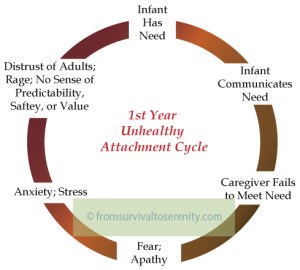
Let’s take a look at two diagrams:

unhealthy 1

healthy 2

Attachment starts with need. As infants we have needs that our primary caregiver tries to meet. When they are met we are content. When they are consistently met we start to form trust and attachment. But our needs aren’t always met, and when they aren’t it results in fear, anxiety and stress.

With healthy attachment we learn that our needs not being met doesn’t indicate a lack of care or love. Further, we learn that not all needs will be met, and that’s alright. In unhealthy attachment however, not having our needs met continues to results in stress, anxiety and fear.

Neglecting your child is the fastest path to damaging their ability to make healthy attachments. If their needs are never met, they will not be able to develop trust and care. But attachment theory says it is boundaries that allow a child to develop attachment in a healthy way.

At the other end of the spectrum is spoiling them. If they are used to having their needs always met (or met at an unrealistic level) it can create a sense of expectation and entitlement, also harming their ability to form healthy attachments.

As parents we often want to provide everything for our children. But as this illustrates, when we do too much we risk doing more harm than good. We need to set boundaries, and allow our children to develop independence in order for them to develop in a healthy fashion.

Healthy Attachment

In attachment theory, the two most damaging traits for forming healthy attachments are anxiety and avoidance.

attachment-diagram1

Anxiety is often seen as the fear of the unknown. It is a fear of what “could” happen, and is largely an overreaction of the fear instinct. Anxious people are often expecting the worst case scenario to happen in any situation. Avoidance is keeping away or withdrawing from something, often due to a fear of a perceived negative result.

Both traits are very damaging to relationships. Relationships are based on trust and security, which requires communication. Avoidance leads to poor communication and an inability to address the regular issues that a relationship will face. Anxiety is also very destructive to relationships. For a great summary on how it can impact love check this article. But at a high level anxiety can erode empathy and damage trust.

Attachment Styles

Attachment Theory has identified a number of attachment styles related to people’s levels of anxiety and avoidance. I’ve seen different versions of the styles, but the following chart outlines a few with some of their characteristics:

attachment-types

Looking at this chart, it’s obvious that secure attachment is the “healthy” form of attachment. As noted however, we don’t all develop in a healthy fashion.

Avoidant Attachment is the most common unhealthy attachment. People with high levels of avoidance tend to have issues with intimacy in close relationships, and do not invest themselves emotionally. Interestingly, they often crave closeness and intimacy, but they need to be in control. Once people start to get too close they start to shut them out.

This often leads to a feeling of instability in relationships. The avoidant person wants closeness, but it makes them feel overwhelmed leading them to withdraw. When they feel more secure they will look for closeness again, but they look for it on their terms.

Ambivalent Attachment is less common. Here people are reluctant to get close to others due to fear that their partner doesn’t feel the same way about them.

It’s important to note that these styles and their tendencies are not absolutes. We all have some level of avoidance and anxiety, and your levels determines where you fall on these spectrums. For example, I would like to think that I have a fairly secure attachment style (wishful thinking perhaps). But while I generally have low anxiety levels, I know I lean slightly towards avoidance when it comes to dealing with conflict.

You may be a certain way, and behavioral psychologists believe that your “go to” style is largely a result of your early years. So if you think you’re a bit messed up and you want to blame your parents? Yeah, it probably is actually their fault.

But one important thing is it is possible to change the mindsets that lead to unhealthy attachment and move more towards secure forms of attachment. Your attachment style CAN change. So even if you do want to blame mommy and daddy for who you are today, it’s up to you who you want to be tomorrow.

Building Empathy

When you look at attachment one of the things that stands out to me is in both healthy and unhealthy emotional attachment, it’s all about you and your needs. What about other people?

Somewhere along the way we have to learn that we aren’t the only ones who matter. We need to learn that the world doesn’t revolve around us. In order to have successful relationships, the needs of the other person also need to matter to us. A world of “me” needs to become a world of “we”. Learning to value the needs of others and place them at a level at or near our own is one of the characteristics of empathy.

When we aren’t being empathetic or we are focusing primarily on ourselves and our needs, we are exhibiting narcissistic behavior.

Lack of empathy is the most notable characteristic of narcissism. Additional characteristics include a sense of entitlement, a focus on how things appear to other people (things need to be perfect) and a need for admiration or external validation.

For narcissists, relationships are vehicles for them and their needs. They will put effort into the relationship as long as their own needs are met, but it is never an equal exchange, and it is never done out of genuine care and concern for the other person.

Noted researcher (and sufferer) on Narcissism Sam Vaknin writes:

I am aware of the fact that others have emotions, needs, preferences, and priorities – but I simply can’t seem to “get it into my mind.” There is an invisible partition behind which I watch the rest of Mankind and through which nothing that is human can permeate.

To me, all people are cardboard cut-outs, sophisticated motor contraptions, ersatz and robotic. I know how I should feel because I am well-read–but I cannot seem to bring myself to emote and to sympathize.

Over the years, I have deciphered the code. I have learned to imitate and emulate expertly the more common affect and expressions of one’s inner landscape. But this veneer is easily breached when I am frustrated or humiliated: the mask slips and the real Me is out: a predator on the prowl.

This is an extreme example. The true narcissistic personality type is rare (occurring in approx 6% of the population). In reality we all have some elements of narcissism within us, and when times are tough it’s common for people to just “look out for themselves”. In periods of stress or personal problems our ability to be empathetic often decreases. But the ability to be empathetic towards our partners on a consistent basis (even when times are tough) is the key characteristic that determines the quality of our interpersonal relationships.

allmine

Empathy is the most important characteristic of any close relationship, and particularly in our romantic relationships. Unfortunately we don’t all learn this, or perhaps it’s better to say we learn it to varying degrees. But no matter what your level of empathy is, it can be improved.

Focusing on Others

In relationships, we all want to be valued. We all want to be loved, desired, and appreciated for who we are. If we want that, it’s safe to assume our partner wants and needs that too.

Is thinking about yourself being selfish? No, not at all. We need to think about ourselves and take care of ourselves. However thinking of yourself to the exclusion of others is a problem.

For our relationships to survive we need to value our partners, and their needs must be important to us. For our relationships to thrive, we need to place our partners needs at the same level as ours (or at least very close). We need to understand that love means compromise. Things won’t always be the way we want, and they won’t always be the way our spouse wants. We need to be willing to work together towards a common good that benefits both.

In nature, when two organisms work together for common benefit it is referred to as a symbiotic relationship. When the benefits are very one sided, it is referred to as a parasitic relationship.

If you are unhappy in your relationship, ask yourself why. Does your relationship add value to your life? Are your needs being met? Now ask yourself if you are adding value to your partners life. Are their needs being met?

All relationships go through ups and downs. But overall your relationship should be something that adds value to both your life and that of your partner.

If it isn’t, take a look at how you approach the relationship. Empathy can be worked on and developed. Remember, it’s not about your needs. It’s about finding the way to best meet the needs of the couple, so that both are feeling valued and fulfilled. Working on improving and sustaining empathy is one of the best ways to improve your relationship and have a happier future.

Putting in Effort

effort-invest-time-like-ant

One of the myths I frequently see about relationships is that they shouldn’t require effort. There’s a line of thinking out there that if the relationship is mean to be then things will just work out. And if things don’t work out? Well then it was never true love.

It doesn’t seem to matter that absolutely every psychologist/counselor/relationship expert has debunked that myth; the line of thinking still seems to persist.

For anyone who already has the mindset that love should not require effort, I realize that I won’t sway you. But for anyone who knows at least on some level that relationships require effort, hopefully this will be a gentle reminder.

Talent vs. Effort

In all aspects of life, everyone has some degree of talent. But we also have within us the capacity to learn. No matter what your level of talent is, you can develop it and improve on it. We all know this.

Did we come into the world walking, and talking? No, those are clearly normal parts of cognitive development.

What about more complex things, like math? In math there’s a reason that we start with addition and subtraction and them move onto more complex concepts. They are foundational concepts.

In our school years, we all have certain subjects that come more naturally to us than others. These are subjects that we have some sort of aptitude, or talent for. But we can still learn the others, and the key to developing any skill is effort.

The Genetic Lottery

I don’t think anyone will disagree that effort is important, but there is a belief that effort will only get you so far. This is something that becomes clearly apparent in the world of sports. If you look at professional or Olympic athletes, these are largely people that won the genetic lottery. Depending on the sport, athletes have some combination of size, speed and agility that can be breathtaking. Often when you look at athletes, it seems clear that they have a natural talent for their chosen sport. And that’s true.

One thing that is less readily apparent is just how much effort they have expended to get to the level they are at. At the top levels, EVERYONE has natural talent. Even at that level, the key differentiator between the good and the great is still effort.

There are countless cautionary tales in sports of people who have all the talent in the world, but they don’t work hard, or they have a bad attitude and a sense of entitlement. When players believe that talent is enough, they generally don’t last long. The truly great athletes are the ones who combine a natural aptitude with incredible work ethic. Effort is the key.

Effort without talent is a depressing situation. But talent without effort is a tragedy.
Mike Ditka

Self-Fulfilling Prophecies

Some developmental psychologists believe that talent is actually somewhat of a self-fulfilling prophecy. Having an aptitude for something causes us to enjoy it more (everyone likes seeing success). That enjoyment in turn causes us to put in more effort, developing the “talent” even further.

On the converse, a lack of immediate success can result in frustration and a reduction in effort. And this reduction in effort reinforces the lack of success.

The real key is effort, and a belief in the ability to improve. That’s not to say anyone can do anything. Even if I started at a young age, I likely would never have been an Olympic athlete. But no matter what I choose to try, if I put in consistent effort I will be better at it tomorrow then I am today.

Effort in Relationships

If we can accept that effort can result in improvements, then I have to ask why we would believe that relationships should be any different? Doesn’t it stand to reason that as good or bad as a relationship is, it can always improve? And that improvement is dependent on effort?

Think back to the early days of your relationship. Maybe one person was the primary pursuer, but a relationship requires both people to put in effort. That effort likely involved making time for each other, and spending it together. And during that time as the relationship developed, probably both people did “the little things” to show the other that they cared, and were interested in continuing to grow the relationship. All of those “little things” are effort. They are showing interest in both the relationship and the other person.

Long term relationships are hard. That early level of effort isn’t sustainable. And unfortunately, all too often “life” takes over people start putting in a minimal amount of effort on the relationship.

I think part of this is human nature. When things get difficult, it can seem like it’s “not worth the effort”. But the irony is, in relationships it is likely the lack of effort that was a major contributor to things getting hard in the first place.

Practice Makes Perfect

Not all relationships are meant to be, and sometimes it definitely is better for people to go their separate ways. But for anyone who believes that if it falls apart then it “wasn’t meant to be”, I ask you to go back to the Mike Ditka quote from above.

“Effort without talent is a depressing situation. But talent without effort is a tragedy.” Your “talent” as a couple is whatever brought you together in the first place. You have at least some degree of talent, or you wouldn’t be together. The question is, what sort of effort do you put in to continue to nurture that talent?

effort

Effort needs to be sustained, and continuous. It’s not something you do once in a while, or just when you feel like it. When people say “it just wasn’t meant to be”, they may be right. But I think that line is often simply a rationalization for a lack of effort.

One mistake people make when they hear “effort” is they think “work”. Work has a negative connotation to it. In some ways they are the same thing, and the main differentiator is your mental approach to it. If you see potential value, it’s effort. If you don’t, it’s work.

Anything of value in life is worth fighting for. Personally, I would rather make some mistakes fighting for something I believe in than lose something of value due to simple apathy.

In relationships, effort should be the most important thing. No matter how things are going, effort shows that someone cares. So if you want to see growth in your relationship focus on effort and not just results. As long as the effort is there, results will come in time.

Building Closeness and Intimacy

closeness

For anyone who has read my site, you know I believe very strongly in love and in long term relationships. I also believe they naturally go through ups and downs, but maintaining and nurturing love is a choice.

You choose how you treat your partner. How much time you spend together, how you spend that time together, how much you value them and appreciate them. You choose how much effort you put into your relationship, and how much you are willing to accept them for who they are.

This idea of choice is supported by every relationship expert I have read or heard about. They all talk about how maintaining long term love is a mindset, an outlook, and a choice.

But what about falling in love? Many people think of love and romance as this magical thing, based on feeling and emotion. And it is. But is falling in love a choice too?

Creating Closeness

A buddy of mine recently pointed me to a fascinating study by Dr. Arthur Aron, called The Experimental Generation of Interpersonal Closeness. I’ll admit the name leaves a bit to be desired, but the study itself is pretty interesting. The study was intended to understand whether or not closeness or intimacy could be created. For the experiment he defined intimacy as “a process in which each feels his or her innermost self validated, understood and cared for by the other.”

His experiment was quite simple. Members of the opposite gender were paired up and given a number of self-disclosure and relationship building tasks of increasing intensity to carry out over a 1 ½ hr period. They were then asked questions measuring the degree of closeness they felt was built through the procedure.

I believe there are variations of the questions, but you can find a sample of them here

He found that:

One key pattern associated with the development of a close relationship among peers is sustained, escalating, reciprocal, personalistic self-disclosure

One interesting part of the study was that he found that it didn’t really matter if you agreed with each other’s ideas and opinions. That didn’t seem to impact the building of intimacy. The important part was the act of self-disclosure.

Falling in Love

There are no real surprises in Dr. Arons study. People often say love “just happens”, but that’s completely untrue. We all know that part of falling in love is getting to know the other person. That’s the time of discovery, where things are new and exciting.

Even in cases where “your eyes met across the room and you knew it was love”, there was still some sort of a process. Your eyes met because there was mutual physical attraction. That may be a good start, but it’s simply the starting point. Even if you moved straight from eyes meeting to sex, that doesn’t make it a relationship (sorry Hollywood and romance novels, it’s true). There will always be a period where you get to know each other, and this period involves self-disclosure.

Does that mean you can make someone fall in love with you? No. Does it mean you can make yourself fall in love with someone simply by learning about them? Well, kind of.

Getting to know someone is how you build intimacy, but it doesn’t always result in love. Some relationships fail quickly, while others start as friendships and develop into love over an extended period of time (potentially years). There is no single formula that will result in success.

Personally, I suspect that when friendships turn into love there was always a degree of attraction for at least one of the members. The whole idea of the dreaded “friend zone” is where someone has feelings for another person that aren’t returned. They often stick around, keeping themselves in the other person’s life with the hopes that maybe it will develop into something more. This happens all the time and is a common theme in love stories (both fictional and real).

In blogs and comments sections there are MANY people out there who are convinced that they are “the one” for someone else. People talk about how much they do for the other person and how they are always there for them, but their love is not returned.

So why do some relationships bloom into love, while others don’t? This depends on the level of intimacy and closeness. As you learn more about another person, you allow yourself to be vulnerable with them, and you become more comfortable sharing information about yourself. We all have emotional walls around ourselves, and when we have let someone breach that wall? I believe that’s when love develops.

Intimacy in Long Term Relationships

If closeness and intimacy is built by sharing and self-disclosure, what exactly does this mean to long term relationships? There seems to be a perception that long term relationships are incompatible with love and romance, and there is some truth to that.

Intimacy or closeness develops through reciprocal self-disclosure, and that period is exciting as it is new and you are learning. But eventually you have learned a lot about each other. Intimacy is built, and the relationship is established. Now how do you maintain it? How do you prevent it from breaking down over time?

That is the part many people struggle with over time. They have finally achieved what they believe they were looking for. They are in a stable relationship, and things are “safe”. A problem is that it’s easy to become comfortable, and it’s easy for both partners to stop doing the little things that you did during the courting stage. Another thing about safe and comfortable is that it can become routine and boring.

Plus over time you start to realize that your partner is just a regular person, who has flaws like any other. Conflict will happen, and depending on how you deal with it conflict can erode the feelings of closeness.

In many relationships, one day you realize the sense of intimacy that brought you together is gone (or at least eroded). You figure maybe it’s a phase that will pass. But it doesn’t, so you find yourselves in a relationship where you have become largely roommates. And being roommates sucks.

Can Guys and Girls Just be Friends – Revisited

One of my most popular posts (in terms of views, comments and likes) is Can Guys and Girls Just be Friends?

In answer to the titular question, my belief is both yes and no. I suppose I’m waffling here, but it really depends on the nature of your interactions and what you are telling the other person.

One reader shared a story with me about her affair, and how it started innocently enough. She was married, and started corresponding with someone through social media. Over time their messages became more intense, and she realized she had fallen in love with this other guy.

It’s easy to see how this happens. I’m not sure about her case, but if the existing relationship is in a bit of a rut and you meet someone new, even if it starts as “just friends”, as you open up to each other the simple nature of intimacy makes it so you are at risk of having it develop into something more.

I recently read an article where someone tried the Dr. Aron questions, and found that they worked for building intimacy. In the article the person states:

The questions reminded me of the infamous boiling frog experiment in which the frog doesn’t feel the water getting hotter until it’s too late. With us, because the level of vulnerability increased gradually, I didn’t notice we had entered intimate territory until we were already there.

When this experiment is done over a period of an hour or so, I can understand that. But when it comes to affairs, I find that very difficult to believe.

People aren’t stupid, they KNOW when the landscape has shifted from feelings of friendship into feelings that might be something more. People can tell when they are becoming excited to hear from the other person, and when they are happy to see them. They know when they are thinking about the other person more than they should be. They know when the relationship has crossed lines that take it beyond friendship and into something more.

They just don’t care. It feels good and is exciting, so they choose to continue the relationship anyways. They may deny that it’s an affair, but the affair has started long before sex, or even the first kiss.

It IS possible to love two people at once. Putting yourself in the position for that love to develop is a choice. Let’s face it, if you are putting yourself in that position then chances are good your relationship is in a troubled spot. If it’s healthy then you probably aren’t taking a lot of time to get to intimately know members of the opposite sex. And if you do, and those feelings start to arise? At that point continuing to see that person after it has developed into love is also a choice.

Back to the idea of guys and girls just being friends, it rarely works (not saying never here, but very rarely). For it to work you really need to put boundaries on the types of interactions you have, and the level of sharing that occurs – especially if you are already in a relationship.

Intimacy and Rebuilding

Alright, intimacy is built through emotionally opening up and sharing with the other person. But this is something that happens as you are learning each other, and once you already know each other well you can’t really “build” intimacy in the same way. Over time relationships can get into a rut and intimacy can break down. So what do you do?

Well, Dr. Aron’s findings on intimacy have some bearing on how you get out of a rut. Think back to his experiment. Did it involve two people sitting in a room watching TV together? Umm, no. How about two people going about individual tasks independently of each other. Again, no.

It involved two people INTERACTING, opening up to each other and allowing themselves to be vulnerable around each other. So why would we expect rebuilding a relationship to work any differently? Why do people wait for “feelings to come back”, or just start living individual lives? How in the world is that ever supposed to help a relationship?

To rebuild a relationship there are things you can do, but you need to DO them. You need to take action, and be conscious about it. You need to recreate the conditions where you fell in love.

BuildingARelationship

Relationship experts agree that you need to actively rebuild. You need to spend time together, make each other priorities in your lives and relearn each other. Even when you have been with someone for years, there is always more you can learn. Beyond learning each other you can also build experiences. So do things together. Go on dates where you have to interact. Maybe find an activity you are both interested in and do it together.

Dr. John Gottman talks about rebuilding your love maps, and he has a series of exercises and questions for couples to do together similar to Dr. Arons findings. In her book Hold Me Tight, Dr. Sue Johnson talks about something similar. She talks about sharing something deep and intimate with someone you love. Different experts suggests different (though similar) things. The main commonality is that rebuilding needs to be intentional, and it needs to be active.

Letting Go of the Past

Rebuilding a relationship isn’t easy. Rebuilding intimacy and closeness means allowing yourself to be vulnerable again, and allowing yourself to be hurt. If your relationship is troubled then that can be difficult. Chances are you have been hurt, so you have emotional walls build up to protect yourself from being hurt again.

But you can’t hold back. You have to let the walls come down and let the other person back in. Think of the study, it is allowing yourself to be vulnerable that allows closeness and intimacy to build (or in this case, rebuild). So if you continue to build up walls, all you are doing is preventing closeness from returning. Effectively you are sabotaging your chances of rebuilding.

If you are holding back, you need to ask yourself why. What are you holding back for? Do you truly want to rebuild the relationship? If so you need to let go.

It’s like the team building exercises on trust, when one person leans back and the other catches them. If you truly want to rebuild a relationship, you need to be willing to take that step and trust your partner. Be willing to open up your heart to them. Be willing to lean back and let them catch you. Build closeness and intimacy into your life, and never let it go.

Power and Control

Man-woman-arm-wrestling

Power and Control. Two things you don’t ever want to think about in a relationship, but at the same time they are things that affect EVERY relationship.

Relationships are full of decisions, big and small. Where you live, how you save/spend money, who takes care of what chores, what car you drive, how you parent, how you spend your leisure time, how often you visit family. Even something as simple as what shows you watch. The list is pretty much endless.

Some decisions are individual ones, as they only affect one person. But when you are in a relationship, a surprising number of decisions actually affect both people in some way shape of form. That’s the thing about relationships; you are no longer just a “me”. You are part of a “we” and you often have to take your partner into consideration with the choices you make.

Add to this the fact that people are different. Chances are good you have some similarities with your partner, often in values and common interests. But for every similarity there are a number of ways that you are probably very different.

These differences allow us to complement and enhance one another, but when it comes time for decision making they can be sources of conflict. Big or small, conflict can happen in all decisions.

The Balance of Power

It’s safe to say that all relationships have some sort of balance of power. If you don’t like the word “power”, replace it with influence – but it’s essentially the same thing. In a perfect world it is an equal split, where both parties in the relationship have equal say in all decisions, and they contribute equally to the relationship. Reality is not that simple though, and an equal split only happens in a mythical magical world where unicorns roam the land (and perhaps not even there).

“Equal” doesn’t actually exist. And with all the areas that people can influence a relationship how would you even measure it? Some decisions have more impact than others, and others involve more efforts. But “equal” shouldn’t actually matter. Some people are more dominant and others are more passive. Some naturally take on a leadership role, and other people are happy to follow. In most relationships people find a rhythm, or a balance that works for them. That balance may be 50/50, 55/45, 60/40 or even 80/20. I can’t see how the last one would work, but as long as both parties feel they are valued, being heard, and their needs are being met it shouldn’t matter.

As a side note, in most cases I believe people actually overvalue their own contributions to a relationship in relation to their partners. If you think about it, you know about all the things that you do. Chances are, there are a number of things you do that your partner doesn’t even notice. Well if you do things they don’t notice, there are probably things they do that you don’t notice. This dynamic creates a skewed view of who is actually contributing what to a relationship. Anyhow, back to the topic at hand…

Power Struggles

If power is relatively balanced in a relationship, you probably don’t even think about it. But even in the most balanced relationships, there will be times that your needs and wants will conflict, and choices have to be made. How a couple handles these times can be very important to the relationships overall success.

Studies show that needing to be in control, or to have things “your way” is one of the fastest routes to unhappiness. No one gets things their way all the time, and it would be extremely unhealthy if they did. Relationships involve two people, and both need to feel valued. So sometimes decisions will go the way you want, and other times they won’t. The question becomes, how do you respond when things don’t go your way?

Do you accept it? Do you get angry? Do you sulk? Do you keep score, and figure your partner got their way this time, so next time it’s your turn?

Who is Right?

Maybe you think that things should be your way, because your way is usually right, or better. First off, that line of thinking is broken. In most circumstances there isn’t a “right way”. There are usually multiple approaches to accomplish the same thing and each persons ideas and contributions have at least some merit.

But just for the sake of argument, let’s assume that your ideas are consistently better than your partners. Does that mean things should be the way you want? I would argue no.

I’m reminded of my grandmother. Growing up, visiting grandma was always a highlight, and one of the things that we did was play cards. This was my introduction to gambling, as we played for money. Of course, grandma provided the money so there was never any risk to me. She would win some, and I would win some. But at the end of the day I always came home with a bit of change in my pocket.

As I got older I realized that as I was learning, grandma always held back. Cards are somewhat random, but she let me win, and let me build confidence in myself and my abilities. As my abilities grew, she played harder, until eventually we were on a fairly even level.

How well would I have learned if she didn’t hold back? If she repeatedly beat me, would I have ever learned the games? Would I have enjoyed them? Heck, would I have liked HER very much?

I’ll admit, cards are different from life. But a focus on things being “your way” immediately makes thing adversarial. It means someone else isn’t getting “their way”. As grandma taught me, even if I know I’m right, the relationship is more important than getting my way. Pick your battles. It’s important to stand up for what you believe is right, but often there is no right and wrong. Relationships aren’t just about one person. They require compromise, and letting someone else have their way is an important component of keeping the relationship happy.

Control

Are you a parent? If so, how do you get your child to do the things you want? If you aren’t a parent, how did your parents get you to do what they wanted?

A common parenting tactic is praise/reward and punishment. Praise reinforces positive behavior (the behavior we want), and punishment is intended to be a deterrent for negative behavior. Punishment can be active (scolding, spanking, time outs etc) or passive (taking something away, not talking to them, etc).

Praise and punishment are needed with children, because children are inherently selfish. They are initially unable to see the world in any way other than how it impacts them. Empathy is learned.
When dealing with your partner however, using punishment to address relationship issues is a VERY bad idea.

Dealing with Anger

Anger is natural, as we all get angry sometimes. However anger is one of the most destructive forces in a relationship, and it requires a healthy outlet. Explosive anger can create an atmosphere of fear. Withholding anger can be even worse as it can result in passive aggressive behavior.

Passive aggression is when instead of dealing with anger through discussion or confrontation, it is dealt with in a more subversive fashion. Often anger is expressed through body language, withdrawal, silence, or withholding affection.

It is understandable to not want to be around the other person when angry. But when this happens for extended periods or becomes a pattern of behavior then this about punishment and control. Passive aggression is a form or retaliation, it is something that is done to hurt or get back at someone.
Interestingly, people who exhibit passive aggressive behavior often don’t fully realize that they are doing it. For them it is simply their method of coping, and is often a result of how they were taught to deal with anger as a child.

A few notes on passive aggressive behavior:

  • It is one of the highest predictors of divorce
  • It is often a symptom of poor communication
  • It leads to low levels of intimacy in a marriage
  • It is the most common form of emotional abuse

When it comes to anger, here are a few things to think of:

Anger

the-more-anger-you-hold

Say What you Mean

There are always elements of power in a relationship. But relationships should never be about getting what you want, and struggles over power and control have no place in a relationship.

A relationship should be a place of emotional safety. It is supposed to be an environment where you are there to support each other, and each others needs. Your partners needs should be as important as your own, and shouldn’t be conditional on whether or not they have met your needs first.

If your relationship is characterized by anger (overt or passive aggression), or struggles for control, then it is not a healthy environment. But it can change. In almost all cases, this is a result of poor communication and coping skills, which likely developed prior to the relationship.

It is important to learn to communicate in a healthy fashion.  Doing so will not only increase the chances of success in your relationship, but it will also help reduce tension and build intimacy.  Beyond the ways that it will improve your relationship, it’s important to your own health.  Anger is natural, but it helps nothing.

Anger is an acid that does more harm to the vessel in which it is stored than to anything on which it is poured – Mark Twain

Life Without Sex – Part 2

couple-in-bed-arguing

In a relationship, sex has many benefits and is an activity that enhances the connection between a couple. Sex drive differences can change sex from a wonderful part of a relationship to a source of conflict, and in extreme cases couples fall into a sexless relationship. In part 1 I discuss this idea of a sexless relationship (having sex less than 10 times a years is considered a sexless relationship), some of the causes, dangers, and what you can do if you are in a sexless relationship and you are the one who still wants sex.

People in this situation can try to remain supportive and understanding, while showing their partner that they still love them. But ultimately, there’s not a lot they can do to change the dynamic.

Today I want to want to look at this from the side of the person who is either not wanting, or is having issues with the sexual side of a relationship.

Different Reasons

Sex is a good thing in a relationship. It builds connection between the couple, and it gives pleasure to both people. But it requires both partners to be interested and engaged. For the person who is less interested in sex, the question becomes why? I see four main reasons:

  1. They are not sure they want the relationship anymore. Sex requires openness and connection. If someone has checked out on the relationship, then it stands to reason that they would find sex difficult with their partner. When this happens, this person really needs to make a decision to either commit to the relationship or to get out. Staying in the relationship with a breakdown of intimacy is not fair to anyone
  2. They see sex as something to be given or taken away. In some relationships people are interested in control and power, and sex can be used as a weapon (and withheld when they are unhappy). A relationship requires empathy and sharing, and these sorts of attitudes are extremely unhealthy. I plan on writing about power and control in the future, but anyone who is interested in power and control is liable to end up bitter, angry and alone if they can’t change their approach to relationships
  3. They have an immature view of love. If someone sees love as something that should “just happen” rather than something that they need to build into their relationship, then they are bound to end up disappointed by what real sustainable love looks like. This can cause a breakdown of desire and intimacy, making sex difficult
  4. They have had a breakdown of desire. Sometimes this just happens in long term relationships. Usually the person wishes things were different, but they are having a hard time “feeling” for their partner. Desire is related to hormones, so there can be any number of causes behind this (stress, anxiety, depression, and menopause among them)

My interest is for the people in the latter two scenarios, as these are people who actually do care about the relationship and their partner. In these cases the person genuinely wishes things were different, but they are having a hard time changing the way they feel. I’ll refer to this as simply having a lower drive. For people in the first two scenarios, well, chances are you should get out of the relationship anyhow.

Tips for the Lower Drive Person

For the lower drive person, this is a difficult situation. Hopefully the higher drive person is being considerate and understanding, but ultimately the lower drive person is the one who needs to find a way to become lovers again.

First I would like to debunk the myth that sex “isn’t truly a need”. From an individual standpoint this may be true. Unlike food and water, you won’t die without it. But your relationship might. So from the perspective of a relationship yes, regular sex is needed in order maintain and nurture a relationship. What “regular” means is up for interpretation, and that is something that is different from couple to couple (and even for a single couple it will change over the life of the relationship). The absence of sex will put tremendous strain on the relationship, and put it at risk of failure.

It is important to understand it’s not actually the sex that matters (which is why occasional “duty sex” does nothing to improve the bond between the couple). Instead it is the closeness and intimacy that sex is symbolic of. THAT is the part that is needed in order for a relationship to thrive. When intimacy is there sex should come naturally as a result of it. This is why it is important to focus on the relationship itself.

Another thing to remember is that your partner has no other outlets. I’m a firm believer that people are responsible for their own happiness (in the choices they make and the attitude that they bring to their own situation). Sexuality is one of the few places that people are dependent on someone else for fulfillment. So if it’s missing in a relationship, then even if the rest of the relationship is in a good spot this problem will start to affect the rest of the relationship.

The best thing you can do is try and identify any problems in the relationship that may be causing issues with desire. If you’re working on the relationship and desire still isn’t coming back, there may be medical reasons (such as hypoactive sexual desire disorder), however these are extreme cases and only affect a small percentage of the population. Chances are there is something that needs to be addressed in the relationship, and the best way to deal with it is through couples counseling focused on the issue with sexuality.

One question to ask yourself is “should someone have to have sex when they don’t want to”? Obviously the answer is no, they shouldn’t. In fact having sex because someone feels they are supposed to (duty sex) can widen the gap of emotional intimacy instead of helping close it.

Here is the dilemma though:

If someone consistently doesn’t want sex and their partner does then it puts their relationship at risk. If their partner wants it all the time, then this is an issue with the partner not being considerate about the person’s needs. But when the couple has drifted into a sexless marriage, there’s a problem. For the benefit of the relationship it’s up to the couple to find some sort of happy middle ground. It will likely involve an adjustment of expectations for both parties, but it also means the person with the lower drive will have to find a way to be sexual again.

They shouldn’t have to have sex when they don’t want to. But instead of looking at this as doing something they don’t want to, it may be better to try to find a way to nurture their sexual side so that they start to want to be sexual with their partner again.

Making Sex a Priority

Sex is important to a relationship and has many benefits to both the individual and the couple. That is a fact. No one should “have to” have sex when they don’t want to. Also fact.

So the question becomes, if someone consistently isn’t interested in sex and it is putting strain on the relationship, how do they become interested again? How can they find a balance where both members of the relationship are happy? One recommendation is to make sex a focus and a priority in the relationship.

One common misconception is that someone has to be in the mood in order to be sexual. Difficulties getting in the mood are extremely common, and happen to pretty much everyone. With busy lives waiting till you are “in the mood” could be a long wait. And what happens if you are in the mood but your partner isn’t? The chances of both being in the mood at the same time is low. Those who wait for “the mood”, well, generally they find themselves in the sexless relationship.

Instead of waiting to be in the mood for sex, many relationship experts suggest you try to make time for sex with the hope that allowing yourself to be sexual will help put you in the mood (kind of a chicken or the egg approach). In this approach, the lower drive person is just as responsible for getting themselves in the mood as the higher drive person (perhaps more so).

Schedule Sex

To do this, you need to schedule sex. You may do this formally as a couple, or at the start the lower drive person may do it on their own (for example telling themselves that “tonight” is a night for sex). If the thought of doing this doesn’t cause additional stress, then instead it’s possible to mentally prep for sex. Think about sex, read a sexy story (either alone or together), whatever works to try and get yourself into the mood. And then be sexual with your partner.

massage

The key is focusing on sexuality, touch (possibly massage or erotic massage), and building connection instead of the act of sex. In fact, if you don’t or even if you find you aren’t able to engage in penetrative sex, that’s fine. It’s more about taking time to be sexual together and rebuilding a sense of safety with physical intimacy with your partner.

Don’t worry about “shutting your partner down” before penetrative sex or orgasm. If your partner sees that you are putting effort into being lovers again, they will likely be very happy and supportive. When you do have sex it may starts as more of a physical act, but over time it should transition into a more intimate one.

Whether you are scheduling this formally or planning it on your own, come up with a desired frequency and schedule it. Once a week? Once every 2 weeks? Do what works for you and adjust it over time. It’s about building habits, and it may seem awkward at first but over time gets internalized. Be willing to accept that you don’t always have to meet the schedule, but the vast majority of the time you should try to.

Mindset is Key

Depending on how badly the emotional connection has broken down, this can be an extremely difficult thing to do. I recognize this isn’t like watching a movie you aren’t really interested. This is your body, and you are sharing it with someone else.

Because of this, mindset is extremely important. If you view this as an obligation you will get resentful and that will make things worse. But if you accept it is an important part of a relationship, then you will see this as an investment in the long term health and happiness of your relationship.

Heading to the Gym

A great analogy for this is going to the gym with a partner. Physical health is a positive thing (there are really no drawbacks to trying to improve your level of physical fitness). The benefits range from physical health to self-esteem to mental health. But committing to physical fitness takes a commitment of time and effort – it doesn’t just happen.

If you haven’t done anything in a long time though, making a commitment to physical fitness is difficult, and at the beginning it seems like work. You know there are benefits, but the way to achieve those benefits isn’t easy.

In order for the workouts to be effective though, you need to come up with a regular schedule and stick to it. Working out one day, and then not doing anything again for a month or even a few weeks doesn’t really help much. And in fact, if you don’t make it regular you may find it’s easy to make excuses skip a workout. Unfortunately when you miss one workout, it becomes a lot easier to miss another.

If you stick to your routine an interesting thing happens though. After a while you will find you start to enjoy it. And not just that, but if you have to skip a workout you’ll find that you miss it and want to make it up. Instead of “work”, it has become a regular part of your life.

Taking this analogy one step further, even for the people who are regulars at the gym there are days that you just don’t want to go. Maybe you didn’t sleep well last night, or maybe you have a cold. Having a partner who is expecting you to be there can sometimes act as the motivation to get out and do your workout anyhow. Sometimes you will go and you really won’t be into it, but other times even when you force yourself to go you will find that your body responds to being there and you have a great workout anyhow.

motivation

Built to Last

Relationships run into problems, and sexual issues are probably the most difficult ones for a relationship to deal with. But in a long term relationship it is important for the couple to maintain sexuality and being lovers.

It’s important to be open with your partner about what is going on, and recognize this as a problem for the relationship, and not just for the individual. If your partner truly cares about the long term health of the relationship, they will show patience and understanding. But it’s also important to remember that your partner has needs in the relationship too, and letting sexual issues go unresolved will threaten the health of the relationship.

When emotional connection has broken down, it’s the responsibility of both parties to do their part in actively rebuilding it. And part of that rebuilding involves making sexuality and sex a regular part of the relationship.

Scheduling and prioritizing sex may not seem spontaneous or romantic, but it doesn’t have to mean that it’s not intimate. It allows you an opportunity to focus on being intimate together. And you may find that once you prioritize it, you remember what you have been missing.

couple-hands

Life Without Sex – Part 1

Life without sex

When I look at the stats page for the site, the most commonly viewed posts are the ones on Happiness and Sex. This makes a lot of sense as there is a correlation between the two. In long term relationships a couples sex life is generally a barometer of the relationships overall health.

Sex is a form of intimacy and is a manifestation of closeness and connection in a relationship. If your relationship is in a good place, then you have the sense of closeness and connection that leads to sex. And if you have that closeness you are generally pretty happy. So although it may not be entirely causal, more sex equals increased relationship satisfaction (note, that was causal – as in “being the cause of”, and not casual. If you’re interested in learning about casual sex you came to the wrong place).

There are all sorts of taboos about sex, but as a component of a healthy relationship sex is a great thing. Sex in a relationship provides a number of advantages physically and emotionally, for both the individual and the couple. So why is it such a difficult topic for couples, and why can it become a source of so much conflict?

In my previous series of posts on sex I talked about how sex can be a source of conflict due to differing sex drives; and that this is both natural and unavoidable. I talked about ways to deal with these differences, and how open communication in the relationship is the best approach to finding a happy middle ground, ensuring these differences allow sex to continue to enhance a relationship instead of damaging it.

I don’t want to rehash a topic that I’ve addressed already, but I recently came across a concept that made me want to look at this once again. That topic is a “Sexless Marriage”.

Sexless Marriage

A Sexless Marriage is defined as a marriage (or any long term relationship) where the couple has sex 10 or less times per year. According to stats, 15-20% of couples find themselves in this state.

Differences in sex drive are normal, requiring compassion and understanding on the part of both members of the couple. A sexless marriage is an extreme though, and is generally a sign of more than just differing sex drives.

Because relationships have ups and downs which can impact feelings of closeness, it’s not uncommon for “sexual droughts” to happen occasionally in long term relationships. In fact it is fairly common occurrence in the first few years after children are born. When it lasts for extended periods of time however, it can become a serious issue and threaten the relationship.

Humans are sexual creatures, and there are many advantages to sex in a relationship. In a healthy relationship sex is a physical manifestation of the love the couple shares. It is a way of showing closeness and desire, and is a form of communication and sharing. It is a special activity that the couple shares with each other and no one else, and it is not just a physical act, but also an emotional and symbolic act.

The absence of sex (or sex being reduced to duty sex) is symbolic in a different way. When this happens it comes to symbolize a lack of desire, closeness, and a sense that the other persons needs don’t matter. But perhaps most significantly, it comes to symbolize a lack of love.

This is a pretty sensitive topic, so I will try to tread lightly here. To be clear, when I talk about sex here, I’m talking about sex as an extension of intimacy (with the idea that the absence of sex also means there is an absence of intimacy). When this happens it’s safe to say that a sexless relationship is bad news, and not good for anyone.

The frequency with which a couple has sex really isn’t that important (as long as it’s not an issue for the couple), and most couples find a balance that works for them. But sex still needs to be a regular part of the relationship. According to the definition of a sexless relationship, you need it at least once a month for “regular maintenance”. Less than that and I find it hard to believe it’s not an issue for the couple.

Once it becomes an issue the taboo nature of sex likely makes it a difficult one to resolve. It does need to be addressed though, as the cost of not addressing the issue is extremely high. Sexual issues are one of the leading causes of relationships breaking down, often leading to affairs or divorce. It’s something you kinda need your partner for. So if there is no sexual satisfaction within the relationship and no signs that will ever change, eventually people will start looking outside of it.

Breakdown of Intimacy

I’ve touched on some of the causes for the breakdown of sex before, but here’s a quick overview:

Life often gets in the way, and people find themselves too tired or too busy. People naturally have differing drives, where one person wants it and the other isn’t interested. If the gap is large, for the lower drive person this causes pressure. For the higher drive person being “shut down” hurts, and after a while they stop asking. Next thing you know a long time has passed.

Desire is related to hormones, and things like childbirth can make changes to a woman’s hormone levels to change in a way that desire fades (body image issues after kids play a role in this). This is apparently a common issue, and there are a number of books written for women that deal with this (one of the top ones is supposedly Great Sex for Moms, by Valerie Raskin).

This isn’t just an issue for women though (well, the childbirth part is). Dampened levels of desire can also affect men, with some of the main causes of lowered sex drives being depression, anxiety or even high levels of stress.

Another problem for intimacy is simply differences between men and women. For years I leaned towards the “nurture” side of the nature/nurture debate. I thought men and women were largely the same and it was socialization that made us different. But there are differences, and these are very evident when it comes to sex. It’s been said that:

Men need sex for intimacy, women need intimacy for sex.

That’s not entirely accurate. Some men seem to treat sex and intimacy interchangeably, but most understand that sex is only a form of intimacy. But there is an element of truth there as men definitely seem to place a greater emphasis on the importance of sex for intimacy then women do.

So what does this mean for the relationship?

Work on the Relationship

One thing to remember is that most sexual issues are issues with the relationships itself, and not issues about sex. You know the saying build it that they will come? Ideally the same can be said here.

I recently wrote a series of posts on rebuilding passion in a relationship. Your main goal should be strengthening your relationship, and as the relationship strengthens it should also rekindle the spark needed for sex. Sex is important, but a healthy relationship should be your goal (with sex as a nice bonus).

But what happens if you are working on the relationship and the intimacy needed for sex doesn’t return?

Tips for the Higher Drive Person

For the higher drive person ensure you understand what makes your partner feel valued and loved, and show them that. If you are doing your best to ensure the health of the relationship and your partner is still not showing any desire or interest in sex? At that point there’s not a lot you can do. You can’t “make” someone want you, and the low drive person pretty much holds all the keys.

Taking care of your own sexual needs may provide physical release, but sex is supposed to strengthen the sense of closeness and the bonds between a couple. So self-pleasuring isn’t going to do much for you here. I guess it could, but if you find you are sending yourself flowers at work or sending yourself suggestive texts then you are probably hitting bottom.

kissing-mirror

In all seriousness, being forced to take care of your own needs for an extended period of time will only damage your relationship. It will break down the bonds between you and your partner, and resentment will build along with a sense that your needs don’t matter in the relationship.

Due to this you need to get it out in the open and try to find a solution (waiting things out won’t work, and will only result in a lot of waiting). Be careful in how you approach this though. Your partner need to be able to understand that you do love them, and that you miss sex with them, and the closeness and benefits it provides.

Remember that your goal is a lifetime of love and happiness with your partner. Sex needs to be part of that and your needs have to matter in the relationship. But the relationship is the main goal.

At the same time, don’t lose sight of the fact that you and your needs matter too. You need to be happy in the relationship, and that can be difficult without physical intimacy. If your partner values you and the relationship, you will see effort on their part. If you don’t see effort you have a difficult decision to make. Can you stay in a relationship without intimacy? Some do, though I can’t see how that is good for anyone. But hopefully there are signs that your partner does want this to change.

So what about the lower drive person? That’s coming in Part 2…