Emotional Intelligence

Emotional Intelligence

Relationships aren’t always easy. Like anything else in life, they have peaks and valleys. They have times where everything is going well, and couples are happy. At other times though conflict and problems arise, challenging and potentially threatening the relationship.

This is because we are first and foremost individuals. With our own needs, wants, and expectations for our life. And in a relationship we are trying to build a life with another individual who’s needs and wants will never perfectly match our own.

I recently read an article on dating that talked about this ideas that relationships start as looking for fulfillment of our own needs:

If you’re thinking that I’m telling you to use someone for your own benefit, you’re right: It is. But if you think dating is anything more than that, you’re confused. We date people to satisfy OUR wants and OUR needs. Once we find the right person, things get less selfish and egocentric.

This really sums up the dilemma people face with relationships. We start them because of what they do for us. We like how the person makes US feel, how well they meet OUR needs, and OUR wants.

When we are first getting to know them, we may think they are nice, or kind. But honestly, we don’t give a crap about them.

It’s all about us, and what they do for us.

But this sort of approach to a relationship is not sustainable in the long term. For a relationship to be successful, we need to become more than just two individuals spending time together. Instead of seeing the relationship as a vehicle for our own gratification, we have to start to see ourselves as part of a “we”.

And finding this balance between “me” and “we” is at the heart of all relationship problems.

This is less of an issue when you are dating, because dating is a facade. In dating, although we are *hopefully* being honest and being ourselves a part of us is also trying to be what we think they want in order to impress them.

In a long term setting this perfectly built facade breaks down, and the unedited version of the person comes out. Sometimes that person is VERY different from the one that was initially presented (in which case it’s probably a good time to get out – fast). Other times it’s largely the same person, but with a few more rough edges.

And when these rough edges start to show, it becomes apparent that this other person isn’t actually perfect (gasp!!!). They actually do have flaws, and to maintain a relationship with them our needs won’t always be met.

A Part of Something Bigger

When the flaws and problems start to surface, in order to sustainable the relationship, the focus on “me” has to change. You have to be willing to let your own ego take a back seat, and the only way to do that is if you see yourself as part of something bigger – a part of a couple, or a team.

If you look at the world of sports, there are many, many cautionary tales of people who has all the talent in the world. They were amazing athletes, and skilled from an “individual” standpoint. But their focus was them, and how the team was helping or hindering their career. This sort of focus is not conducive to a healthy team, and usually athletes who bring in this focus are eventually cut loose. To truly be successful, then need to embrace the concept of “team”.

nameonthefrontofthejersey

That may be sports, but the same rules apply in any team setting; including relationships.

What allows people to do this is sometimes referred to as Emotional Intelligence.
There are all sorts of definitions for emotional intelligence, and a high level of emotional intelligence is often correlated with high levels of success – both personally and in a career setting.

Wikipedia defines emotional intelligence as:

the ability to recognize one’s own and other people’s emotions, to discriminate between different feelings and label them appropriately, and to use emotional information to guide thinking and behavior.

One of the ways of identifying emotional intelligence is through self-awareness, self-regulation and empathy.

  • Self-awareness is being aware of your own emotional state, and knowing your strengths and weaknesses.
  • Self-regulation is about being able to control your emotions, and not allowing emotions to control your decisions and actions (in an impulsive fashion).
  • Finally, empathy is being able to understand other people’s emotions, and taking them into account when making decisions.

What is a Relationship

Dating is about having fun. It’s about having your needs met. And when they aren’t, you move on.

Relationships on the other hand are a bit more complicated. They are about building a partnership, and sharing your life with someone else. They involve both good times and bad, so they require both commitment and a willingness to work through conflict.

In a relationship, a high level of emotional Intelligence is perhaps the most important characteristic you can have. You NEED to be able to take the needs and wants of your partner into account in almost everything you do.

Does this mean you “give up you”? Does it mean your needs don’t matter? No, not at all.

You still matter. It’s not about giving up on your needs. But you aren’t the only thing that matters. Your partner also needs to matter to you. And when these needs conflict (which WILL happen at times) you need to be able to reach a common ground. That common ground may not be ideal for you, but sometimes the “we” needs to be bigger than the “me”.
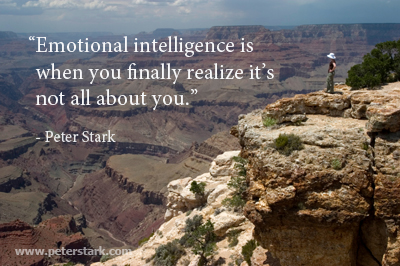
Not All about you

Relationship Breakdown

When relationships start to break down, a common complaint is that one or both parties start “acting like they are single”. This doesn’t mean they are going out messing around with other people (though it could). Usually what it means is that empathy has broken down.

Empathy in a relationship is about taking your partner into account, and understanding that your actions impact them. Understanding that even if something isn’t important to you, it still needs to be a priority if it’s important to your partner.

The offending partner often stops taking the other person into account. Or maybe they still do, but only when that persons needs happen to line up with their own (in which case it doesn’t really count, does it?).

JohnGrayNeedQuote

As it says above, focusing on yourself and doing what is best for you isn’t exactly the best recipe for a successful relationship.

A truly successful (and happy) relationship requires a reasonable degree of emotional intelligence by both parties. It requires empathy – considering your partner and taking them into account at all times.

In times of stress the world tends to turn inwards, and emotional intelligence breaks down. Thankfully, like anything else it is a skill that can be worked on and developed.

If your relationship is going through a hard time, always try to keep you partner in mind. Emotional intelligence, and empathy, is the key to long term success.

Why and How Matters More Than Who

WhyHow2
Love.

That’s why we are all here.

It may sound cliche, but I think it’s true. Humans are social animals, and we are all looking for acceptance and belonging.

No one wants to be alone. We all want to find that “someone” we will be with for the rest of our life. And sometimes we think we’ve found the person we can imagine ourselves growing old with.

But even still, many relationships don’t work out.

When we sort through the aftermath of failed relationships, it’s always easy to find the reasons it didn’t work out.

Maybe we had different interests, or different values. Or different attitudes towards any number of things.

And looking at the differences that we had can provide validation for why it didn’t work out.

We just weren’t a good fit. They weren’t the right person for us.

Next time we just need to find a person who is a better fit for us. If we can do that, then we would have our forever.

The Right Person

The “right person”. The “one”.

These concepts are driven into us through romantic notions of love.

And there is some truth to them.

It seems obvious that “who” you are with has some bearing on the success or failure of a relationship. Some people ARE more compatible than others, and certain personality traits seem to mesh with our unique makeup better than others.

There will always be differences though. Those differences are actually one of the strength of a relationship, because although they can be sources of conflict they also allow us to complement each other and bring out different sides of ourselves.

Due to this I think the “who” is actually a smaller factor than most people think.

There are no magic wands in life. There is no one person who, once you meet will turn your life into rainbows and unicorns.

ALL relationships run into challenges over time.

Who you are with is only a piece of the puzzle. What’s more important than the who is the why, and the how.

Why are you with your Partner

I am a huge believer in intention, and the question of why you are with your partner is perhaps the most important one you can ever ask yourself.

There are two levels to this question.

The first one I touched on in my last post. What was it that drew you to them? What made you decide this was someone you wanted to be with?

Depending on where you are in life, “what” you want in a relationship may change. What matters to you at 20 or 30 may not hold the same importance at 40 or 50.

If we hope to find someone we can be with for the rest of our lives (in spite of thse changes) perhaps the more important question is:

Why did you want a relationship in the first place?

I believe an honest answer to this question goes a long way towards determining the success of any relationship.

Relationships start with our own needs.

We find someone who we enjoy being around. We hopefully find them attractive, or at least feel we have some sort of chemistry with them.

But why do we want to be with them?

Are we looking for someone who will take care of us and fulfill our needs? Someone to share bills with? To provide a safe environment (physically and emotionally)? To provide a periodic sexual outlet? To potentially raise children with?

Are we looking for someone who makes us happy?

Take a look at this quote on happiness in relationships:

bewithsomewhomakesyouhappy

I get the sentiment behind this. Obviously we want to be around people that make us feel happy. But I think the idea is actually quite messed up, and can become twisted into something it was never intended to be.

To be happy, you have to first be happy with yourself.

No matter how good your relationship is no one can make you happy all the time – and in fact, your partner shouldn’t have to. You will always have times that you aren’t happy. And if you associate your level of happiness with the quality of your relationship, then during those unhappy times it can feel like something is wrong in the relationship.

When you are looking for someone to “make you happy”, you are putting a stress on your relationship that it will never be able to meet.

So instead of looking for someone to take care of us and make us happy, we should be looking for someone to share our life with. We should be looking for someone to share experiences with, and looking to enrich each other’s lives.

When we take this approach, the concept of happiness is better represented by the following:

makesomeoneelsehappy

This is a much healthier state both for the individual and the relationship. In either mindset, the actions and interactions in a relationship often look the same. But there is a big difference between wanting someone to make us happy and looking to share our experiences and happiness with someone.

When we want to “be happy”, we are in a selfish state of mind. Our relationship is one where we take more than we give, because we are interested primarily in what we get out of it. Our focus becomes how the relationship is meeting our own needs, and what it provides for us.

That’s not to say that our needs aren’t important, because they are. But a relationship needs to become about more than that.

We need to truly care about our partner and their needs. Their needs should not be viewed as part of an exchange, where we are meeting their needs in order to have ours met.

We should *want* to meet our partners needs and take enjoyment from the act of doing so. We should finding happiness within ourselves from the enjoyment of sharing our life with our partner.

The “we” has to become as important as the “me”.

How do we treat our partner

The next important thing in a relationship is how we treat our partner.

I suspect this is actually related to the “why”. When our focus is ourself (and how well the relationship meets our needs) we have automatically set up an antagonistic approach to our relationship.

When this happens couples get into patterns of conflict and withholding. “Oh, you didn’t do this (for me)? Well fine, then I won’t do this (for you)”.

Everyone falls into this sort of behavior occasionally, but hopefully not often.

It’s petty, it’s destructive, and it’s about power. In fact, intentionally withholding as a form of “punishment” is generally considered abuse.

By focusing on the couple and looking at what is good for the relationship, we can see the relationship in a different light. We are definitely an important part of it, but it’s not all about us. It’s not all about our partner either. We need to be in a position where we are both able to thrive at the same time.

Think about how you interact. About how you treat each other, not just when times are good but also when times are hard.

When you are stressed, do you take that out on your partner? Or do you try to work with them to ease any burdens.

How well do you support each other?

People use “we just weren’t compatible”, or “it just didn’t work out” because it’s the easy answer. When we say this, we are absolving ourselves of any responsibility.

“Who” you are with IS very important. But why you are with them, and how you treat them is equally important.

So instead of focusing on “the one”, focus on what you can do to improve your approach to your relationship each and every day. Don’t look for someone to take care of you. Don’t look for someone to make you happy.

Instead look at the good you have, and find joy in what you are able to provide.

You may find that giving and putting in effort provides it’s own rewards, and as you build you may also receive more in return.

Escape With Each Other

Hug

In my last post I presented the idea that relationship issues are frequently (and perhaps usually) not actually issues with the relationship. Rather, they are issues with stress management.

I think it’s safe to say the following is true:

  1. people have different amounts of stress in their lives
  2. we are different in how well we manage the stresses we do have
  3. some ways of coping with those stresses are healthier than others

We all have stress in our lives, and studies show just how damaging stress is. It’s extremely bad for your own health, and it’s also extremely bad for relationships. In fact, high stress jobs tend to also be associated with high divorce rates.

So stress management is pretty important for both your own health and the health of your relationship. We all have things we do to de-stress. Ways to escape, however temporarily, from the stresses of life.

My idea in my previous post was that over time, in our heads our partner comes to represent our stress. We start to incorrectly see them as the source of our stress instead of seeing them as someone who is dealing with the same (or at least similar) stresses as us at the same time.

In a healthy relationship, our partner is our shelter in the storm of life. They are the first person we go to in order to let go, or relax. So once we’ve started to associate them with the stresses of life, our relationships get into trouble.

It is often said that bad relationships cause stress. That may be true, but stress doesn’t only happen in “bad relationships”. People can have relationships that have all the ingredients to be amazing, but they can still be destroyed by stress.

Allowing Escapism

In my last post I talked about escaping from stress, and how many forms of escapism are unhealthy ways of dealing with stress. For example, I believe this sense of escapism is actually one of the leading causes of affairs. But there are also healthy forms of escapism.

One reader (bac4sccr) made the following comment:

I believe the trick (I am no expert though) is to allow the escapism. You may think I am crazy but if it is allowed you can get away from the stresses of life. The catch is can you do the escapism together as a couple. Zombiedrew2 already used sex as an example of escapism. I agree that it can be used but it cannot be the only form. It could be weekly dates where you are not allowed to talk about money or kids or your car breaking down. You do something with your partner to escape. You associate this escapism (positive) with your spouse and then your relationship grows because you associate it and your partner with positive thoughts and feelings.

I absolutely love this comment, and wanted to expand on it a bit – stealing some of my reply to his comment.

As a side note, many thanks for the people who write in and leave comments. I try to respond to every comment I get, and feel it is the interaction between bloggers and readers that really drives a site. If you have any thoughts on any of my posts I encourage you to write in. I am always interested in different ideas and insights, and believe we can learn a lot from each other as well as provide a bit of support for each other at the same time. Plus when you comment (or even just hit the “like” button) it lets me know someone is actually reading – which is always nice.

Back on topic, I think escaping together is probably the lifeblood of a relationship. And it’s also the area that MOST couples fail.

Miserably.

Escaping Alone

The hardest part of a relationship is balancing the “me” and the “we”. It’s not healthy to completely lose yourself in your relationship, but at the same time you don’t want to be roommates who simply share bills and sleep in the same bed.

It’s important that you maintain the couple. You should never use the excuse of there being “not enough time”, because it’s pretty damned important. Important enough that you need to MAKE time. And when you actually do have time, you need to let go of the distractions of life. Turn towards each other and focus on each other.

Yeah, you still need to do things as an individual. It’s important to have time to yourself, away from your partner. But when most or all of your escape time is as a “me”, here’s what happens…

Your escape time is when you can let go of the stress of life. So when your escape time is usually on your own (or at least away from your partner) at a subconscious level you start to associate the feelings of being relaxed, and being free from stress with the times that you are away from your partner.

If you had already started to associate the stresses of life with your partner, this just deepens it.

And if those stresses have led you to have any doubts about your relationship? Well, this will just “prove” those doubts to you.

I think this happens to couples with kids more than couples without, and there’s a reason for it that is at once sad and ironic.

Kids are awesome, but they require a lot of care and attention. Often it can be hard to find care, so one parent ends up home with the kids while the other is off having “me” time. So they are able to relax on their own.

Why?

Because they actually trust their partner with the kids.

They can relax because they know that their partner will take care of the kids. This sense of trust allows them to relax. But if they only relax when they are away from their partner, over time that negative association is made.

Hmm, I have fun and I can relax on my own. But when I’m with my partner I’m stressed and can’t relax. Shouldn’t I feel differently? Maybe this indicates a problem in our relationship? Maybe I’m better off on my own?

Yeah, when it comes to the health of the relationship that’s not really a good association to make.

Trends in Divorce

Divorces can happen to couples at any time, and for any number of reasons. But if you look at stats on divorces you will see that there are a few trends, and times in life and marriage where they happen more frequently.

The first group are marriages last less than two years. Chances are those are couples who were simply a bad match, and they couldn’t get along.

The next group is probably in their late 30’s to early 40’s. They are hitting midlife, and are probably at one of the hardest stages in life for dealing with the stresses of “day to day” life. This is when people are most likely to have young kids and tighter cash flow. But it’s also when they are most likely to question “is this it” about their relationship and life in general. If your marriage is going to fall apart, chances are this is when it happens.

And the last is after the kids have grown up and moved out. This couple was probably in trouble when they hit group 2, but due to the kids they were able to hold on and get by. Suddenly they look at each other and realize they have grown apart and the only thing they had in common over the past 15-20 years was the kids. Some stay in the marriage and live largely independent lives. Probably because they’ve invested so much time and they don’t want to start over.

Holding On

I guess my point in all this is that you start a relationship because you saw something in each other once.

Something wonderful.

Something beautiful.

Something you wanted to hold onto, forever.

But a lot of us screw things up. We lose the very things that brought us together, and we don’t realize it until things are in a bad spot – and for many it’s too late.

And when it fails, often it wasn’t the relationship that was the problem. It was the stress of daily life, and the fact that instead of tackling it together stress caused us to retreat into ourselves and focus more on being an individual.

Finding time as a couple and making it a priority is the ONLY way out in my opinion. But to do that you need to recognize the difference between relationship stresses and life stresses. The life stresses are ones you are both experiencing at the same time, and changing the relationship won’t make them any better.

So yeah, you will need to escape sometimes.

But do it together.

Focus on each other, and always make time to connect (or reconnect if need).

Remember that you are supposed to be each others shelters from life. When times are hard, don’t turn away from your partner.

Turn towards each other, and just love each other.

Asking the Right Questions

asking-right-question

I suspect everyone has gone to see a doctor at one point in time or another.

Let’s say you hurt your hand somehow, and it’s bothering you enough that you decide to see a doctor. What happens?

Does the doctor put your arm in a cast? Does he/she send you straight to surgery to amputate your hand? Do they remove your liver?

You know, while they may ultimately give you a cast or amputate the hand (your liver is probably safe), it’s a pretty safe bet that those (fairly drastic) measures aren’t where they start.

Instead, they start with something simple.

A question.

They start by asking why you are there – what is bothering you? Then they ask a series of questions related to your reason for coming in. Maybe they ask when the hand started hurting, and they may ask you to try moving it in different ways while describing any sensations.

I hear complaints sometimes that doctors don’t always “get it right”. But really, if you think about what they have to do I suspect their job is quite difficult.

People go to them with a list of symptoms, and based on these symptoms the doctor has to determine what the underlying issue *could* be. Sometimes there are multiple potential issues matching the symptom list, so they ask additional questions to try and narrow things down; to ultimately find the actual cause of the problem.

What does the doctor base their decision on?

They base it on knowledge gained through years of schooling and experience. We go to them because we trust that they have built up sufficient skills to help us. And if they haven’t, hopefully they refer us to someone who is better qualified.

When we have problems, it’s important that we turn to the right sources. In the example above, the “problem” was a sore hand. For a sore hand do you call an auto mechanic? A gynecologist? No, you need to turn to someone who has knowledge and expertise in the problem area. Even skilled professionals sometimes make mistakes. But by turning to an “expert” we better position ourselves for the best results.

Dealing with Problems

The human body is a pretty complicated thing. But at least it’s tangible. At least you can point to an area that “seems” to be the problem (though due to the interconnected nature of things, sometimes that is actually just a symptom and the real problem lies somewhere else).

When we are dealing with feelings and emotions though, things get much more complicated.

We all have problems and issues that we deal with, and often our hallmark of “good health” is our level of happiness. If we’re happy then things must be going well. And when we aren’t, well then that indicates some sort of issue – right?

Things like issues with anger management or chronic unhappiness let us know that something is not right in our life. So we try to figure things out, or “get by” on our own.

And that’s where we go wrong.

The thing is, we are terrible judges of our own problems because we are too close to them. We can’t see past the emotion of our involvement in order to see clearly. And because of this frequently we can’t see the difference between a symptom and the actual problem.

Sometimes we really have a splinter, and we end up doing makeshift surgery on ourselves – amputating the arm and the liver instead.

One of the areas this manifest itself the most is with relationships. Our relationships are some of the central things in our lives, so if we aren’t happy it’s easy to look at the relationships for what is wrong. All relationships have problems, so once you start looking it’s usually pretty easy to find something.

But a question you need to ask is, is the relationship issue the actual problem? Or is the relationships issue actually a symptom of something else?

Looking for Help

For most of us, there are a few people in our lives that we are able to turn to when we need to open up and talk about our problem. Ideally our partner is the person we open up to the most, and beyond that it’s usually close friends or family.

It’s great to have sounding boards, and often these people can provide a different perspective and help ground us. Even then you need to remember that they only have your side of the story, and only have what you give them.

If we go in to a doctor and say “I’m sore”, but aren’t able to (or won’t) tell them where it hurts, when it started or what it feels like, they really don’t have much to go on.

Here’s a larger issue though…

…these people have only their own personal experiences to draw upon, and this colors their ability to give you advice. Even if they have been through something similar, it doesn’t matter. Every person is different. Every situation is different. What worked for them or what was best for them isn’t necessarily what is best for you.

Shopping for Answers

Sometimes when there is a problem people have come to conclusions about what is wrong and what they need to do, but a part of them is scared to act. After all, what if they are wrong?

So they turn to others for their “opinions”. But those opinions don’t really matter, because they are really looking for opinions that match their own.

They could get multiple opinions that aren’t what they want to hear, and those are ignored. But when an opinion matches the one they want? Then it provides validation that they were right (that sort of thinking reminds me of this scene from the Lego Movie).
When you have already decided what the appropriate answer is, all the questions in the world don’t really matter.

Starting Fresh

A buddy of mine was recently divorced, and he’s loving being single again. He had been married a number of years and had a family.

When I asked him what he’s enjoying the most, he says it’s the freedom and the time to himself. He doesn’t have to answer to anyone, and has been able to pick up some new hobbies.

Well, except for when he has his kids. When he has his kids, his week revolves around them and he has no time to himself to do his new hobbies.

Oh yeah, and he’s started dating again so during his *me* weeks he has to make time to fit in his new girlfriend.

It makes me wonder, is that new freedom real or is it just an illusion? Was it really the marriage that was the problem?

Maybe.

But perhaps it was actually the sense of responsibility that came from going to work everyday and coming home to a wife and children who both put demands on his time.

Maybe he just needed to find a way to carve out a bit more time for himself. Marriage and families definitely restrict you. You aren’t “free” to do what you want. But maybe he could have found a way to get a bit of balance back in his life.

My worry is, if/when he hits the point where he’s either married or living with someone again he will find himself back in the same spot he was in before. And he’ll have broken up his family in the process.

For many people, there is often a sense of relief after a separation or divorce. A sense that “yeah, I made the right decision. I’m happier now”. And that sense really comes from the nature of changing up a stagnant situation.

Often within six months to two years though, people find that their “new” situation is really no better than the old one. Some parts are better, and others worse.

The grass isn’t greener on the other side. Both sides have patches of green and patches of brown. But unfortunately the grass often looks greener from afar, and it’s not until you actually get there that you realize it’s only green where you water it.

Keep an Open Mind

When trying to understand our problems, one of the most important things is being able to keep an open mind. It’s easy to have an idea of what is wrong and then latch onto that. But is it the problem? Or it is a symptom?

Depending on the nature of the problem you are dealing with, the consequences of mistaking a symptom for a problem can be considerable.

When dealing with issues that can have serious implications (such as issues with long term relationships or when kids are involved), I would definitely recommend looking into professional counseling services when possible.

Not all counselors are good, and even the goods ones aren’t always a good match for a couple or individual.

But it’s always a shame when someone mistook a symptom for a problem, and amputated an arm when they really had a splinter.

Should You Have to Change?

changeHeading

Love is an interesting thing. We all want to be accepted, and we all want to be accepted for “who we are”.

In fact, by definition unconditional love means is that someone is not putting conditions on their love for us. They are accepting ALL of us, the good and the bad. In fact, part of the concept of self-love is being able to look at yourself and say “I am enough”.

Being able to love yourself, and being loved unconditionally are two things we should all strive towards. And in my opinion they probably the most important building blocks to happiness, and healthy relationships.

One place people seem to get confused though is in the belief that unconditional love and accepting yourself as you are means you are a finished product. It means you can’t change, and you can’t improve.

Patterns of Behavior

It doesn’t matter who we are, we can always improve. And sometimes we really should.

I know a guy who never seems to be able to hold a job for long. He would spend a few months here, a years or so there. In all cases he would leave the job and I would hear about how awful it was at the company. Usually it was an issue with management, how terrible they were and how they treated the employees poorly. Although it must have been hard on his family, his wife was very supportive of him. She seemed to admire the fact that he was willing to stand up for himself and what he felt was “right”.

Then one day I got a job at one of the places he used to work and I met some of the managers. When I met them, I had a hard time reconciling the stories I had heard with the people I had met. That’s when it occurred to me that perhaps it wasn’t the places or the management.

Maybe it was just him.

But when he spoke about how terrible these places were, he genuinely seemed to believe it.

A few years ago I read a book by Anne Sheffield about how depression impacts relationships. She had grown up in a household with a mother who suffered from depression, and as an adult she had a few failed marriages.

All her marriages ended because of similar issues, and after the second or third (I can’t remember) she realized that maybe the problems didn’t lie with her partners. Maybe the commonality was her. It was at that point that she started to realize she also had depression, and it had been affecting her ability to maintain a relationship.

Reading that story made me think of the guy who couldn’t hold a job for long.

Each time he left or lost a job, he had a reason. And taken individually each of those reasons seemed valid and defensible. But when you look at them as a pattern of behavior, the one common item was him.

alwaysdone

Through the Looking Glass

I’ve talked about my buddy Gandalf, who spent much of his adult life without fulfilling relationships before. He ended up seeing a psychologist and related to me some of his experience:

Early in my therapy my psychologist had me list out what I thought was the perfect partner. After going through that list with him he said one word that I’ll never forget. It was “selfish”.

My mindset at the time was that I wanted and needed loving, but I didn’t think that I needed to give any love back. It never even occurred to me that I should even give any love back. To me, my thinking was that it was their duty to give me love and that I didn’t have to return anything back because just the act of loving me should be enough for them.

There was no empathy for anybody else. My mind only focused on me. It is known as the Narcissus Paradox, where it appears that I would be thinking of others, but really, my mindset was only focused on me and my needs. I was nice only to the point of where I could get other people to show me affection. My thinking was only on how to get other people to show me love, and not on how to love other people.

This leads to passive aggressive behavior and giving people the silent treatment because I didn’t understand how to deal with conflict or how to get what I wanted from other people.

I now realize that this is not only very selfish, but childish and immature. There are several factors that contributed to me having this mindset, but lack of being loved as a child is a significant factor in this. If you don’t grow up in a loving environment (both between the parents and the parents to the child) then you grow up without knowing and understanding what love is and the empathy required for a loving relationship. I am now in the process of learning this, but it takes time. However, as my friends have told me, it’s better late than never.

He had people around him who loved him, and accepted him for who he was, flaws and all. But I’m sure the people who cared about him (myself included) wanted and hoped for him to change.

Change is a difficult concept. We’ve probably all seen people who have relationships where there are parts of their partner that they don’t like, and they try to change those parts. For anyone who has seen that, you know that it never works out well. People generally don’t change.

I have children, and one of my most important roles as a parent (in my opinion) is to try and shape their behaviors in a way that they can interact with the world in a healthy fashion. When I do that, am I not trying to change them? I am the parent, and part of being a parent is teaching.

A big part of teaching as a parent is around helping your children understand their emotions and their feelings, and allow them to cope in a healthy fashion. Is that changing them? Yes, I am the parent and they are the child, so part of my role is teaching. But am I only trying to teach them because I am the parent? No, it’s because I love them and want the best for them.

Don’t we want the best for all the people we care about? We aren’t responsible for others, but isn’t it normal to want to help those who seem to need it?

It’s a fine line between wanting someone to change to better suit what YOU want from them, and wanting them to change for THEM. And the distinction between those two things is blurred, because often the types of changes that benefit the individual also benefit the people who care about them.

What makes you “You”?

The idea of change often scares the hell out of people. Even when people know their behaviors and actions are damaging and destructive, they often defend them by saying “this is just who I am”. To change would mean you are changing who you are, and by extension that would mean you are no longer “you”.

This is scary. But really, what are you? We are a collection of habits and behaviors, some good and some bad.

What if some of your habits or behaviors are broken? What if something is wrong with the current version of you?

Thinking of my buddy Gandalf story above, he recognized that there WAS something wrong with the old version of him. And although it was hurting the people around him, the main person it was hurting was himself.

This is a difficult situation, because generally we are told that people should be able to accept us as we are. We shouldn’t have to change in order to be accepted, and we should be able to be happy with who we are. So the idea that he should have to change somehow seemed wrong.

But here’s the thing, he wasn’t happy with who he was. In fact, he didn’t really like himself at all. Interestingly the people around him generally did accept him. But he didn’t see that, and he didn’t accept himself.

It was only later when he found himself chronically unhappy and falling into clinical depression that he started to realize and understand exactly how broken this thinking was. And he needed to change, because the way he approached the world was not a situation under which love or true intimacy can thrive.

Should he have had to change?

No.

But not doing so would have kept him in the same negative cycles he had been in for years.

Were there benefits to him for making changes?

Definitely. Both for him, and for those around him.

Although he saw that, he was terrified to change. Because the way he was, and the way he coped with life, was the only way he knew.

LifeChange

I think back to the guy who moved from job to job. He didn’t have to change. Although it probably put tremendous pressure on them, his family accepted him as he was.

He didn’t see a need to change, because in his mind he was never the problem.

People often deny they have a problem. Or they accept it, but say “it’s just the way I am”.

But when you deny a problem, blame others, or minimize it and fail to see how it impacts both you and those around you, you give up the power to change.

The Road to an Affair

dark-road

Affairs.

Lots of people have them.

In some cases people are serial adulterers. They are hedonists who are only interested in themselves, and they don’t care about who they hurt in the process. Basically they are narcissistic and selfish, and just overall not nice people.

But stats say that anywhere from 20-40% of people have affairs at some point. That many people can’t ALL be terrible human beings.

People generally don’t advertise when there has been an affair in their relationship, but often it gets out. And when friends and family find out that someone they know had an affair they are often stunned. A common reaction is:

He/she had an affair? I never thought they were the sort of person who would do that. I guess I didn’t know them that well after all.

This sort of reaction isn’t just isolated to outside observers though, as the betrayed partner is often in a state of shock.

And not only is the betrayed partner shocked, but often the person who HAD the affair is also shocked. Many people who have affairs are somewhat horrified with themselves both during and after. They never thought *they* would be the sort of person to have an affair.

Yet they did.

And that leads them to realize that they aren’t who they thought they were either.

When you look at stories, there are a lot of common elements. Usually starting with long term relationships that are “in a rut”, where the passion is gone or fading. But sadly, that happens to most of us over time.

So is everyone at risk of having an affair? Well, even if 40% of people do, 60% don’t. So are there actually some common characteristics of people that make them more susceptible? I believe there are.

In this post I want to explore that, as well as provide some thoughts for those who are either having an affair or have thought about it.

The Myth

I think the idea that sexual needs not being met leads to an affair is only partially true. Yeah, if your sexual needs aren’t being met it will spill out into the rest of the relationship. But I actually think that’s a symptom and not a cause.

I believe affairs are much more frequently about emotional needs and connection. And when you feel emotionally connected then sex is a natural result of that.

So people are in relationships that are in a rut, and the emotional connection has broken down. They meet someone and connect emotionally, and don’t actually intend for it to go any further. But once that emotional connection has been made, nature takes over.

In fact, a recent British survey on affairs found that for both men and women, attention and emotional connection were among the leading reasons for affairs. Here are the top three reasons, broken down by gender:

  • I felt flattered by the attention (men 35%, women 44%)
  • I felt emotionally deprived in my relationship (men 29%, women 43%)
  • I was dissatisfied with my sex life (men 32%, women 15%)

Note the difference between men and women when it comes to their sex life. Sex is twice as important to men than women. I suspect those numbers are skewed a bit by different perceptions around sex. For men, sex is often seen as symbol of the relationship, so dissatisfaction with a sex life is dissatisfaction with the relationship. For both genders however sex is only part of the reason behind an affair, and attention and emotional connection are more significant factors.

When people say they didn’t mean for an affair to happen or it was a mistake, I think there is some truth to that. They probably weren’t looking for an affair. They were actually looking for attention and an emotional connection that was lacking in their own relationship.

They just didn’t mean for it to go as far as it did. But by pursuing a friendship/relationship after they knew feelings were developing, they are completely at fault.

cheating

The Cheaters Perspective

In the blogsphere you find many stories of relationships broken by affairs, mostly from the perspective of the betrayed spouse. A few months back I found a blog written by a guy on the other side of the fence; someone who betrayed his wife and is now trying to deal with the fallout from his decisions.

An affair is always wrong – I will never suggest otherwise. But although we may not choose to have affairs, the pain and loneliness of a stagnant relationship is something I suspect many couples in long term relationship can relate to.

In his blog he starts with the affair and it’s ongoing aftermath, and slowly peels back different layers of his history. But for purposes of telling his story here I will try to stitch together a few pieces in some degree of chronological order (The sections below in blue are reprinted from his site with permission).

The Breakdown of the Marriage

Up until this point in our marriage we only really ever fought about one topic. Sex. I have a higher drive than she does and so it has always caused friction. I would make an advance, sometimes I would handle it poorly and sulk for a short time but often times I just would leave the bedroom to watch TV or something else. Just so I would not bother her. Then she would feel extremely guilty and we would end up doing it in the morning half the time or maybe the next week. Either way neither of us ever felt good about the situation.

After a few years of this, I started to believe that even when she accepted my advances she was just doing it to get her “wifely duties” completed. It wasn’t because she wanted me or even sex for that matter. It was very hard for me to deal with but I did what I thought was best. First I assumed I must suck at sex. I must be awful because I love how she makes me feel and if I don’t make her feel this way then I could see why she doesn’t want me.

I would try and talk to her about it but it usually ended up having the focus about sex and not just my wanting to know that she did indeed want me around. Then she would feel guilty and then try to have sex with me and then I did not want it because it was only because she felt guilty, not because she wanted me. It was a frustrating cycle. I don’t know if you can imagine but having the only person you have known and loved constantly reject you and avoid you will destroy you. She was everything I had ever known.

My response was to keep slowly pulling out of our marriage. I stopped going out of my way to work on us. I stopped reading and researching ways to make your marriage better and closer. Instead I just avoided alone time. We stopped having sex but every couple of months and it was nothing spectacular.

The Rise of the Affair

One day as I was driving home from my commute I came across an app to meet other people. I could view peoples pictures and decide if they were a match for me. After a couple of weeks I had a few dozen matches of people I thought were out of my league. I would chat with a few here and there but one drew me in particular. She was funny and cute and we seemed to really have a good time chatting back and forth. We talked for a few months and I noticed I was much more pleasant at home. I felt good about myself because my ego was being fed. I was happier and even my kids noticed it.

I thought this was a perfect setup. I really believed I had no intention of ever meeting her and she never pushed to meet me. We were both content with what we were getting. It seemed to take the edge off my marital problems and my wife and I were getting along better. We still were not very active in the bedroom but when she denied me it wasn’t such a big deal because I knew there was at least someone else who found me attractive and good company.

But it also started a destructive dialog in my head. It was something like:

  • “These women find you funny and attractive but your own wife doesn’t.”
  • “She won’t be intimate with you because she does not find you good-looking.”
  • “You are just the father of her children and her partner but you will never be the love of her life and you can never make her happy.”

These thoughts or ones similar would just pour through my mind. I couldn’t get them to stop.

Exciting and New

We kept sharing more and more personal information with each other. This went on for a days and I felt like we really had a connection. She kept telling me how easy it was to talk to me and how I can make her feel so safe that she can share most anything with me. She told me that she has not felt this at ease with anyone before. I told her that I felt the same. I was a lot less guarded around her and felt like I could say anything and it would not surprise her or scare her away. I was thinking how much different she was than my wife. How exciting, how refreshing. I did not feel judged, just accepted. I felt like she really understood me and liked me for who I was, even though she truly did not know who I was yet.

I think this led to a lot of the attraction I felt. It was new and exciting and she was interested in everything I had to say. We were sharing and exploring each other intellectually and emotionally. I really believe that is what really hooked me, it had been a long time since someone made me feel this way and I wasn’t even sure if I actually felt this excited and close to my wife all those years ago. Now in hindsight, I can say that this is probably how I first started with my wife.

Crossing the Line

Now I have thought about this for a while, why did I finally decide to meet her again even though I was pretty sure deep down that I knew what I was getting into. I know on the surface I thought I could control myself. So really, the second time I was going to see this woman we would actually do it. No way! Not in a million years! Uggghhhh… (I guess on the surface I was old-fashioned, but deep down I knew. I really knew).

Ending the Affair

I was lonely and dying for attention, which is what led me to look for it else where. I did not do this looking for an affair, but just some attention that validated I was worth something. Then I met the other woman (OW), one thing led to another until I was in a full blown affair. It was euphoria when were together and agony when we were apart. This is what fed the illusion that it was such a great “relationship”. The reality was, it was just fantasy land and as I began to see her with everyday problems like us, the less and less I wanted to be with her.

I think I was finally really realizing what I had done. I was seeing that the OW was really just fantasy land and none of it was real. My wife helped me recognize this by her asking about the OW and why she was so perfect. I told her she wasn’t and if I decide to leave the marriage I am not running into her arms. She has a lot of problems that she would have to fix before I would let her around my kids. Once I told her this it pretty much shattered the fantasy that I had with her. I started seeing her with her problems and everyday trials just like everyone else.

I have tried to give excuses for why the affair happened. The reality is I am the one who made the decision to cheat. If I thought the marriage was that bad I should have left, not taken this route. I made that choice and she had nothing to do with that choice. I have to take responsibility and be a key component in both her recovery and my own.

Things to Learn

As I said earlier, cheating is always wrong. But generally, it doesn’t happen in a vacuum. Most commonly, an affair is an attempt to fill gaps that are missing in a relationship. And attention is the number one thing both men and women are looking for.

They want to feel loved again, and they want to feel valued. In the story above, the guy turned to “dating apps” for the attention he felt was missing in his relationship. This is not uncommon.

I recently read an article on Tindr that found 36% of users are actually married, and an additional 12% are in a “committed” relationship. That’s almost ½ of all users who are probably not looking for an actual relationship. So what are they looking for?

Sex? Probably. An ego boost? Definitely. But mostly, attention.

It’s a sad commentary that in many relationships, we often do a poor job of making our partners feel loved and valued. And eventually, they look elsewhere for the attention that is missing.

In a prior post I talk about some of the reasons I think this happens. Basically I think we get too caught up in every day life, and we stop making our partners a priority. After all, they will always be there, right? Thing is, when you stop making the other person a priority they start to feel it. And it hurts.

Some people won’t like this, but I believe in relationships damaged by an affair the partner who was cheated on does hold some of the blame. I’m not suggesting it’s 50/50 or anything, and they aren’t the ones who cheated. But in most cases they contributed to the conditions that led to affair. Unless they recognize their own role in the breakdown of the relationship (whatever it may be), they will never be able to heal and move forward.

Life does get busy. Jobs, kids, house maintenance, personal lives etc. But in order for a relationship to survive, it needs maintenance. It needs time, and effort put into it. And it can’t only come from one person. Both members of the relationship need to feel valued, and loved.

When we subconsciously think “I’m married now, I don’t need to try”, problems will invariably set in. Relationships only stagnate when you let them.

For the person who has cheated (or is on that path), a few things to consider:

When the guy in the story above was on the dating app, it felt good. He was getting the attention from other women that he wasn’t getting from his wife, and it made him question why? He came to his own conclusion:

What did they see that my wife didn’t? This question never went away. I could not get it out of my head. It would not go away. I was the same person wasn’t I? I looked the same, had the same personality, then why?

It is a funny question to me now. What did they see that my wife didn’t? I can answer it without a problem. They saw someone who had an interest in them. Who made them feel attractive and interesting. So they never saw me, they saw what I was giving them. So the real question I should have been asking myself was not “What did they see that my wife didn’t?” but “What I am giving them that I am not giving my wife?”.

Another thing to note is that an affair is rarely about our partners, or our relationships. It is about ourselves, and our coping mechanisms. As another person wrote after his affair:

I wish I’d known what love was. I craved feelings I labeled as love. Feelings that came from having someone I valued value me in return. It made me feel I was all that. In fact, the more I esteemed the other person, the stronger the effect. But, what I really loved was how they made me feel about myself. The reflection of my image in their eyes made me feel amazing. But love isn’t that feeling, rather it’s the grace my wife extended, not when I deserved it, but rather when I least deserved it.

One final thought.

People are often more susceptible to have affairs when they are dealing with things like depression, or if they have issues with self-esteem or self-love. If you struggle with loving yourself, external validation from others is needed. However it’s important to understand the following:

All the external adoration, respect and adulation in the world, can’t drown out the internal voices that tell us, we are not good enough and unworthy of; happiness, love and an abundant life. When we need others to tell us we’re amazing, worthy and lovable, in order to feel good about ourselves, it is never enough. It goes into the bottomless pit where our inherent self-worth should be. It may feel like we are reaching out to receive love, but in actuality, we are seeking external noise to help drown out our negative core beliefs.”
― Jaeda DeWalt

Affairs are never the answer. They are a form of escapism, a way of running from the problems that relationships will face from time to time. Sure, the cheater gets an ego boost and some sexual release – which helps them feel better (for a time). But they don’t solve anything, and they don’t make things any better.

A better solution is effort. Communication. No matter where you are, and how deep the hole is you can always get out. But you need to want to.

The guy in the story realized that he felt good around other women because they were giving him attention. But that attention was in turn because of the attention he was providing to them. Attention that he had stopped giving his wife long ago.

The Magic Sword

magic sword

Growing up I read a lot of books, mostly in the fantasy genre. I read a lot, and from grades 7-10 I probably averaged a book a week. After a while I found that most fantasy books followed a standard formula:

  • Young boy of unknown parentage is being raised somewhere in the middle of nowhere
  • Young boy meets a mysterious stranger, who convinces him to embark on a quest for a magical talisman (with a party of battle savvy comrades of course)
  • In the process, young boy finds out he is the last survivor of an ancient (probably royal) lineage
  • Young boy masters the magical talisman and uses it to defeat the great evil that is threatening the land

I’ve probably read that story (or some slight variation on it) hundreds of times, and I have to admit that as long as it’s fairly well written it never gets old for me.

One of my favorite fantasy authors is Terry Brooks, and somewhere around grade seven I read his first book (The Sword of Shannarra); which follows the standard fantasy template pretty closely.

Young boy meets mysterious stranger? Check. Young boy embarks on quest for magical talisman? Check. Even back then, the book didn’t really present a lot of surprises. But I could always look forward to whatever twist would exist on the magical talisman. It turned out this one was a sword.

What was the magic of the sword going to be? Was it going to burst into flames? Would it shoot ninja stars? Maybe it would shoot flaming ninja stars!!! My excitement and anticipation mounted as I read the book. So what did this magic sword do? It’s power was…

(wait for it)…

It made people see the truth.

The truth? Really?

Let me tell you, when you are 12 or 13 years old, that’s a pretty freaking disappointing power for a sword to have. Flaming ninja stars would have been SOOOO much cooler.

As a child, the truth seems like a pretty stupid power. Over the years I’ve come to realize that the truth is actually VERY powerful. And it’s not always easy.

We All Lie

Truth is a difficult concept. But even accepting that there are different interpretations of “truth” I believe it is safe to say that as people, we commonly hide behind lies and partial truths.

If you are one of those people who claim you never lie, then I want to make clear that my personal definition of lying includes lies by omission, as well as semantic manipulation.

Some people are EXTREMELY careful in their wording of their responses so that they can say “hey, I didn’t lie! You just didn’t ask the right question”. Guess what, if someone is asking you a question with a specific intent, but you are finding loopholes to dance around that intent based on wording, you are still lying.

Sometimes people tell just enough of the truth to downplay the question at hand. Holding back truth is still lying in my book. It’s probably worse actually, because now in addition to lying you are engaging in manipulation.

So yeah, we all lie. Some do it more frequently than others, and some lie about larger things than others. But we all do it.

Why do we Lie?

If we can accept that people lie, the question becomes why. Why do people lie?

Here’s my take:

People lie to “protect themselves”. The most obvious reason is to avoid consequences. We have done something, and we know there are negative consequences associated with it. So we lie to protect ourselves from the consequences of our actions.

Not all consequences are tangible though. Often the consequences we are trying to avoid lie in the realm of feelings and emotion. Feelings such as fear, ridicule, guilt and disappointment are the strongest drivers behind lying.

People will generally acknowledge that lies and deceit are bad. Lies (when discovered) can destroy the foundations of relationships, altering them forever.

But even more damaging than the lies we tell others are the ones we tell ourselves.

The Responsibility Principle

A while back I wrote a post on accountability. In it I discuss the responsibility principle, which is an idea that our brain naturally goes through a series of steps in the process of becoming accountable.

First we try to deny things. If that doesn’t work, we see if there’s someone we can blame. We then try to rationalize things, saying “yeah, I did this. But it was because of X”.

Next we “accept” responsibility, but only because of a sense of shame or obligation.

The last step is taking true responsibility. Accepting we are accountable for something because we know we are (accountable), and because it is the right thing to do.

Incidentally those caught up in taking responsibility due to shame or obligation also tend to take on responsibility for things they aren’t actually responsible for – which isn’t healthy.

An important thing about these steps is they happen subconsciously. And they aren’t “all or nothing”. No one is responsible all the time, and even the people who blame and rationalize the most have moments where they take ownership.

Avoiding Responsibility

We ALL try to avoid responsibility. Not all the time maybe, and the frequency differs from person to person. And when we do the people around us usually bear the brunt of this.

As a kid, things happen and it’s the fault of our parents, or our siblings. Someone gets us mad and we lash out, so it’s their fault for getting us mad. After all, WE shouldn’t be expected to channel our emotions in a healthier way. And we wouldn’t have lashed out if THEY didn’t do something first.

(Incidentally, this is the excuse abusive partners give in their relationships. “I didn’t want to hit her, really. But she did X and made me mad”. If it’s not an excuse for physical abuse, then it shouldn’t be an excuse for emotional abuse either. As kids we are just learning to understand our emotions, so it’s *somewhat* excusable. As adults? Not so much.)

Maybe we’re having problems in school. Well, clearly it’s because we have a bad teacher. Having a hard time at work? It’s probably because of your boss, or the co-worker that doesn’t like you.

And then there is our partner…

If you are in a committed relationship, your partner is likely the person closest to you and the one you spend the most time around. So they are likely to bear the brunt of the blame. You aren’t happy? Well, they aren’t doing enough, or they don’t support you enough. Or maybe it’s just that it’s a bad relationship. Obviously you would be happier with another person.

Don’t get me wrong, sometimes your siblings do get you mad. Sometimes parents don’t understand, and all too often communication in relationship could use improvement. But if you find that you are often the victim of bad luck and/or bad situations, the commonality is probably you.

I see a blaming, justifying and rationalizing as a form of lying. But it is lying where we aren’t lying to others, and instead we are lying to ourselves about our own role in our choices and decision.
A good example of this was my buddy Gandalf.

He was chronically unhappy, but he always had reasons for it. Maybe it was this, or maybe that. There was always *something* to explain why he was unhappy. But it was never his fault. As he changed things and remained unhappy, he eventually ran out of things to blame. The truth was, it was never the external items. His issue was within himself, and HE needed to make changes to his outlook on life in order to change.

We all do this in some capacity. We tell ourselves lies in order to feel better about ourselves. And eventually we convince ourselves that those lies ARE the truth, and they become our reality.

Scared to Try

It’s not only our actions and the decisions we make that we lie to ourselves about. We also lie to ourselves about the decisions we don’t make.

Fear, ridicule, guilt and disappointment. These are some of the main feelings that we lie to avoid.
Let’s say there’s something we want, but we are scared. Maybe we’re scared to try, and maybe we are scared of failing. So we tell ourselves we aren’t good enough, or smart enough, or pretty/handsome enough. We tell ourselves these things, and they become excuses for why we won’t even try.

Well if you tell yourself “I can’t” for long enough, eventually you start to believe it.

self-acceptance

I Can’t

One of the worst things you can do is say “this is just who I am, or this just the way I am”.

It can be hard to believe in yourself at times, but not believing in yourself is one of the most damaging things you can possibly do.

If you find yourself focusing on what you “can’t” do, stop. And take a breath.

We all have limitations.

There are always things we can’t do.

But focusing on what we can’t do or what we don’t have makes us victims. It leaves us out of control of our own lives. Instead find out what you CAN do. Finding what you can do, and working towards solutions is much more important.

Making Choices

I recently read an awesome post (at a great blog) about dealing with an “unhappy marriage”.

In it the author says you have three choices. You work to fix it, you accept it as it is, or you leave. Those are your choices. That’s it.

People often look at those choices and they don’t like any of them. They think – Fixing it requires communication and effort, but I don’t want to accept it, and I’m scared to leave. So they go for a fourth option. They “stay”, putting in no effort, and instead have an affair to have their happiness on the side. They blame their partner for their unhappiness, and justify the affair to themselves by saying “hey, I wasn’t happy. Everyone deserves happiness”.

They are looking for shortcuts, and instant gratification. They are looking for a solution without effort, and life without consequences.

In all aspects of life I think those same three choices apply. Fix it, accept it, or leave it. But to face that, you have to face the truth. And the truth is life requires effort, and things don’t just get better on their own.

Life isn’t always fair. Sometimes really good people get dealt really bad situations. And I am not going to pretend that people can “make things better” if they just believe, or if they try hard enough. There are a lot of things that are out of your control. But there is also a lot that you can control.

Your choices.

Your decisions.

Other people may influence you, but you own them.

Sometimes decisions have big consequences, so it’s so much easier to deny, blame, and rationalize. But the “cost” of doing this is very high. It cost us our happiness and our belief in our self.

In The Sword of Shannarra, the main character was able to vanquish evil with truth. But very few people could handle the truth, and often it comes with great cost.

A journey into the mirror is not always easy. But sometimes we have to face truths that are unpleasant in order to grow and improve.

It Will Never Be The Same

NotTheSame

A lot of people who write blogs on relationships write because *something* has happened or gone wrong in their relationship. So they turn to writing to help make sense out of their world, and as an outlet for the pain they are feeling. A lot of people write about the loss of a relationship they didn’t want to lose. Others write as a way of working through their emotions while holding on (or at least trying to hold on) to a relationship that has been altered by whatever has gone wrong.

For the people who are trying to hold on and rebuild love, a common theme that I come across is both a fear and a sense of sadness that due to whatever has happened, things will never be the same. The relationship that they once had seems irrevocably altered, and accompanying this belief is a sense of loss.

My Story

I write about life and love, but although I cite examples and experiences from my life, I don’t talk much about “me”. This was never intended to be an online diary, but rather is a way of developing and expressing my philosophies about life and love. I believe in love, and long term relationships. And my goal with this blog has been to try and give hope to people who may be feeling lost, and remind them that we all go through the same struggles.

In this case however I feel my experiences are very relevant.

Like many others I came to blogging when my relationships was in crisis. Although I try to stay away from talking about my relationship any many of the topics I cover don’t really apply to me, my own personal crisis was the catalyst for my writing.

My wife and I had been together for many years, and I thought life was pretty good. Then I found out she wasn’t sure if she wanted to be married anymore. She wasn’t sure if she loved me. In my mind, she gave up on our marriage. I won’t pretend to understand what was going through her head at that time. That’s her story. But I do know how it impacted me.

It destroyed me.

See, I believed.

I believed marriage was for life. I knew she and I would always be together, and we would always support each other. I knew that no matter what challenges life presented us with, we would get through them. Together.

For years she was my one true certainty in life. My safe haven, and my shelter in the storm of life.

And suddenly she wasn’t.

She didn’t believe what I did.

I knew life came with challenges, but I never expected the challenge to come from her. I never expected her to question something that (to me at least) was the best part of my life.

I waited to wake up one day and find out it was all a bad dream. To find out that it was just some cruel joke. But weeks turned into months, and the reality of my situation hit home.

When I say it destroyed me, that isn’t drama or exaggeration. It messed me up worse than anything I had ever experienced before. The world I felt I “knew” crumbled around me, and that led me to question absolutely everything. For her to feel the way she was feeling, she obviously didn’t feel the same things I did – the things I thought she felt.

And if I was wrong about that?

Well, what else was I wrong about?

Had she ever truly loved me? If so, when had it changed? Why had it changed?

Looking at our life, what was real? Was anything real?

I had always believed in myself, and even that belief was now shaken.

I guess a lot of people have been there, but even after all this time it’s hard to articulate just how fundamentally my world was shaken by the experience.

We were on a dark path for a long time, and the only thing that allowed me to keep my head above water was belief. My belief in “us” was now shattered, and my self-confidence and belief in my self was badly damaged. But I still believed I had done my best. I still believed I had always tried (and would continue) to do the right thing – whatever that was. I just hoped my belief in the good we had and the good that could still be would be enough.

Lost Innocence

We all start innocent, and growing up you believe in different things. You believe in Santa Claus, the Easter Bunny, maybe even the tooth fairy. You believe mommy and daddy love each other, and will always be able to keep you safe. Actually you probably don’t even understand “safe”, because you don’t know threats, you don’t know fear, and you don’t know pain. You only see the light and good in the world, and not the darkness.

Over time, this innocence fades. You find out Santa is just a man in a suit, and there is no Easter Bunny (the tooth fairy IS real though, I’m pretty sure about that one). You start to find out that the world isn’t quite as safe as you thought. Bad things happen to good people sometimes. People get hurt. Tragedies happen. Relationships fail.

In early relationships we experience heartache firsthand, and we hear the rather sobering stats on divorce.

But that early heartache we experienced was simply to prepare us for the person we would be with forever. And divorce only happens to people who give up, and stop loving each other. We know that won’t ever apply to us, because we are different. We believe.

Sure, Santa wasn’t real. And yes, bad things happen in the world. Maybe the world around us had lost it’s magic and wonder.

But for me? My marriage one of the last pieces of magic left in the world.

It was my fairy tale. It was my love story.

And now that magic was broken too.

I believe for me, and many others, this is where things will never be the same again.

That magic.

That belief that no matter what, you will always be there for each other. That your love is somehow special, and different.

When you experience heartache with the person you truly committed your heart and soul to, to the person you believed you would always be with; that changes you forever.

Shifting Landscapes

I watched a video on relationships recently where the speaker made a comment I found particularly poignant. She said (paraphrasing here):

In todays world many people will have more than one marriage in their lifetime.

And in some cases, that marriage is to the same person.

I suppose she could have been talking about splitting up and eventually remarrying. But I saw the comment as a recognition that the nature of relationships change.

If you think about it, you aren’t the same person you were at 20, or 30. You change, you mature. Your life situation changes, and your needs change. Sometimes you have a better job and more money, other times less. You go from single and on your own, where you can do things how you want when you want, to having someone in your life. And now you need to fit that other person in and they are impacted by all the little decisions you make.

And in a relationships you not only see your partner at their best, but also at their worst. And likewise them with you.

Situations change. Maybe you add kids to the mix. Or a promotion, or a loss of a job, serious illness, the loss of a close loved one. There are any number of things that can happen that affect us. Some in small ways, and some in large. Life is all about change.

One of the most common mistakes people make (and I include myself in this) is not realizing or understanding that. We meet someone, we are happy with them, so we get married. We think “great, we are married” and now we will be together forever. Time goes by, life happens, and we continue to mature and change. But we lose sight of the fact that our loved one is changing too. Their needs aren’t the same as they were, yet we continue to treat them the same way, and they do the same with us.

The changes are subtle, so we don’t even see them at first. We “think” things are fine, but over time a number of little changes add up. This causes a distance to start to develop between a couple, as they have become so caught up in day to day life that they fail to see the changes that have happened right in front of their eyes.

everyonechanges

Sometimes we catch it in time, and we are able to accept that the person we are with is not the same one we married, but that’s alright because neither are we. Other times people fight the change, and spend their time resenting that the person isn’t the same.

I haven’t really figured this stuff out yet, but it seems imperative to me that a couple keeps the lines of communication open, continues to communicate their needs, and accepts that change is part of life and will be one of the few constants. If we want to stay together we need to keep growing and learning each other as we change both as individuals and as couple.

Accepting Change

It’s true, things WILL never be “the same”.

But that doesn’t have to be a bad thing. If your relationship has been challenged, then there is something about the way “it was” got people into trouble. Even if one person was happy, obviously the other wasn’t. Relationships involve two people, so you need to find a new path, one that works better for both people. You have to find a way that you can both be happy with the path you are on.

My wife and I are still together.

I wish with all my heart our marriage never been challenged. I wish “happily ever after” meant our love was never tested or challenged.

The experience sucked. I hated it, and wish it had never happened. I wish I could turn back the hands of time and change things. Somehow fix things before they went wrong.

But I can’t. All I can do is determine how to move forward. Ask myself what can I learn, and how I can use the issues we faced to make our relationships stronger.

And I HAVE learned, a lot. I’ve learned about myself and what I want and need out of life. I’ve learned a better understanding and appreciation about love. And hopefully I’ve learned more about my wife.

I still believe in “us”, but it’s different now. Now I believe we CAN make it, not that we necessarily will.

I wish I was still that person who knew we WOULD make it, instead of just knowing we CAN make it. And that distinction saddens me. I mourn that loss of innocence.

But I was faced with a choice. I could either hold onto the image of what I believed we had, and likely end up bitter and alone. Or I could embrace the fact that life goes through phases, and people and relationships change.

I choose the latter.

Maybe the loss of innocence was actually good. I’ve said before that I don’t believe in perfection, and I don’t believe in “meant to be”. I believe life presents us with opportunities, and it’s up to us to determine what we want to do with them.

We almost squandered our opportunity, and hopefully we will never do that again.

I recognize now that love is fragile. I believe that as long as we prioritize time for each other and ensure we focus on our relationship, we will make it through. I believe we need to continue to learn each other, and hope that we both grow and change in ways that allows our love to survive.

If we don’t do that? If we take each other for granted and lose sight of being a couple?

Then our relationship will fail.

It’s that simple.

Before I “knew” we would be together forever. Now doubt is there, and I hate it. But I know we have a chance. We have an opportunity, and it’s up to us to determine what to do with it.

So yeah, maybe things will never be the same. But then again, things will always change.

And I still believe.


Now paranoia’s setting in and I’m falling from these stars again
While every part of me screams, “hold on”
Cause if you can’t learn to bend then you break
Oh my God, how long does it take?
Every lesson we learned took so long
But it made us strong

I-I-I-I’m still standing, I-I-I-I’m still climbing
Even when the rest are falling, the rest are falling
The rest are falling

From Watch Me Rise by Mikky Ekko

Killing with Kindness

smilingApple

Best intentions.

Ideally when we act, we are acting with best intentions. But sometimes our best intentions don’t work out the way we had hoped. Sometimes the question of “best for who” can be raised, as there can be conflicting interests. And sometimes our understanding of what is best is skewed.

I see two different ways that we can inadvertently do harm with best intentions. First is trying to do (or help) too much, and the second is by trying to avoid conflict and never saying “no”.

Becoming a Parent

I first started to understand the complexity behind intentions and motivations when I became a parent. As a parent, we have a few different roles.

One of those roles is to provide for our children. We provide them with a safe environment. A home full of love and caring. It’s easy to get caught up in being a provider and try to provide every “thing” and every opportunity for our children.

It’s easy to understand why we do it though. Maybe we want to give our children an opportunity we always wanted but never had; and so it becomes important to us to ensure our children have those opportunities.

Because we love our children we try to give them everything and do everything for them. But in the process, we are doing considerable harm.

Attachment Theory

A while back I wrote about attachment theory. One of the main ideas behind attachment theory is that healthy attachment is all about establishing boundaries.

As young children everything is about us, and our needs. When we don’t believe our needs are being met we respond with stress, anxiety and fear. As babies this may be crying, as toddlers it becomes tantrums.

With healthy attachment children learn that needs not being met doesn’t indicate a lack of care or love. Further, they learn that not all needs will be met, and that’s alright.

In unhealthy attachment however, not having their needs met continues to result in stress, anxiety and fear.

Any parent knows that kids can be masters at manipulation. As parents we try setting boundaries, and our children continually push them. They push while exploring and trying to understand the world around them. As parents we need to get them to understand and accept “no”. But have them understand that “no” doesn’t mean we love them any less.

When we fail to establish boundaries, we are actually crippling our children. We are teaching them that they can do whatever they want, and that rules either don’t matter or only apply sometimes. By doing this, we are giving them a sense of entitlement.

Provider and Teacher

In addition to being a provider for our children we are also teachers; and this is the harder role. It’s relatively easy to provide food and put a roof over our children’s heads. It’s MUCH harder to teach.

Think about how you learn. You learn by failing. By making mistakes, seeing where things went wrong, and trying something different next time.

As a parent, the hardest thing to do is watch your child fail. So sometimes we try to make decisions for them. We try to prevent them from making the same mistakes we may have made.

But our children need to learn on their own.

This is where boundaries come in. We need to set boundaries, but let our children explore and learn within those boundaries. We need to be able to watch them fail. We need to know when to let them pick themselves up and when to help them. And that’s a VERY hard balance, and a difficult thing to do.
It hurts to watch your child fail, so sometimes we try and help them to prevent them from failing. We are doing it because we care, but we do too much.

doingtoomuch

This conflicts with our role as a teacher. As a teacher, our real role is to prepare our children for life on their own. To mold them into independent beings, who can make the right choices when they need to. But when we do too much, instead of “helping” our children we are creating dependence.

Adulthood

Societally we have this notion of adulthood. People reach some magical age (18 or 21) where they are now “legally adults”, and they are now deemed responsible. This doesn’t mean we actually ARE responsible (look at college life for ample proof of that), it simply means we are now responsible for our own decisions.

We start relationships, maybe even start a family of our own. And hey, we’re adults, so we’ve got everything figured out now. But in many ways not much has changed since we were children. In many cases we are still that child pushing boundaries in order to understand the world around us and our place in it.

Dealing with Conflict

I’ve touched on this in the past, but one of the biggest failings we have in our development is most people grow up with the notion that conflict is bad (I know I did). A logical conclusion that can be made is, if the presence of conflict is bad, then avoiding conflict means things are good – right?

Yeah, not so much.

Because we want to avoid conflict, we fail to establish boundaries in our relationships. Your partner is doing something that hurts you, and often we don’t want to say anything. It’s “not a big deal”, so we let it go in order to avoid conflict. And in the process we set ourselves up for larger, more serious conflicts in the future.

I’ve got a buddy who is really into sports. He has a wife and a young family, but most of the year he’s out 3-4 nights a week with his buddies playing various sports and then going for drinks after. According to him she’s fine with that. I’ve often wondered, is she really fine with that? Or does she just not want to say no?

If I were her I think I’d be more than just a wee bit resentful.

Establishing Boundaries

Establishing boundaries in relationships is difficult. I think part of the reason we don’t want to do it is because we don’t feel we should have to. Our partners should “know” when they are pushing boundaries too far. They should “know” when they are hurting us. But honestly, unless we say something they probably don’t.

It makes me think of contract negotiations in sports. Often you hear about players who are horribly overpaid. When you think about it though, who’s fault is that? I would argue it’s the fault of the person paying them (team owners). Players may often overvalue their worth, but the owner has to be the one to agree to it. They can always say no, or offer less. If a player is offered more than they are worth, of course they will accept it.

Relationships are the same. Just as the authors of books need editors, sometimes we need our partners to reel us in and keep us in line. Sometimes our partners need to tell us “no”, or say “you can choose to do that, but be aware that I’m not fine with it”.

For my buddy who’s out almost every night, maybe his wife IS fine with it. I’m sure she’s fine with him going out once a week, maybe even twice. Supporting your partner in their interests is important. But I would guess she would also like some help at home, and some additional time spent with her husband.

He probably started with one or two nights, and then added more. And if she never said anything, he probably thought the silence was consent. He pushed boundaries, and she never established where they were.

My guess? This turns into a significant issue for them sometime in the future. And he’ll be stunned, because he always thought she was fine with it.

My buddies scenario is just an example, but I think we all run into cases like this. We want to be “the good partner”. We want to be supportive. We also want to avoid conflict. So we put ourselves in situations where we give and give. We want our partners to establish boundaries on their own, and usually they do. But we are all different, so where they establish the boundary may be different from where we believe it should be.

When this happens, instead of being resentful with our partners we need to take a look at ourselves. We need to learn to say “no”. To say “hey, I matter here too”. I like to think the best of people, and I believe that in most relationships both partners truly do love each other. So done right, I think most partners will understand and adjust their behavior accordingly.

Being an adult doesn’t mean we have things figured out. Relationships are complex, and we should always be growing and learning. Just as a parent plays a dual role of provider and teacher, in a way we do the same in our relationships.

A common complaint I see is that relationships become one sided. One person feels they are giving and giving while the other person just takes. That’s not a relationship.

For the person who feels they are “giving”, ask yourself what are you asking for in return? Are you allowing yourself to be taken advantage of? Kindness and caring doesn’t mean always doing something for the other person and not asking for anything for yourself in return.

It’s not about being petty and withholding stuff until you get what you want (that’s about power and control, and is bad news). It’s simply knowing your value and saying “I’m worth your time. I’m worth your attention. My needs matter in this relationship too.”

Your partner matters, and you matter. For the relationship to be successful and happy you need to find a balance where both people feel valued and appreciated. And establishing boundaries is essential to that, and to happy relationships.

Coping with Stress in Relationships

stress

Sunday nights are usually family movie night in my household, and this past weekend we watched Angel in the Home (aka Foster).

The movie was sweet, but also dealt with a fairly dark topic. It’s about a couple who have experienced a tragedy in the past, and they are unable to conceive. They decide to foster a child who is wise beyond his years, and in the process of fitting this child into their lives they realize that their relationship has broken down, and they learn to rebuild the love that has been lost. It had some pretty powerful moments, and I think presented an honest look at the breakdown of love.

Watching the movie tied in to some of the things I’ve been thinking about lately. Namely the idea that stress (either in the form of a single traumatic event or extended periods of stress) will damage and can potentially destroy relationships.

Stress in Relationships

When I was younger I remember hearing about a local family whose child was killed in an accident, and how the tragedy caused the couple to split apart. I didn’t understand it at the time. There were other children in the family, and in my mind the other children would need their parents even more after the loss. I also thought that as a couple, one of the biggest roles we play is to be there for each other. Couples are supposed to be safe havens for each other, where no matter what the world throws at them, they will always be there for each other.

Naively I thought that a tragedy like that would be a time that the couple would depend upon each other even more, and that somehow it would bring a couple closer together. But all the evidence shows that is not the case.

It doesn’t even have to be a specific tragedy. Even without a specific trigger, extended periods of stress commonly cause relationships to break down. An article on stress in relationships describes this as follows:

When you are stressed you can become less-than-careful with the person you love. You concentrate on your own situation and forget how it affects your partner. Soon you have a vast gulf in understanding, and ultimately this could lead to the breakdown of the relationship.

The Stress Management Society’s relationship experts have seen stress cause divorce. Their advice is to make your relationship a priority.

Only The Strong Survive?

What does it mean when stress causes a relationship to break down? Is that perhaps a reflection on the relationship itself? Maybe it just means the couple wasn’t “meant to be”, or their love wasn’t strong enough to survive.

Any longtime readers know that I don’t believe in “meant to be”. I think life gives us opportunities for things, and it’s up to us to determine what we want to do with those opportunities. We can make the most of them, or we can squander them.

But even for couples with strong “couples skills” that are doing their best at focusing on the relationship, extreme stress can be a killer:

It would nice to think that the stronger the relationship is, the more likely it will survive if one of both partners is suffering from the effects of severe stress, but sadly the reality is very different. A study carried out by Neff, L.A. and Karney in 2009 and published in the Journal of Personality and Social Psychology found that relationships exposed to high levels of stress over a long period of time faltered, irrespective of how good they were.

Even when each person had good relationship skills, exposure to stress changed their perception of the relationship. Ultimately, this led to a breakdown in communication, anxiety, arguments, and all kinds of other relationship problems.

One important thing to note is that it doesn’t matter what the actual source of the stress is. The stress may be completely external to the relationship, and it is still liable to spill over into the relationship.

In discussing the same 2009 study, Dr. John Grohol states that in times of stress:

In times of stress we are more likely to see the relationship as being negative, not realizing the impact the stress is having in the validity of our evaluation — it colors our perception of the relationship itself. Remove the stress, and people’s positive relationship skills can once again — and usually do — take over.
The take-away for couples is simple — each individual needs to learn to deal with stress in positive ways outside of the relationship (through activities to minimize the buildup of stress in the first place, regular exercise, and other stress-relief activities). No matter how well you function in everyday life, all the skills in the world may go to hell in a hand-basket when stressed out.

The Stress Curve

We all manage stress differently. Some people have a higher tolerance level for stress than others, but no matter where your tolerance level lies we all have a point that it starts to take a toll.
Look at the following “stress chart”:

stress-curve

We may have different thresholds, but no matter where your threshold is there are physiological affects once you have hit it. Exhaustion, irritability, anger, and eventually breakdown.

I’m sure we’ve all experienced this on some scale. Maybe it’s a hard day at work, a struggle with the kids, or even a bad experience while driving. Whatever it is, the stress of the situation has put us near or past our threshold line, and as a result we are irritable.

Who do we take it out on? Interestingly, we can usually “keep it together” when we need to such as at work or in a public setting. Instead it’s at home that our frustrations come out, so the person on the receiving end is often our partner or our children. Maybe they do something to set us off and our response is out of proportion with what they have done. Maybe they don’t even do anything.

Psychologists say we do this at home because it is there that we can let our defenses down. It is our place of safety. But as a result, we are taking out our frustrations on the people we are supposed to love the most.

Stress and Intimacy

One of the side effects of stress is that it breaks down intimacy. It’s important to understand this link, because often a breakdown of intimacy is seen as a sign of issues in the relationship. From the article above:

When life gets tough, stress can cause communication to break down and intimacy levels to suffer. Stress can also affect our libido and, unfortunately, stress and sex drive issues may eventually cause a relationship meltdown, particularly if neither partner is willing to address the issue. So before your relationship hits the buffers due to chronic stress, it is essential that you understand the link between stress and relationship problems.

When one partner is suffering from the effects of extreme stress, a diminished sex drive can be the end result. No two people are the same, but men and women often react differently to stress. Women are more likely to lose their desire to have sex when stressed, but chronic stress is just as likely to affect the male libido, too. And when one partner is continually being given the cold shoulder in bed, it will not be long before the relationship begins to suffer.

Dealing with Stress

Due to the effects of stress on relationship, it seems obvious that in order to preserve the health of a relationship a couple has to pay attention to their levels of stress.

At their core relationships are based on empathy, and stress breaks that down. So when experiencing stress it’s very important not to lose sight of the relationship. It’s very easy to get caught up in how the stress affects you and makes you feel, and lose sight of your partner – their needs and how the stress is affecting them.

Highly stressful situations should be avoided where possible. However it’s not always possible to change stress levels, so it’s also important for a couple to try and develop mechanisms for dealing with stress (both individually and as a couple).

No matter what is happening, it’s important that communication remains part of the relationship. Stressful times and situations often can’t be avoided, so keeping communication strong is the key to surviving difficult times.

Once communication breaks down, the relationship often follows.