Can Guys and Girls “Just be Friends”?

justfriends

A buddy of mine (who happens to be married) recently came across an old girlfriend, and they ended up going for lunch and catching up on each other’s lives. He mentioned this to me because they ended up exchanging numbers and talked about getting together again, and he wasn’t sure if it was a good idea. Especially because he enjoyed seeing her, and it brought back happy memories of the times they shared.

For anyone who’s a regular reader on thezombieshuffle.com, I’m pretty sure you can guess my advice. Umm, did I mention that he’s married? Yeah, he is. From talking to people, and reading assorted relationship books and blogs I know his situation is far from unique. I’ve touched on thoughts on straying when your relationship is in a rut and on affairs before. But I thought this story provided me with an opportunity to provide a slightly different twist on things.

Radio Story

I commonly listen to the radio on the ride in to work, and for the morning show they have both a male and a female host. A number of months back they had a discussion on whether or not guys and girls can ever be “just friends”. Their perspectives weren’t surprising.

The girl said yes, of course, and she cited a number of people she knew who had platonic guy friends. The guy had a different take on things. He said no, not a chance. Guys and girls can be friends, but in most cases the guy is looking for more. And the guy is probably actively thinking/imaging the girl in, shall we say, less platonic situations. His opinion was that the guy is content to be just friends, but if the girl were to “open the door” for things to go further, then the guy would be more than happy to comply.

As a guy, I have to agree with his perspective. I’m not sure if women are just naive about this or if they are just wired differently. But in most circumstances the guy would be more than happy to move beyond the friend zone. I’m not suggesting this applies in all cases. I have a handful of female friends who remain friends. But I also recognize that my female friends are definitely different from my male friends, making the nature of the relationship different.

So can guys and girls ever be “just friends”. My belief is sure, they can be. But it depends on both their history and their present. What I mean by this is that although it is possible, it depends on their shared history. If they have been more than friends in the past, then it changes things considerably. It’s still *possible*, but old feelings will always be there. This is where the present is also relevant. If neither of you are in a relationship then there should be no issues. If one or both of you are? That changes things.

Digging up the Past

A while back I read an article talking about how social media and cell phones has changed the way affairs happen, and it has also caused a rise of broken relationships due to “exes”. Sadly I didn’t bookmark it, but it was a great article.

If you were in a relationship with someone in the past, then no matter how it ended there were good times. It’s normal to sometimes think about exes. Maybe there’s something that reminds you of them, a song, or a sight, and memories that were forgotten come rushing back. Those memories may make you think about them, and wonder how they are doing and where their life has taken them. The social media world has made it easy to take things beyond just memories, and to actively reach out and see how the other person is doing. That’s something I strongly caution against. It’s best if exes remain exes, and remain in the past.

If you are in a relationship, friendships with members of the opposite sex come with a number of potential risks. But adding exes to the mix? That’s a recipe for disaster. It’s one thing to wonder about how someone is doing, but if you are actively looking them up you have to ask yourself what you hope to accomplish. Especially if you are doing it at a time that your own relationship is in need of some attention.

When Does an Affair Become an Affair?

One common misconception people have is about what an affair actually is. Commonly people believe that affairs are only happening with sex is involved. But that is completely untrue. Relationships rarely start with sex. Heck, some couples still buy into the notion that they want to wait until they are married for sex (a dying breed, but it still happens). Relationships are built on connection, and emotion. The physical side simply comes out of that.

What people often think of as affairs is really the physical side, but any emotional connection is just as much of an affair. I found the following on this site, and it sums is up well:

It starts very innocently. Very slowly they get to know each other. It’s often an emotional affair to begin with. Maybe they have long conversations, whatever.
However it happens, eventually they realize that they’ve crossed some sort of line. But they realize it after they’ve crossed it. And it feels wonderful because it was a line they were hungry to cross. But it also feels terrible because they know it’s cheating, and they know they never wanted to be a cheater. But it keeps going.

Crossing the Line

So where does crossing the line start? Where does a friendship start to develop into something more? It starts with flirting. Wikipedia refers to flirting as:

Speaking and behaving in a way that suggests a mildly greater intimacy than the actual relationship between the parties would justify, though within the rules of social etiquette, which generally disapproves of a direct expression of sexual interest. This may be accomplished by communicating a sense of playfulness or irony

Some people are flirts, but if you are already in a relationship flirting is a dangerous game. And you have to ask yourself, what is the purpose of the flirting? Is it to seek attention? To feel beautiful and wanted? To make yourself feel better about yourself? Perhaps the biggest question is, are you flirting when your partner is not around in a way that you would not when they are?

People know when they are doing something wrong. So if you are behaving differently when your partner is not around you are essentially defining your flirting as unacceptable to the partnership.

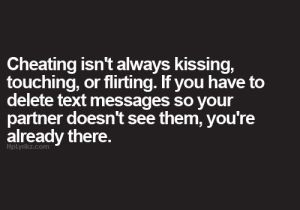
This is where I disagree with the notion that people don’t realize it until after they’ve crossed the line. They knew all along that they were doing something wrong. They may have set lines that they believed they wouldn’t cross. The problem was, they set those lines incorrectly. Instead of setting the line at kissing or sex, it should have been set at other things. It should have been set as soon as you were doing something that you felt you needed to hide.
textingcheating

Emotional Affairs

There are all sorts of great articles on emotional affairs, but here are a few signs that your relationship has crossed the line:

  • You share frustrations about your marriage or relationship with the other person
  • Your flirting is starting to get more aggressive and intense
  • You are arranging to meet the other person for things like coffee and lunch, but you neglect to tell your partner about this
  • You are thinking about and contacting the other person at unusual times – early mornings and late at night

If you are doing any of the above, you may still be telling yourself that it’s innocent, but in your heart you know that you are lying. It may or may not have become physical, but guess what, it’s still an affair. And if you don’t actively stop it, you run the risk of it getting more serious.

cheating8

What to do?

I opened with talking about my buddies lunch meeting. The fact that he was asking my opinion tells me that he already knew the answer to his own question. Affairs don’t just happen, they are a result of choices. If you want to stay faithful to your partner the best thing you can do is not put yourself in a situation that can result in an affair.

One thing about affairs is that happy people don’t cheat. Chances are, if you are thinking about other people then there is something missing in your relationship. In my buddy’s case, he’ll be the first to acknowledge that his marriage is “in a rut”. Being in an unhappy situation makes you more likely to look for happiness elsewhere.

Thing is, affairs are the easy way, and I would even suggest the cowards way out. If your relationship is in a bad spot, look inwards and see what you can do to repair it. Make it your priority and work together with your partner to see if you can repair things. If you find you can’t, accept that your relationship has ended and go your separate ways first.

But acknowledge the fact that you can’t actively work on your relationship if your mind is partially with someone else. You NEED to cut that other person out of your life completely if you expect to have any hope of addressing the issues in your relationship. Unfortunately many people believe they won’t be caught, so they try to have the best of both worlds.

One of my sons occasionally will do naughty things, and sometimes when I ask him to stop he tells me “I don’t want to, it’s fun”. He knows it’s wrong, but he does it anyhow because he enjoys it. That is a self absorbed approach to the world, and shows no respect for the rest of the family. He’s 8 though, an age where the world seems focused just on you. If you are still doing that as an adult there’s a word for it – narcissism. If you are in a relationship it’s supposed to be built on trust, and respect. As soon as you cross those lines and start hiding things from your partner, all you are doing is showing you are not worthy of the trust they have given you. It may start small, but soon you are juggling two lives, and your pursuit of your own “happiness” is liable to hurt everyone around you.

People-Say-You-Dont-Know-What-Youve-Got-Till-Its-Gone

Relationships and Possession

possessiveness

I read a fair number of relationship articles and blogs, and one thing that I see again and again is that women don’t like it when men become possessive. Um, yeah. That seems like it should be fairly obvious (women do this too, but men seem to be bigger jerks about it).

The word possession implies ownership, and no one likes to think of themselves as property. Plus when you hear stories about it, they are commonly accompanied by stories of someone trying to control the other person. That seems like bad news all around.

Then I got thinking, don’t we all kind of think of our partners as “ours”? We don’t necessarily think of them as our property, but think of some of the things you’ll see on cards:

ImYoursYourMine

I’m yours? You’re mine? Those terms are actually kind of creepy when you think about it. We use them as terms of endearment, and they need to go both ways. But it does seem like there’s a degree of ownership there.

Are Relationships Possessive?

So are committed relationships inherently possessive? I don’t think so. I believe they are built on commitment and trust (which go hand in hand). But this commitment and trust NEEDS to be mutual. For you to truly commit to someone you have to believe you can trust them, and you must also believe they are committed to you.

Fear

Have you ever thought about fear? Fear is largely a learned emotion. There are instances where fear is believed to be innate and related to perception (there’s a classic study with babies and “visual cliffs” that you can read about here). But by and large fear is a defense mechanism that develops when we experience things that we come to recognize as threats.

As we learn that things are threats, these threats elicit the fear response, accompanied by physiological changes such as increased heart rate, breathing and potentially shortness of breath. Here’s a Wikipedia link to it if you want to learn more (it’s pretty fascinating stuff when you think about it).

So fear is a good thing. It’s a rational response to a perceived threat, and is one of nature’s built in ways of protecting us.

Anxiety

Fear is rational, however it can also become irrational. When this happens it moves into the realm of phobias and anxiety. Everyone has their own phobias (spiders creep me out). Anxiety is more subversive though, because it is like the fear of fear. It’s irrational, but seems very rational to the person experiencing it.

I have plans to write more on Anxiety in the future, but for now I’ll just steal a somewhat amusing description from a book I read on it (paraphrasing as I don’t have the book handy).

Imagine you are on an African safari, and you are sleeping in a tent on the savannah. You hear a noise and wake up and you suddenly worry that it may be a lion, and you may be eaten by a lion. That is fear.

Now imagine you are sitting at a bar in New York. You hope to one day go on an African safari, and suddenly you find yourself experiencing the physiological fear responses because you believe that if you go you may be eaten by a lion. That is anxiety.

Anxiety is more complex than that and I don’t mean to downplay the seriousness of it. But generally anxiety is an irrational response to perceived threat, situation or even future situation.

Perceived Threat

Alright, so you may be wondering what the heck all of this has to do with relationships, commitment and possessiveness.

If you are in a truly loving, committed relationship with another person, then you are in a position of mutual trust and respect. When your partner is out you don’t even think about it as you trust them implicitly.

Fear is learned though, so if you have been hurt or betrayed by someone close to you before then it is a natural defense mechanism for you to experience fear if you perceive a threat to the relationship through your partners actions or behaviors.

When people start to feel threatened in relationships it can cause them to either pull away, or start to hold on too tight. Jealousy is fear that you are losing the relationship to someone else, and it can turn into control and possessiveness as someone is trying to hold on and try to regain some control over the relationship they feel they are losing.

Rational and Irrational Fear

When it is based on tangible evidence, Jealousy can be a rational fear response. There are all sorts of warning signs when a relationship has taken a negative turn, and you can usually “feel” the shift. You know something has changed. Counselors will often tell you to trust your instincts on these things, and that if you feel something is wrong you are probably right.

But what if it’s really an irrational fear response? People who are insecure or who have been hurt in the past are more likely to experience this. They are more likely to be hyper vigilant for any sign of threat to the relationship, and run the risk of perceiving threat when it’s not actually there.

Love and Trust

Jealousy can be a normal reaction to things, and I believe even the most emotionally secure of us have felt it at one point in time or another. But whether it’s rational or not, jealousy is still very corrosive to a relationship.

Relationships aren’t based on possession and control They are based on commitment and trust, and jealousy involves a breakdown of these. This is one of the many reasons communication is so important in relationships.

We all will do things to hurt our partners from time to time (hopefully inadvertently). But it’s important that we don’t let things fester and grow. We all have our own insecurities, and being honest and upfront about those insecurities is important. Get issues out in the open. If your partner understands the ways you have been hurt in the past then they may be more conscious of things that could be seen as threats by you.

One of the dangers of being hurt is that it can cause us to build up walls to “protect ourselves” from being hurt again. But those very walls that we build up are also likely to be the things that push people away from us. To truly love, you need to let those walls come down. It’s not easy, but you need to allow yourself to be vulnerable to being hurt again.

And you may be. Life has no guarantees. You may be hurt again, and love may break down. But possessive behavior won’t help anything. The simple fact is, you can’t control someone else and you can’t make them love you. The only one you have control over is yourself. There’s a line from a U2 song that says:

You can hold onto something so tight, you’ve already lost it

Being possessive and trying to control won’t help anything; it will just push someone further away. Try to operate from trust instead of fear. If you believe someone is violating that trust then communicate. It may just have been your own insecurities and irrational fear. And if it was a legitimate breach of trust, it may be a situation you are better off getting out of.

When is it too late?

crossroads1

Relationships will always run into troubles. They are an unavoidable outcome of two different personalities working together. Traditional wedding vows even come with that warning built in. When your commitment is supposed to be “in good times and in bad”, the implication is that bad times will exist. We all know this intuitively. But sometimes the bad times can overshadow the good times, threatening the relationship.

Think of your relationship as a bank account. A while back I posted something about a marriage box, but a bank account works better because it can hold a negative balance. All the good moments in your relationship are deposits into the “Relationship Satisfaction” account, while the bad moments are withdrawals.

Good times act as a buffer against bad times, and ideally your account “balance” always stays positive. During hard times your account may run into a negative balance, and it’s normal for this to happen occasionally. But if the account is in the negative for extended periods then some sort of action is required.

Maybe the account owners can take a good look at how they got there and come up with a plan to get out of the hole together. Maybe they want to get out of the hole but are having a hard time doing it so they need to bring in outside help to come up with a plan. But sometimes the only recourse seems to be declaring bankruptcy.

When your relationship is in a critical spot you may find yourself wondering if it’s possible to save the relationship, or if it’s too late. If this happens, it’s time for some serious reflection.

Reflect

Before making any decisions it is a good idea to reflect on where you are and how you got there. The saying “those who don’t learn from the past are doomed to repeat it” is very true.

What are the problems? Can you identify the issues that are causing conflict for the two of you? Often the surface problems are really only symptoms of deeper issues, and it can be difficult to look at a situation impartially when you are emotionally invested in it.

If you are having difficulty identifying the issues then try to focus on the good. There has to be at least some good, or you wouldn’t be together. So what has been good? What have you learned? Is there anything that you would do differently if given the chance, and if so is it too late to do that?

One of the many challenges long term relationships face is that it is natural for people to drift apart over time. Caught early enough this can be an opportunity for a couple to throw out what hasn’t been working, and strengthen their bond for a better future. But sometimes it is caught too late and it marks the end of the relationship.

Things to think about

In addition to reflecting on the specifics of your relationship there are a few other things that are important to consider.

Statistically, first marriages are the most successful with divorce rates rising considerably for second and third marriages (I haven’t seen stats on non married long term relationships, but I suspect the numbers are similar).

I found this surprising. I expected people learning from their mistakes and wanting to “be better” next time to result in improved marital odds the second time around. So why is that not the case? The main reason is that a marriage is about more than just the two people in the relationship. They are the key players, but additional factors act as the glue holding a relationship together.

Children (if present) are the biggest one. But even in the absence of children there are things like families, joint friends and shared history. In leaving the relationship you are often leaving behind much more than just the other person, and that can be very difficult. Obviously the length of the relationship plays a big factor here, but in subsequent long term relationships this glue that holds people together is often weaker.

Another important point is, the reasons the first relationship failed often impact the success of future relationships. Frequently people who can’t make a first marriage succeed fail at future relationships because they are either looking for something that doesn’t exist, or they bring the same baggage that destroyed their first marriage into subsequent relationships.

Statistically speaking your first marriage is really your best shot, so it’s important to make it count.

Moving on

If you decide to move on, it’s important that you understand why you are moving on. What do you hope to change? What do you hope will be different next time?

One thing I would strongly recommend is that you leave the relationship on it’s own merits (or lacktherof), and not because you already have another relationship lined up, or because you have started another relationship already. Too often people it seems people stay in a situation where they weren’t happy only because there is nothing better available, and then they leave when something “better” comes along.

There are countless stories of people who leave a relationship for something new only to wake up six months to a year later and realize they made a mistake. If you have entered another relationship or have one waiting in the wings, you can’t fairly judge your current situation.

Don’t expect the next relationship to be “better”. It may be, but chances are you contributed to the demise of your current. So take a look at yourself and see what you can do better next time, and use this as an opportunity to grow as a person. If you bring the same baggage in, you will often end up with a similar result.

When a relationship ends there are hurt feelings, and often a period of grieving is needed. It’s natural to need to vent and want to lash out, but try not to cast your ex in a negative light. Treat the relationship as a chapter in your life. You once cared deeply about each other, so try not to let the hurt override the fact that you did have good times.

And remember that giving up doesn’t mean you are weak. Sometimes it means that you are strong enough to let go.

Rebuilding

In order to rebuild, both people have to truly want it. If two people still love each other then it’s never really too late to rebuild a relationship. Anything can be worked out. But rebuilding is often the hardest path.

If you need to rebuild, then there have obviously been issues that have put your relationship in jeopardy. But in order to move forward together, you have to let it go. This doesn’t mean you forget about something and pretend it never happened. You must address it, forgive, and be willing to start fresh.

I can’t recall where I found this passage, but it says it beautifully:

Forgiveness is the only way to heal your emotional wounds. Forgive those who hurt you no matter what they’ve done because you don’t want to hurt yourself every time you remember what they did. When you can touch a wound and it doesn’t hurt, then you know you have truly forgiven.

In rebuilding, you will need to redefine your relationship and the future will be different from the past. It has to be. Years of established patterns can be hard to break, so it is likely best to find a skilled counsellor to help you find a new path forward together.

Rebuilding is very difficult. But it can also be very rewarding to know that you were able to persevere and stick together when times were the hardest.

Making a decision

So when is it too late to save a relationship? There’s really no magic formula, and no right or wrong answer to that question.

The one thing I will say though is that if your relationship is at a crisis point, the worst thing you can do is nothing. If you recognize there is a serious problem you can’t just ignore it and hope that it will pass. Problems don’t solve themselves, and they don’t go away on their own. You need to either roll up your sleeves and go to work as a couple, or accept that the relationship has ended and move on with the process of healing.

Whatever decision you make, the fun part is that you will never know if it was the right one. But you can’t let yourself dwell on that. Don’t ask yourself if there was anything more that you could have done, because there always will be. Instead ask yourself if you have done enough.

Life will work out

Life is a journey, and most of us hope we can find that special someone to share our journey with. But your journey is exactly that, yours. It’s a personal journey, and there is no single correct path.

We can’t know the future, and there are no guarantees in life. You will never know if the decision you made was the “right” one or not. The only thing you can ever say is that it was the right one for you at the time that you made it.

In the words of James Mercer (of the Broken Bells):


But I’ve been turned around
I was upside down
I thought love would always find a way
But I know better now
Got it figured out
It’s a perfect world all the same

It IS a perfect world.  It’s complicated, and broken, and perfect all at once.  Life doesn’t always work out the way you expected it to, but that’s alright, because it WILL work out. You only have one life, so make the best of it.

Sorry about the Affair, it “Just Happened”

cheating2

Affairs. Cheating. Adultery. Infidelity. It doesn’t matter what you call it, it happens with an alarming frequency. If you look up statistics the numbers you find will be all over the map. But based on the numbers I’ve read, 20-25% of women, and 30-40% of men will have an affair during a marriage or other committed relationship. Even plus or minus 10%, those are staggering numbers.

Of all the issues a couple can run into, nothing is as damaging as an affair. Often they signal the point of no return for the couple. Relationships are built on trust and mutual caring and respect; and affairs tear those foundations down. Even when relationships are able to rebuild and recover after an affair, the landscape of the relationship has fundamentally shifted. As the saying goes, you can forgive, but you never forget.

Types of Affairs

In a prior post, I talked about types of sex. There’s sex as the physical act and intimate sex, where it goes beyond the physical act and is also an emotional connection. Similarly I see two types of affairs. For lack of a better term I’ll just call them “sex affairs” and “love affairs” (if anyone has better names let me know).

Sex affairs are purely about sex. This may be one night stands, or it could be a recurring sexual relationship where there are no expectations beyond the physical side of things.

Love affairs go beyond the physical. There is actual connection between the two people and they want to see each other for more than just sexual gratification.

Sex releases oxytocin, which helps facilitate feelings of trust and attachment and build connection. So sex affairs can develop into love affairs, because the sex can lead people to believe they have fallen in love with someone just based off of the sexual connection.

Although there are differences between the types of affair, there are also similarities. In both cases, the person engaging in the affair knows they are doing something “wrong”, but they figure it is alright as long as they don’t get caught. Some people get away with it for years. Sometimes their partners find out but turn a blind eye to it. Other times their partners find out and they confront the person. When forced to confront the affair, either to themselves or to their partner (when they are caught) the offender often has all sorts of reasons and excuses as to why they did it.

Rationalizations

From various relationship books, articles, blogs, and the comment sections on blogs I’ve seen many different rationalizations given for why people have affairs. I don’t believe I have ever been the “victim” of an affair, but I feel strongly about commitment and that causes me to have pretty strong feelings on affairs (you’ve been forewarned). Here are some of the common rationalizations I have seen, and my thoughts on them …

It just happened
Really? Things like that don’t “just happen”.

Imagine you are out for a walk. While walking you trip, and another person sees you falling and tries to catch you. Now let’s also imagine that while you are falling there is some strange wind vortex that causes both of your clothes to come off and at the same time makes it so instead of the person catching you with his/her hands they catch you with their genitals. Oh yeah, they also happen to catch you on your genitals, causing to two of you to get tangle up by the genital area. Then, in the process of trying to untangle yourselves the wind pushes you back together repeatedly until one or both of you orgasm. Under those circumstances I suppose yes, it could have “just happened”.

But there are a fair number of events that have to happen in a certain sequence in order for this to take place. Is it possible? Anything is *possible*, so I guess so. Is it probable? Maybe I’m crazy here, but I’ve got to say no. So no, I don’t think “it just happened” is really a viable rationalization.

It didn’t mean anything
This one is a bit better, as the person is partially taking ownership of the issue. They are acknowledging they made the decision to cheat. But they are saying it’s alright, because it didn’t mean anything. “Oh yeah, I did have sex with another person. But don’t worry, because I didn’t actually care about them. It’s really you that I care about”.

It didn’t mean anything? Umm, yeah, actually it did. The affair may not have meant anything with regards to their feelings for the other person. But it meant a lot in terms of showing how they value their partner. It meant they put their own personal desires above the commitment of the relationship. It meant commitment is something they feel they can turn on or off as it suits them.

Affairs are Romantic
Of all the rationalizations I’ve seen this one is my personal favorite. When I’m picturing a romantic setting I tend to visualize things like a candle lit dinner to the backdrop of soft music. Or holding hands and walking down the beach during sunset. Or even just curling up with my partner and simply enjoying their presence.

Maybe my thinking just isn’t as progressive as it could be, but for some reason the prospect of having sex with someone other than the person I am currently in a committed relationship with doesn’t qualify as romantic (even if it is done by candlelight, on a beach at sunset).

I suspect the person just had a poor choice of words, and what they really meant was affairs are exciting. That I can kind of understand.

As a kid I remember sneaking a peek at my Christmas presents. My brother showed me a technique where I would cut the tape on one side of the present, open it to see what it is, and then just cover it over with another piece of tape. I was often able to find out what I was getting in advance, and it was difficult to detect. Sure, it took the fun out of Christmas; but at least I could plan out which presents I would play with first! Around the same age I discovered swearing, and I would frequently swear with my buddies. I would even occasionally sneak (alright, steal) a dollar from my mom’s purse to go buy candy. There was a degree of excitement in doing something I knew was wrong. Of course I was about eight or ten at the time, and eventually I grew out of these things.

I’ll admit these aren’t exactly the same as having an affair. But there IS a bit of an adrenaline rush and excitement in doing something you know you shouldn’t be doing. If you get your kicks from the danger of being caught doing something wrong, then I can see how there would be an allure to affairs. But that doesn’t make them romantic.

We can’t control who we fall in love with
While it’s definitely possible to love two different people at the same time, it doesn’t happen overnight. It requires intimate sharing of emotions and feelings to build the connection that leads you to fall in love with someone. And that is the part you DO have control over.

If you are committed to someone else, you owe it to them to not take actions that will jeopardize your relationship. Don’t put yourself in situations where this is a risk. If you’re ever doing something and you know you wouldn’t be comfortable telling your partner about, then you know you probably shouldn’t be doing it. If it’s something like buying yourself a new outfit, then maybe those little lies by omissions aren’t that harmful. But when it involves interactions with another person? Sorry, people know when they are crossing certain lines. They just choose to do it anyways.

Let’s say it does happen and you find yourself having fallen in love with another person? Well then you have a choice to make. Have enough respect for your partner to end one relationship before moving forward with the other one.

I wasn’t happy
This is at once obvious and troubling. There’s a saying “happy people don’t cheat”. If you are happy in your relationship why would you?

One of the first questions I would have for someone in this case is “Why aren’t you happy?” All sorts of things can cause unhappiness, and it may have nothing to do with the existing relationship.

If you aren’t happy in your relationship, you are more likely to be taking actions that put you at risk of falling in love with someone else. But like I said above, if you find yourself in love with someone else pick a relationship and move on.

The Real Reasons

Alright, we’ve had a few common rationalizations. Now let’s get down to the actual reasons that people have affairs (well, according to me).

A big part of affairs is emotional immaturity. This isn’t overly surprising when someone is young (say early twenties), but it becomes a bit alarming when it persists as someone gets older. I’ve seen exchanges where a guy points out a girl and tells another guy that he’s “banged her”. To which the other guy says something like “nice”, and they fist bump. The girl in those cases is simply a conquest, another notch on the bedpost. There is no interest in a relationship; this is just hedonism.

Commonly people who have affairs have self image issues. They need the validation of another person wanting them sexually to make them feel good about themselves or give them an ego boost.

Another reason for affairs is selfishness. Someone wants the positives of a committed relationship or marriage, but they don’t want the restrictions that come along with it. They feel they should be able to have the best of both worlds. Their focus is “them”, and their pleasure. They don’t respect their partner. They may claim that they do, but if they did would they really be having an affair? Hell, I doubt they even respect themselves. Commitment involves trust, and by having an affair they are showing that they aren’t deserving of that trust.

If an affair is a love affair and not just about sex, it can be more problematic. Love affairs are often symptoms of deeper underlying issues. They may be issues with the existing relationship, or personal issues. Either way, the affair becomes a way of trying to fill a void that they are feeling. Just as some people turn to drugs or alcohol to “deal” with issues, others turn to sex.

People should work on their relationship first instead of trying to fill a void by stepping outside of it. Try to understand what’s wrong with your existing relationship. View any problems as opportunities to improve what you have, and work on it. Long term relationships aren’t always easy, and commitment shouldn’t only apply when times are good.

There are many cases where people have tried to repair their existing relationship and it hasn’t worked. When this happens, it should be decision time.

Don’t stay to “keep the family together”. That’s really just another excuse to try to have it both ways. A way to have the kids and the safety and comfort of home while doing whatever you want. If you’re having an affair chances are you have checked out emotionally on your partner. That not a good environment for the kids anyhow.

And don’t stay just for the financial stability of that comes with the existing relationship. Actions have consequences. If the current relationship was bad enough that you decided to stray, then be willing to accept the consequences. It won’t be easy, but it shouldn’t be.

Putting in your Notice

Have you ever changed jobs? With jobs, most people line up a new job before they put in their notice to quit their existing one. That’s fine, because jobs are a form of a contract where what you do outside of work time is your own business.

If you aren’t happy with your current job you can start looking for a new one, and if an opportunity comes up you take it. You put in your notice and for two weeks or so you show up to your current (now old) job, while counting down the days until the new one begins. If you don’t get the job it’s no big deal because you still have your existing one to fall back on.

Many people do the same thing with relationships. Often a relationship ends and it’s amazing how quickly one of the parties finds themselves in a new one. I suspect the “new” one was often in the works or already started before the old one ended.

Unlike jobs, the commitment of a relationship doesn’t have set hours. And it doesn’t only apply when your partner is around. If you are in a committed relationship with someone, no matter what state it is in now, at one point in time you cared about that person. If the relationship has broken down to the point that you believe it is beyond repair, or if you believe you have fallen in love with someone else, you owe it to the love you once shared to end the relationship before starting one with someone else.

Disposable Love

A while back the keypad started to go on my microwave at home. First one number went, then a few months later another one, until finally I only had 2 or 3 working numbers. I have to tell you, it was REALLY annoying. I was coming up with all sorts of bizarre timing combinations in order to heat something up the way I wanted. Stuff like “Hmmm, I need to heat this for 90 seconds? Only my 3 key is working so I guess I’ll heat something up for 33 seconds 3 times, and take it out a bit early on the last time.” Yeah, it was a pain in the ass.

I talked to a buddy who is more mechanically inclined than I and he told me that for the cost of having someone come look at it and repair it I was better off getting a new one. Microwaves are pretty cheap, but I still felt guilty. The microwave itself worked perfectly fine, it was just the keypad that was broken. Yet off I went to an electronics disposal place with a microwave that was probably 90%-95% functional.

This happens all the time. What’s that, my printer isn’t working right? I guess I’ll get a new one. My couch is looking a bit tired? No problem, I’ll replace it. Issues with my camera? Ah, that one was 2 years old anyhow (gasp!!!), I can get a new one that will be WAY better, and have more features for less than it would cost to fix that one.

The Next Shiny Thing

It’s bad enough that we live in a world where it’s easier to throw things out than to fix them, but marketers have also been able to convince us that we need something new when the thing we have is still working perfectly fine.

Have you ever tried getting rid of a CRT television (tube TV)? Landfills are full of perfectly functioning ones, and no one wants them. You literally can’t give them away. Why? Because flat screen TV’s are the way to go. Heck, I know guys who had amazing TV’s and got rid of them to buy new ones because the refresh rate went from 60-120 MHZ. Any sort of feature rich gadgets are bad for this. There are probably massive landfills full of discarded mobile phones and computers/tablets.

Our society is insatiable, we are never satisfied with what we have and we always want more.

The Blame Game

Another societal shift seems to involve attitudes around responsibility. Maybe it’s always been this way, but it seems that in the past ten to twenty people have taken on the role of either passive observers or victims. Things happen, and it’s rarely our own fault. Instead, things happened because of this, or that.

North America has become infected with a litigation mentality. Late night television is full of commercials for “ambulance chaser” lawyers, telling you that all the bad things that happened to you aren’t your fault, and if you hire them they will get you money from the people who are REALLY to blame (If you’ve watched Breaking Bad, think of Saul Goodman – love that guy).

Impacts on Relationships

These attitudes have seeped into views of relationships. There seems to be a rise in the perception that problems in a relationship are unnatural, and that if a relationship is not perfect then it signifies that there is something inherently wrong with it. There is a romanticized notion that you don’t have to work at a relationship if you find “the perfect match”.

As a result people are throwing away relationships that are largely good, because they don’t want to put in the effort to work on the parts that need improving. It’s the same “disposable” attitude that occurs with consumer goods. Many people look at relationship problems and think they are unfix-able. Or they say “yeah I could fix this, but it would take a lot of effort. Besides, I can just get a newer model that’s faster, sleeker, shinier and has more features. It’s not worth the effort.” It’s too difficult to work on something and face the realities of how people got into the situation they are in. It is easier to just walk away.

I’m not suggesting that someone should stay in a relationship no matter what. But I do think that there are many relationships out there that are worth putting the effort in, worth fighting for. Yet many people can’t be bothered to put in the effort.

Instead of just landfills full of “stuff” our societies landscape has become littered with broken families, broken hearts, and lost hopes and dreams.

But He/She did it first!!!

A few months back I was listening to the radio on the way into work, and they were asking people to call in and share their thoughts on the following scenario:

The announcer had a friend who’s husband had an affair. The couple had worked through things and kept the marriage together. But now, the wife felt that because he had strayed she had a “free pass” to do the same.

I was disappointed (but not surprised) that callers largely backed the wife’s idea of having a free pass. Personally, I don’t get this. What the guy did was wrong, and it destroyed any sense of commitment and trust between the couple. For the couple to truly move forward, that commitment and trust needs to be rebuilt. I understand pain, anger and a sense of betrayal. But if your goal really is to move forward with the relationship, retaliation accomplishes nothing. If anything it’s counterproductive, as all it does is layer hurt upon hurt.

Taking Ownership

In my university days I remember a discussion on rights. It’s common to hear people talk about their rights – I have a right to this, I have a right to that!!! The professor of the class talked about how no one is ever entitled to anything, and rights come hand in hand with responsibilities. In order to claim a “right” FROM someone/something, I have certain responsibilities I must meet TO that someone/something.

I had never thought of it that way before but I loved it. Everything in life has a cost, and this applies to relationships too.

What is the “cost” in relationships? I think that’s an easy one. If you want to get anything out of a relationship, you need to be willing to put into it. In happy times, this exchange is easy and happens naturally. We want to please the other person and make them happy, so we do little things for them to show them we how much we care. And when we are giving of ourselves, we naturally receive in return.

This gets harder when times are tough. During these times we are less inclined to give of ourselves, and we can become suspicious when the other person does. Have you ever had a moment when someone was being nice to you, and you found yourself questioning what their angle was? “He bought me flowers? What did he do? What does he want?”

It’s easy to blame issues in a relationship on the other person. And realistically, there may be one person who owns a larger share of the blame for a distressed relationship. But there are still two people involved. Instead of looking at all the things the other person is or isn’t doing, people need to take a hard look in the mirror.

Take ownership of an issue. Instead of pointing a finger, ask yourself what you can do to help things. How can you help improve a situation?

Built to Last

Relationships require work. Many people say they know that, but don’t understand it and aren’t willing to put in the work when things get difficult. In a relationship, the only way forward is together. You need to communicate. You need to be able to put aside any hurt or resentment

This picture says it all:

MarriageLongevity

Our society is always looking for the quick solution, the easy way out. Think of all the diet fads that profess to allow you to eat all the foods you want and still lose weight. Think of all the get rich quick schemes. The people who market these things succeed because people don’t want to do the hard work. They want to believe there’s a magic wand out there that will make everything better.

Unfortunately there are no magic wands. Actually ever if there were, it wouldn’t matter. I’m a fan of the Harry Potter books and movies, and I’m reminded of a scene near the end of The Prisoner of Azkaban (my favorite book and film btw). There’s a scene where Harry believes something is going to happen, and he’s waiting for it. But at the last minute he realizes that nothing is going to happen, and he will have to take action himself. Even a magic wand is useless without a desire to facilitate change, and make things better.

Acceptance

All relationships hit “rough patches” eventually. And sometimes it can seem like things will never get better, and it’s easier to just walk away. But instead of looking for the “next shiny thing”, look at what you do have. Focus on the good that you do have, and see the difficult times as opportunities for improvement. In the long run, overcoming challenges together will only strengthen a relationship.

No relationships isn’t perfect. Sure it’s possible that there’s someone else out there you could be happier with. There will always be something newer, shinier, and with more features (so to speak). But does that matter? Look to work on improving what you do have, and accepting that it is “enough”.

You’re not alone (Identity Crisis – Epilogue)

The focus of my writing is relationships (specifically long term relationships), and the trials and tribulations they can run into. As my thoughts on relationships have evolved I have realized that beyond the interpersonal dynamics that come to play in a relationship, everything is still built on individuals.

In relationships the whole is often greater than the sum of the parts. But at the same time a chain is only a strong as its weakest link. Cliché? Sure. But that doesn’t make it any less true. When one person is going through a difficult time, the other person needs to step up and help them. One individuals problems affect the whole relationship, and can potentially destroy it. So for the health of both the relationship and the individual, it’s very important that the members of the relationship deal with their own issues.

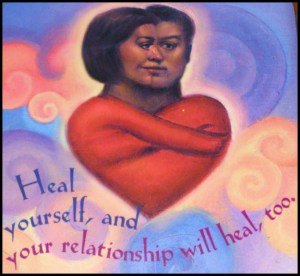
HealYourself

Because of that, the last few weeks I’ve taken a bit of a step back and focused more on the individual. My last two entries have been about understanding who we are, and accepting ourselves for who we are. Today’s entry finishes off that line of thought with a few additional thoughts that didn’t quite fit anywhere else.

A Perfect World?

I would like to think I came from a pretty good home. I’m sure it was better than some and worse than others, but for me it was home. Back in my high school days I had a buddy who would hang out at my place (my parents place) all the time. One day when he was over, he witnessed some sort of a family blow up. I can’t remember the details, but as with any family it could have been any number of things. I do remember what came next though. In the awkward/embarrassed silence that followed, he turned to me and said

I always thought you had the perfect family, but yours is just as screwed up as mine.

Fast forward many years, and a few months back I was talking to another friend. His family is going through some very difficult times, and he needed to vent. You know how on a hot day when you look down a road into the distance you can see the heat radiating off of it? This was kind of like that; as he talked I could almost see the pain radiating off of him. When we parted we did one of those awkward half pat man-hugs, acknowledging that something significant had just passed between us, but we weren’t quite sure what to do about it. He thanked me, and told me that he was glad we talked because it’s been weighing him down and he doesn’t really have anyone else to talk to.

These stories illustrate two very important things to me:

  1. We tend to believe other people’s situations are better than our own. In reality, every person and every family has their own issues.
  2. When our own issues are weighing us down, we often feel alone.

Dealing with Pain

I have always considered myself a “strong” person, and believed I could deal with anything life threw at me. I have also always been fiercely independent, taking a sense of pride in the fact that I had been able to fairly successfully navigate the waters of life on my own.

When my life took its unexpected turn a few years back, all of that was tested. I found myself in waters I couldn’t navigate and I was flailing, drowning if you will. I was a basket case, and from day to day I had no idea how to cope. It was a difficult time, and thinking back what stands out the most is how alone I felt.

I knew I had people who I could turn to, but I didn’t even want to talk to my closest friends and family. I didn’t want to tell them what was going on. I was embarrassed by it. To tell people would be to admit it – to admit that I was a failure. So instead I tried to pretend nothing was happening. I got up every day and got ready for work. But now in addition to putting on my clothes I had to put on my fake smile, while inside of me everything felt broken.

Sharing Your Story

The first person I opened up to was my brother. He will probably always see me as the annoying little brother, but to me he’s always been an easy person to talk to and I’ve always known he would be there if I ever needed him. One of the things I remember from those early conversations is him telling me to make sure I had my support net – people I could talk to.

One of the next people I talked to was a close buddy. I felt guilty “dumping my issues” on him because I knew he was dealing with some fairly serious issues of his own. But something interesting happened. Although our situations were different, he could relate to everything I felt. All the emotions I was going through were things that he had gone through as well. And my opening up to him allowed him to open up to me as well. We talked, we laughed and we cried. But that opening up and allowing ourselves to be vulnerable was cathartic. And I would like to think it helped both of us.

Over time I opened up to more people and I was surprised by how common my story was, and by how many people were going through similar issues. One guy’s wife left him just after their first child was born because she found the role of wife and mother wasn’t quite what she expected and she wanted “to be free”, another guy found out his wife was having an affair after many years of marriage, and yet another was living in a marriage where he and his wife were nothing more than roommates anymore. The stories were different, but the pain was the same. So was the sense of isolation and the feeling of failure.

Knowing that other people were going through similar things didn’t change my situation, but it made me realize I wasn’t alone. And somehow that helped.

Struggling to Cope

About a year ago a co-worker killed himself, and it sent a wave of shock through my company. Suicide? The guy in question had always seemed so positive and happy. How could this happen? That got me wondering if he had also been getting dressed every morning and then putting on a smile, hiding the turmoil inside.

I didn’t know him well, and I don’t know what his support net was like. Maybe if there were more people he had been able to open up to, he would still be here today.

Suicide is pretty extreme, and I won’t pretend to know the specifics of his case. But I will say that everyone has their own ways of coping with things. Usually those approaches work for us and we are able to “get by”. But sometimes we face situations or issues where our coping mechanisms are no longer sufficient, and we don’t know what to do.

I’m guessing this is how a lot of addictions start, as they are ways to numb ourselves to the situations that we are facing. And this is also probably where mental health issues start to arise. I’m not a doctor, but from what I understand mental health issues often arise due to a traumatic event or prolonged periods of stress causing brain chemistry to change slightly, altering the way someone perceives the world.

When I was younger I would hear stories of people “snapping”, and having some sort of mental breakdown or psychotic episode. The person in question was always referred to as “going crazy”. The things that make the news are always the extreme cases, but like everything else it can happen to varying degrees.

We are all Damaged

Look around at the people you see on a day to day basis – your co-workers, friends, classmates, even your family. How well do you really know them? If you think back to my gemstone analogy, we only see certain aspects of people.

We choose which parts of ourselves we present to the outside world, and it stands to reason that the parts we show are the ones we are least likely to fear being judged on. Statistically speaking, some of the people you talk to every day are struggling with very real issues. Alcoholism, drug abuse, gambling problems, serious illness (both physical and mental) to themselves or a loved one, failing marriages…

…the list goes on. It is probably happening right in front of you, and you don’t see it. They come to work every day, putting on their smiles, and trying to mask the pain they feel inside.

Even for your closest friends and family, you may know them well but do you really know the intimate details of their lives? You may know their job, but do you know how much money they make? You see the material things that are on display like their clothes, their cars and their homes. But do you know what their level of debt is? You may see how they interact with their spouses in public, but does that really tell you how happy they are in their marriage? Sometimes people hear about a couple splitting up and it comes as a complete shock. Sometimes the first thought is “I thought they were happy together”. Even with our closest friends and family, we still choose which parts of our story we want to reveal.

In reality, we are ALL damaged in one way or another. All the people you see on a day to day basis have their own flaws and issues. Everyone has problems. Every relationship has problems.

And you know what? That’s okay. It doesn’t make us any better or worse than anyone else, it just makes us human.

There is a crack in everything.
That’s how the light gets in. – Leonard Cohen

Don’t Compare!!!

Going back to my buddy at the beginning, he knew all the details of his family but had a limited view of my family. Comparing them, he thought we were “perfect”.

It’s a difficult thing to do, but try not to compare yourself to others. Because really, it’s impossible to do an accurate comparison. You know all the details of your own life, but you don’t know the details of anyone else’s. Chances are some parts of their lives are better than yours, and other parts are worse. Everyone has problems. Perfection doesn’t exist.

It is especially damaging to compare relationships. You don’t know the details of someone else’s life. Chances are, it has problems too. Instead of focusing on what you are missing, it’s better to focus on what you can do to improve things.

Another common problem is comparing your current relationship to a previous one. There may be some things that were better before, but how much time has passed? Are you the same person you were then? Did you have the same responsibilities then that you do now?

If you are ever making comparisons about your life or your relationships to look at what is wrong, or missing, you are doing yourself and your relationship a great disservice. No good can ever come of it. You need to judge your situation on its own merits.

Look for the Positive

Accept that there will always be issues, and that life will always have disappointments. It’s easy for the “bad times” to overshadow the good, but instead of focusing on the negative focus on what is good in your life.

Remember that you aren’t alone. Everyone has issues, everyone has problems. I haven’t read the book “The Happiness Project” (it’s on my to-do list), but from what I know of it, it mirrors my personal philosophies. Happiness is a choice. Perhaps you can’t “make yourself be happy”, but at the very least you can influence your level of happiness by how you approach life.

Look for the positive in things. Instead of focusing on what is wrong, look at all the good around you. Take time out every day to appreciate what you have instead of focusing on what you don’t. Accept that problems and issues are normal, and that’s alright. Problems are simply opportunities for improvement.

If you have been set in a negative mind-set this sort of change isn’t easy, but it is possible. Make it part of your everyday life. It will feel forced at first, but over time it will become natural.

Identity Crisis Recap

As individuals we are all seeking happiness, fulfillment and belonging. We are social creatures, and it is through our relationships that we find these things.

We are constantly juggling many roles though, and sometimes it can feel overwhelming and we can feel lost. I’ve talked to many people who have spoken of how they lost their identity in their relationship/marriage. Or more accurately, they allowed their relationship to define their identity.

Your relationship should be important to you. I would argue that it, and the person you are choosing to be with should be the most important thing in your life. But they should never be the only thing. We are complex, and have many interests and needs. Always take time away from your spouse to pursue other interests. That time away is just as important for nurturing your relationship as the time you spend together.

Commit yourself fully to your relationship, body, mind and soul. Never hold back. This opening up and allowing yourself to be vulnerable allows you to maximize the satisfaction you can get out of the relationship. Yes, you will get hurt sometimes. But you will also be open to a level of connection that can’t be achieved if you build up walls to “protect yourself”.

In order to commit yourself fully to a relationship, you must first love yourself. Stop trying to play a role. No one is perfect, and that’s alright. You need to accept yourself as you are, and be able to say “I can always improve, but I am enough”.

Don’t compare yourself and your situations to others. Everyone has problems and everyone has issues. It’s part of what makes us human. In order to be happy, it’s important to focus on the positive and not the negative. Even problems are simply opportunities for improvement.

Lastly, when times are tough remember that you aren’t alone. Don’t be embarrassed to reach out and ask for help. Vulnerability isn’t a sign of weakness.

Accepting who you are (Identity Crisis pt. 2)

In the past few years I’ve read a lot of different relationship books, and most of them are psychology books. They tend to be factual and talk about the way people work, the way relationships work, positive and negative actions etc. They usually have quite a bit of valuable content, but honestly? Most of them are pretty damned boring to read.

Every relationship is different, so I don’t believe there is a “one size fits all” solution to relationship issues. So when reading something my approach has always been to see if anything resonates with me. If so, I try and adopt it. If not, I ignore it. A lot of the content in relationship books is just common sense – things that seem obvious. “be kind to your spouse”, “don’t sleep with other people” kind of stuff. But although obvious, they do talk about many traps that are easy to fall into if you aren’t careful. So sometimes getting a reminder of that “common sense” is beneficial.

The Gifts of Imperfection

The Gifts of Imperfection
Recently someone recommended I read “The Gifts of Imperfection” by Brené Brown. I knew a little bit about what it was about, but I was still expecting more of the same old dry psychology texts with case studies. I ordered it online, and when it showed up I was a bit alarmed to see a “featured by Oprah” sticker on the cover.

Now, I don’t think I’ve ever even seen a full episode of Oprah. The only time I ever see daytime television is at the dentist’s office and the daytime television of choice there seems to be Springer or Dr. Phil (which is surprisingly entertaining).

Even if Oprah was on, usually I’m only half paying attention. It’s kind of hard to focus over the sound of the drill, polisher or questions/commentary from the dentist (side note – why do dentists talk to you while they work? Their freaking hands are in your mouth – It’s not as if you can respond!!!)

Anyhow, although I’ve never watched Oprah I have this image of her stuff as being all new age touchy-feely. Sure I spend a lot of time thinking and writing about relationships, and I’m relatively in tune with my emotions. But I’m still a guy. When I see a nail, I look for a hammer. I’m not sure if new age is really my thing.

But I bought the book, so I started reading. It opened with the following:

Wholehearted living is about engaging in our lives from a place of worthiness. It means cultivating the courage, compassion, and connection to wake up in the morning and think, No matter what gets done and how much is left undone, I am enough. It’s going to bed at night thinking, Yes, I am imperfect and vulnerable and sometimes afraid but that doesn’t change the truth that I am worthy of love and belonging.

Wholehearted living is not a onetime choice. It is a process. In fact I believe it’s the journey of a lifetime.

I mentioned earlier that when I read something, I see if anything resonates with me. And I’ve gotta say, that opener hit home. I didn’t just read it, I felt it.

If you’ve read any of my prior posts you will know that I believe life is all about choice. Your outlook on life is up to you. Happiness is a choice that you make. Even love is a choice. Situations and problems don’t resolve themselves – we choose what actions we take (and doing nothing at all is also a choice). So that opening really spoke to me.

This wasn’t like most of the books I had read. And honestly, it wasn’t even a relationship book. It wasn’t all about facts, instead it was full of big ideas.

I’m Worthy Now

One of the keys of the book was the idea that we as people are worthy of love and acceptance today. Right now. Many people believe they are only worthy under certain conditions: If they could get a better job, if they could lose 10 lbs, if they could gain the approval of their parents, if they could…

…well, you get the idea. If maybe our situation was different, or we were something other than what we are right now. Part of it may be fear – oh I can’t do this because… But another part of it is that people often don’t feel they are “enough” and they think they need to be something more.

The message was that you need to accept yourself as you are and believe in yourself. You need to accept that although the person you are isn’t perfect, you are enough. Embrace yourself and accept yourself for who you are. That’s not to say we shouldn’t all strive for self improvement. But we should be accepted for who we are and not feel we need to fit some mold.

Perfection Doesn’t Exist

One of my mantras is that perfection doesn’t exist – it’s an ideal for us to strive towards. And I’ve always thought perfectionism was striving towards that ideal. Brené Brown has a different take though, and she sees perfectionism as a bad thing. According to her:

Perfectionism is not about achievement and growth. Perfectionism is the belief that if we live perfectly, look perfectly and act perfectly, we can avoid the pain of blame, judgment and shame.

Healthy striving focuses on you. It occurs when you ask yourself, “How can I improve?” Perfectionism keeps the focus on others. It occurs when you ask, “What will they think?”

This had never occurred to me, but I think it makes sense. A healthy approach to problems is that they are opportunities for improvement. But I’ve seen cases where people get really upset when one little thing goes wrong. Something may be going 98% right, and instead of appreciating how well things have gone I have seen people who place what appears to be an irrational focus on the 2% that went wrong.

Numbing Behaviors

In our search for worthiness, people have things they turn to when times are tough. Escapes that allow them to take the edge off any pain they may be feeling. The book talks about numbing behaviors, and defines them as any actions people take to avoid experiencing the pain of feeling unworthy. Addictions are the most common things people would think of as numbing behaviors, and they can be drugs, alcohol, gambling etc. But really, anything can be a numbing behavior. Books, TV, the internet, Facebook, video games, even exercise.

Everyone has their own outlets, their own escapes. Any of these escapes can become an addiction when someone turns to these behaviors frequently and compulsively. That makes sense, but here’s the part that I really thought was interesting. She goes on to state:

We cannot selectively numb emotions. When we numb the painful emotions, we also number the positive emotions.

So when we turn to something to try and escape the lows points in life, at the same time we are dulling the enjoyment we can have, and limiting the high points in life.

Loving Yourself

Suffice to say, I enjoyed the book and thought it presented some really interesting ideas. The book was largely about learning to love yourself. In order to do that it says we need to:

Practice letting go of who we think we’re supposed to be and embracing who we are. Embracing who we are means accepting that we are not perfect, loving ourselves for who we are

I think that self love and accepting who you are is very important. And the importance of it can be seen when you look at how it impacts us in relationships.

At one point in the book the question is raised – can you love others more than you can love yourself? Brené Brown never conclusively answers that question (she has some arguments for and against), but here’s my take on it:

I believe that to feel loved we need to believe we are accepted for who we are. But if you go back to the gemstone idea from my last entry, it’s not easy to say who we really are. We are a lot of different things. In that entry I mentioned that the people who are closest to us are able to see the most of us, and our spouse should be the person who is closest to seeing the whole person. Everyone holds back to some degree though. We all have parts of ourselves that we are embarrassed of or ashamed about, and we try to hold those back even from those closest to us.

Here’s the problem – if we don’t love ourselves we are liable to hold more of ourselves back from the relationship. This is kind of like the numbing behaviors from the book. If we try to numb the pain, we also numb the positive emotions. As we hold back from our relationship for whatever reason (maybe we are scared to not be accepted or we are scared to fail), then we are also limiting the happiness that we can potentially have in that relationship.

What we get out of our relationships is directly proportional to what we put in. So for the greatest level of fulfillment we need to commit ourselves fully, body and mind to the relationship. But in order to fully vest ourselves in the relationship, we first need to be able to look in the mirror and be happy with what we see. And that’s not always easy.

So today’s advice to anyone out there is quite simply, love yourself. Love yourself and accepting yourself for who you are, and work on loving yourself every single day. Accepting yourself for who you are isn’t the same as resignation that you can never change. It doesn’t mean you can’t improve the things that you aren’t happy about. But it does mean that you don’t believe you need to change those things in order to be happy.

Till death do us part?

In a post about marriage, I mentioned that I see marriage as a way of symbolizing the commitment between two people.

I’m a big proponent of marriage. I love the notion of knowing that you want to share your life with someone, and that no matter what life throws at you, you will always be there to support the other person and that you in turn can count on them to support you. This sense of commitment is at the heart of what allows you to be more than just two individuals. So what exactly is commitment?

People buy starter cars, and starter houses. But I would like to think that everyone goes into their marriage with the hope and the expectation that it will last. I’m not sure about all cultures, but part of the marriage ceremony is usually reciting vows that represent an affirmation of the love and commitment the couple has for each other. The vows are usually something like:

In sickness and in health,
in good times and in bad,
till death do us part.

Those are some pretty significant words, and in the excitement of the moment people probably don’t really think about what they are agreeing to. Lets take a look at those lines:

In sickness and in health. This one seems easy enough, though some sicknesses can take a big emotional toll on people and relationships. Even still, most would agree that walking out of your marriage because your spouse is sick is pretty despicable (things like alcoholism and mental illness complicate this a bit).

In good times and in bad. This is a real tough one, and really illustrates to me that the marriage has to become about more than just two people. Let’s face it, you ARE going to have bad times. You are going to have times that you hurt each other, and times that you really don’t like each other. At those times love can seem tenuous, and it’s at those times that your commitment to one another will be tested the most.

Till death do us part. It may seem silly, but to me this is the dream. To know that it doesn’t matter what life throws at you, nothing will be able to get between you and keep you apart. Until you get to those bad times though, you don’t realize that the level of commitment required to make that happen is staggering.

Let’s say most people get married between 25 and 35, and the average life expectancy for men is around 80. That’s around 50 years for a marriage to stay together in order to hit “till death do us part”. People change, so that commitment needs to be there.

The Grass is Greener?

A while back I went for lunch with a female friend of mine who has been married for a number of years (probably 7 or 8). As we were talking, it came up that she’s a bit unsure about their future. She told me she loves him, but she’s spent time wondering if this was it, if this was as good as it got. She wonders if maybe there was someone else out there who she could be happier with.

It didn’t sound like she was overly dissatisfied, and she made it clear to me that she wasn’t looking for anyone else. But at the same time, she wondered. And from talking with some of her girlfriends, she found that she had other friends who were thinking through the same things. She told me that she was open with her husband about her misgivings, and it frustrated him (well, yeah!!!).

I have to admit, I was shocked. Here was someone I had known for years, who I’ve always believed had a good head on her shoulders. But the way she was talking she had some ambivalence towards her marriage.

Now I don’t know her husband well, but I’ve met the guy a few times. And between my impressions and the things she would tell me about him he seems like a pretty good guy. So of course I started to look at it the way most guys do – as a problem that maybe can be fixed.

I asked her some questions. Were there issues between them? No, not really. Was there anything wrong with him? Again, no. She couldn’t really articulate what was missing, she just had this sense that maybe there was something more out there.

Off to the gym…

Thinking of that conversation made me think of the gym. Bear with me a moment and hopefully this will make sense…

Have you ever had a gym membership? If not, have you ever bought a piece of exercise equipment for your home (same ideas apply)? Many people get a membership and at first they use it quite regularly. But after a while the novelty of going to the gym wears off and it’s not used as frequently. Things like work, kids, or just life in general start to get in the way. It gets harder to make it to the gym, and it seems like there just isn’t enough time.

After a while, people realize that they’re barely using the membership. They may look at it occasionally and feel guilty, knowing they *should* be using it. Once they’ve gotten out of the habit of using it, it becomes hard to motivate yourself to get back. Periodically they will make use of it, but once they’ve let it drop in priority the same effort isn’t there. They may still use it, but they are just kind of going through the motions.

Some people hold onto the membership anyhow, telling themselves that they will get back one of these days. Others realize that they won’t get back, and they cancel the membership.

Believe me, if you attend a gym regularly you see this cycle play out frequently. After a while you get to know who the regulars are and who the drop-ins are. Usually at new years the gym will get a rash of new people, but within a few weeks the numbers start to drop. Some drop quickly, others last a bit longer. In fairness, some do to stick it out and become new regulars.

The exact same thing happens in relationships. The success of a relationship really comes down to commitment. What you get out of a relationship is completely dependent on what you put into it.

You only get out what you put in

Thinking of the traditional marriage vows (listed above), I realize that they are missing something important. They really just talk about staying in the marriage under all circumstances (sickness, health, good times and bad), and that is part of it. But is commitment really just about staying in the marriage? Just because you haven’t physically left a marriage, does that mean you have kept your vows? No. Just like going to the gym and going through the motions won’t help you get stronger or lose weight, staying in a marriage doesn’t mean you are committed. Commitment is about what you put in.

Take a look at this:

MarriageBox

I love this concept of a “Marriage Box”, and to me it sums up everything about what it means to be committed to a marriage. I used to think the commitment was only about a refusal to give up. But the more I look at it I realize that commitment is not just about what it takes for someone to walk away from something, but it’s about what someone is willing to put in. It’s about not just worrying about yourself, but also dedicating yourself to you spouses welfare and happiness.

Self fulfilling prophecy

In the book “Love is Never Enough”, Dr. Beck gives examples of some of the couples he’s worked with. In one of the examples (starting on pg 221 if you’re interested) he describes a woman who had a negative image of relationships from her parents. She married, but for fear of getting hurt she never truly committed herself to the marriage. She held back, and was constantly looking for flaws in her husband as these gave her rationalizations for not fully committing herself to the marriage.

The problem is, by not fully committing she also caused considerable tension in the relationship. Her efforts to protect herself from potentially being hurt put her on the path to destroying the very relationship that she was scared of being hurt by.

Thinking of my friend, I wonder if there is something similar happening. Has she really committed herself to the relationship she has with her husband? I don’t know her situation, but she could take the time she spends thinking about what “could be out there” and focus it on making her relationship the best it can be.

The example from the book does seem to have a happy ending though, and I think it’s one we can all learn from. As the wife started to focus on the positives in her marriage she was able to commit herself to it more. As she gave more of herself, she ended up receiving more in return as her husband was more loving and attentive. Her relationship strengthened, and she found that as she put more of her heart into it, her relationship became more fulfilling.

The power of positive thinking

If you read my post on happiness, you know that I’m a big believer in the power of positive thinking, and I believe that it’s a key to happiness. Focusing on what you have instead of what’s missing will give you a greater appreciation of the things you do have.

When it comes to relationships I can guarantee that for anyone, in any relationship, there IS someone else out there that you *could* be happier with. But so what?

Perfection doesn’t exist, it’s an ideal. No relationship is perfect. Short of any deal-breakers (infidelity and abuse being common ones for people), what you have today can probably get better if you and your spouse commit yourselves to the relationships and each other. Embrace what you have and see imperfections as ways to improve.

I opened with talking about wedding vows. With current divorce rates the traditional vows may as well be:

As long as I feel like it,
And it’s convenient for me,
Till something better comes along

Get out of that mindset. Ask yourself what you can do, today, to make your relationship better. Recommit yourself to your spouse and your relationship, and embrace a happier future.

Great Expectations in Love

In the posts I’ve made so far my focus has been on what causes relationships to break down.  I don’t want to dwell on the negative, but understanding what we are doing wrong can help us understand how to be better.  That’s how we learn.  Make mistakes, try and figure out what we did, and do it differently the next time.

After spending a lot of time reading and thinking about this, I think I’ve figured out the largest cause of relationship breakdown.  Are you ready for it?  Alright, here we go…

Go get a mirror, and look into it?  Do you see the problem?  No?  Maybe look a little harder.

Your biggest problem is yourself!!!

Before you start throwing things at me (virtually of course) let me explain this one a bit.  This isn’t really a bad thing.  Well, kinda, but it’s also natural and I suspect unavoidable.  We all unwittingly sabotage our own relationship to varying degrees, and often we don’t even realize we are doing it.

How do we do this?  I’m glad you asked.  We do this through our expectations of what life and love should look like.  In his book Love is Never Enough, Aaron Beck talks about these expectations as “shoulds”.  We have an idea of what our idealized life “should” look like.  When we act a certain way, we believe that our spouse “should” respond in a certain way.

Here’s why I think this is so subversive.  This happens at a subconscious level, and often we aren’t even aware of it.  We often can’t even articulate what things “should” look like, we don’t know what our expectations really are.  But we sure know when those expectations aren’t being met.


We learn from what we see

In my first post, I talked about how for much of life and relationships we stumble about just figuring things out on our own.  There is no class we take in school on relationships.  Children don’t come with instruction manuals.  When relationships start to falter, there is no handle with a sign that says “pull in case of emergency” (though how cool would that be.  Mind you even they did exist where would you put it?).

When I said that there was no class on relationships that wasn’t entirely true.  I’ve realized we do get a class on relationships, and it’s called our parents.

*** cue awkward pause ***

Think about this for a moment.  How do we learn about relationships?  Where do we get our concept of what a relationship “should” look like?  It may happen at a subconscious level, but for regular interpersonal interactions we learn from what we see.  And for many people the relationship we see modeled with the greatest frequency during our developmental years is that of our parents.  This becomes our view of normal, and sets our expectations on what a relationship “should” look like.

Yeah, I’m sure some of you are now squirming, thinking something along the lines of “ewwww” or “Noooooo, my eyes, my eyes!!!”  Maybe you are saying “my parents had a terrible relationship”.

When you’ve had bad experiences modeled to you, these may be things that you consciously try to avoid in your own relationships.  We pick and choose the things that we saw that we liked, and try to exclude the things we didn’t.  I’m not sure how well that actually works though.  Look at cycles of abuse.  You would think having terrible experiences as a child would make you do anything in your power to prevent that from happening in your life.  But many studies have shown that being abused is often a strong predictor for future abuse.  Cycles repeat.  We tend to do what we know.

During our developmental years we are always observing and learning from what we see.  It doesn’t matter how abnormal or dysfunctional our model may be – we are still learning.  Just as some schools have better teachers than others, some models of relationships are better than others.  What we learn may not always be great, and we are just as likely to pick up bad habits are we are good ones.

Our model of a relationship isn’t always from parents though.  If you grew up in a single parent home maybe your model of a stable relationship was someone else; grandparents, or the parents of a close friend.  Heck, maybe part of it came from watching The Cosby Show, or Rosanne on TV.  It’s different for different people, and is probably even a collage of different influences.  But chances are there was *something* you saw modeled in your childhood years that formed much of the basis for what a relationship “should” look like to you.  And chances are you didn’t even realize it was happening.


What does this mean to me?

So we learn from what we see?  Alright, if you can accept that, then what does that have to do with us subconsciously undermining our own relationships?

Here’s where I think we get ourselves in trouble:

We all have our own expectations, our own ideas of what life, love and personal interactions should look like.  And we subconsciously judge things based on how well they meet those “shoulds”.  These can be small or large.  From my spouse should greet me in the morning with a hug and a kiss; to my spouse (usually wife for this one) should stay at home with the kids when/if we start a family.

Well guess what?  Our spouses have their own “shoulds” as well, but their life experiences are different and their influences are different.  So their “shoulds” are probably different as well.  And where the “shoulds” don’t line up, one or both parties are bound to be disappointed.

If one spouse is expecting the other to stay home with the kids, but the other spouse plans on going the daycare route, you’ve got potential for trouble.


Your way isn’t necessarily the only way

Here’s an example from my own life.  It involved a minor conflict between my parents and I, but it was the same collision of “shoulds” that I’m talking about.

While growing up, my family celebrated birthdays with the immediate family (parents and siblings), as well as a handful of friends.  For my wifes family, birthdays included a much larger extended family (aunts, uncles, cousins, etc).

When my kids started having birthday, we went with the extended family approach.  In some ways it was a blended approach I suppose, as I continued to invite parents and siblings while my wifes extended family was included.  We did this for years.  One day one of my parents made a comment something along the lines of the way we were doing birthday parties wasn’t what a kids party “should” look like – it was more of an adult party.

You know, I love my parents.  They’re great.  They are pretty open minded and understanding.  But at that moment they were judging the way we chose to do things through their own lens of what a kids birthday party “should” look like.  This was a collision between how my side of the family thought birthdays “should” look and how my wife’s side of the family “should” look.  Who says what a kids party should look like?  No one, we define that for ourselves.

If you run into conflict on your expectations try to remember that life isn’t like math – there is no right answer.  When it comes to conflicting expectations between couples there is no right and wrong (well maybe in extreme cases, but for the most part our expectations are just differences).  Be open minded.  Try to understand your spouse.  And be open to the idea that just because you’ve always expected something “should” be a certain way, that doesn’t mean it has to be that way.


Two common “Shoulds”

Here are two common “shoulds” that seem to cause conflict in couples.  Read almost any relationship book, and you will see some variation of these.

I shouldn’t have to tell you what I want, you should know.

There’s this romanticized notion that when two people are really in sync, they just know each other.  The idea that one person can start a sentence and the other person can finish it.  And I do think there is some truth to this.  I’m not sure if it’s a matter of being in sync, or if it’s a matter of being around a person long enough that you get to know them and how they respond to things, and therefore you can often predict their behavior.  As for being in sync, it may be that both your “shoulds” and the other persons “shoulds” just line up really well.

The thing is, people are different.  No one is exactly the same.  Often in relationships there are many elements of our characters that are similar and that gives us common ground.  But there are also differences, and those differences are a big part of what draws us together.  When we talk of people complementing each other, or the idea of the whole being greater than the sum of the parts, we are talking about differences.

I’m not sure about you, but I can’t read minds.  I’ve talked to a number of friends, both male and female, and none of them can read minds either.  Well, one buddy claims he can but I’m pretty sure he’s crazy.  For the people that are close to me, I can often predict how they will respond to situations.  I can often make guesses as to the things they like and don’t.  But guess what?  Sometimes I’m wrong.  And the better I know the person the more accurate I usually am.

So in response to “I shouldn’t have to tell you what I want, you should know”, I say no, I shouldn’t.  Sometimes your spouse will know what you want and other times they will have some pretty good guesses.  But if you *really* want something, it’s best to just tell them.

The other big one is:

We shouldn’t have to work on our relationship.  If you need to work on things it’s not true love.

You know, I’m not even sure where to begin on this one.  But I’m pretty sure I can blame Disney for this.  Why do people not accept that relationships require work?  Most wedding vows have some variation of “in good times and in bad”.  Most people will acknowledge that everyone has good days and bad days.  Also, think of anything that you’ve done.  Chances are pretty good that the first time you did something was worse than the tenth, or twentieth.  We get better at things over time.  So yeah, you probably will need to work on things occasionally.  You need to find out what you are doing wrong before you can improve on it.

It seems to me there are two choices.  Say “hmm, my relationship has ran into trouble so it’s not true love”, and then move on to another one.  Or try to find out what’s going wrong with the relationship you are in and see if you can improve it.  If you walk away any time things get difficult, chances are you will go through a lot of relationships in search of the perfect one.  You may also work on your current one and find out that no, this isn’t going to work.  But you may also find ways to make your bond stronger.

Side note – In defense of Disney, they ARE getting better in their messaging.  Movies like Enchanted, Mulan and even Frozen have done a lot to change up the old “princess is rescued by handsome prince and they live happily ever after” story line.  But I digress.  Anyhow…


What can you do?

As I said earlier, chances are we don’t know what our expectations really are.  We only know that we are disappointed when those expectations aren’t being met.  So a really important thing to do is try to understand ourselves and identify these expectations.

Take some time and think about some concepts in a relationship and what they mean to you.  What do you want your relationship to look like? What does it mean to you to love someone and be loved?  How do you express affection and how do you expect it to be expressed to you.  What do you actually want from your relationship?

Major areas for conflict in relationships are how you spend time together, splitting of household duties, parenting, sexuality and finances.  In all of these areas you probably have some “shoulds” that may conflict with your spouses.

All those things that are happening at a subconscious level.  Think about times you have been disappointed or hurt.  What happened, or didn’t happen?  Try articulating why you were disappointed and what you expected.  Try figuring out the specifics of what you think your relationship should look like (it’s largely that exercise that led me to writing this blog).  My assertion is that before we can understand each other we need to understand ourselves.  And I can guarantee that’s not an easy thing.

Once you have identified your own personal “shoulds”, ask yourself why is that the case?  Why “should” you expect something to be a certain way?  Are they really absolutes, or is there room for change?  If your answer on why you expect something to be a certain way is just “because that’s how it’s supposed to be”, then maybe you need to re-examine that one.  Most shoulds are actually wants, and some of them have no real basis beyond “that’s the way I learned something”.


You are a role model

As I got thinking about this I realized that if my parents were the primary model for what I believed a relationship “should” look like, then that means I’m a model for my own kids (hmm, kind of a scary thought sometimes).  This brought two things to mind:

  • Don’t hide natural parts of a relationship.  Relationships are full of ups and downs, good times and bad.  As parents I think it’s natural to try and shield our children from the negative sides of things.  For example, many people try not to ever fight when the kids are around.  I get the sentiment, and will admit to doing that myself.  But I question if we are maybe doing more harm than good when we do this.  Fighting happens.  I’m not saying show the kids everything, but maybe let them see that conflict and more importantly dealing with conflict is a natural part of life.  Just because mommy and daddy argue doesn’t mean they don’t love each other.  As an adult I’m trying to learn how to deal with conflict now, and it’s not easy.
  • Don’t ever stay just for the kids.  I hear of couples who have let the spark die (and I use the word “let” intentionally, because I think that’s a decision), but they stay in the marriage so the kids have a stable home life. C’mon, what exactly are you giving the kids?  What sort of life are you modeling to them?  Do you really want your kids growing up in a cold environment where mommy and daddy never interact, never touch and don’t tell each other they love each other?  Sorry, I think that’s probably doing more harm than good over the long term.  Kids learn from what they see.  Either put the effort in to make things work, or don’t and move on.


Change is hard

There’s a saying, you can’t teach an old dog new tricks.  You can, it’s just not easy.  It can be difficult to unlearn years of learned behavior and expectation.  Let’s say you’ve been able to identify some of your shoulds, and you have come to realize that they don’t necessarily have to be that way.  Even then, in the heat of the moment when your “shoulds” are violated your default reaction will be one of hurt and disappointment.  Be aware of that.  Everything in life requires practice.  There are all sorts of theories on how long it takes to form a habit.  I don’t think there’s any real magic time or magic number.  But the point is, things get easier over time.

Free Agency

Well it’s that time of year again. Football is over, while Hockey and Basketball playoffs are underway (leaving many a spouse feeling abandoned). Baseball is just getting started, but for many players it’s time to start thinking about free agency.

I have something of a love-hate relationship with the concept of free agency. I’m not really sure when it happened, but free agency seems to have shifted the balance of power in sports, from the owners to the players (at least for the super-elite players). I question if that is really a good thing?

In some ways, yeah, for sure. Players no longer are stuck in their contracts. They are more in control of their own destinies and aren’t “property” of the owners the way they once were. Although that seems like a positive, the sports landscape is littered with players who either on their own or through the advice of their agents, have made some TERRIBLE decisions – damaging not only their own careers but also the fates of their teams in the process.

As a fan I have seen teams that looked like they were on the verge of becoming something great fall apart due to free agency. So often teams fall apart before achieving the potential that was clearly there. Often free agency plays a big role. In a world of salary caps and outrageous salaries it seems harder than ever to keep a good team together.

In an earlier post, I talked about how in sports the team goal is usually winning. Players want to win too, but they also have their own individual goals. And success usually is best achieved when a coach is able to have the players achieve some of their individual goals in pursuit of the team goal.

When free agency looms, a player has a lot of things to consider. How happy are they on the team? How happy are they with their role on the team and the future outlook of the team? Do they thing they could achieve more on a different team? Win more? Land a larger contract (giving them more financial security)?

I think there are four main attitudes that players have when looking at free agency. There is some overlap between these, but here are the approaches that I see:

Four Attitudes in Free Agency

1 – The Journeyman
These people are just happy to be employed. Give them a role on a team, and they will do their best to fill it. They tend to be specialists, going from team to team filling a specific need, but never sticking in one place for very long. These guys tend to have short term deals.

2 – The Stat Padder
These are the hedonists of the sports world. Yeah, they wanna win. But they are just as happy to lose as long as they “get theirs”. These are the guys who have to be reminded that “there is no I in team”. These guys look at themselves and their needs first and foremost. They either don’t understand the financial side of a team, or they don’t care. They will do things like push for the maximum dollar contract, and then complain about how a team is built later if it’s not winning – when often their own contract is the biggest thing that has limited the abilities of management to put a team around them.

3 – The Lifer
Almost the opposite of the stat padder, for these guys the name on the front of the jersey is more important than the name on the back. The team, its culture and their legacy with the team is the priority. These are the guys who can often be seen accepting deals at less than market value so that the team will have additional money to sign players. These guys still want to win, and care about their own contributions to the team. But when times are rough it’s just part of the process.

4 – The Ring Chaser
This is something commonly seen near the end of a career. A player may have been a journeyman, stat padder or (less commonly) a lifer. At some point they realize the end is near and they just want a chance at a title. They don’t necessarily care what their role is – rotation player, bench warmer, towel waver, it doesn’t matter.

No Guarantees in Life
A player’s outlook going into free agency will impact their decisions, but one thing history has shown is that there are no guarantees. Sometimes players land deals, and you just know it isn’t going to work out. Other times players go to teams that look like a perfect fit, but for some reason or another it doesn’t work out. Maybe someone gets injured, or the chemisty is bad. Sometimes players find success, but not to the level they expected. And other times you get matches that don’t make sense at all, but somehow they just work.

In relationships all the same things apply. Marriage is a form of contract. It’s different from sports ones perhaps given that there is no pay and no expiry date. With no end date, people don’t become free agents in the same way. But even in the happiest of relationships I would guess people periodically take stock of their lives and question whether the path they are on is still the one that they want.
You can question things at any time, but often midlife is a time where people look at the decisions they have made and question if they made the right ones or not, and if what they want their life to look like moving forward. When that happens, the same attitudes I mentioned above apply.

Personally, I don’t understand the stat padder. In the world of relationships, I think these people are probably the “players” (in relationship terms, not sports terms. Hmmm, this is getting confusing). If your relationship is all about you, and your focus is your own happiness and doing what’s best for you, then I question what the point is. To me that’s not a relationship. I’ve always been more of a lifer. In sports terms, I see something special in the idea of being someone who plays their whole career for a single team and gets their jersey retired at the end.
It all comes down to the team though, and I suppose how you measure success. If the team is doing it’s best to win, and management is doing it’s best then that’s all you can ask for. There are many great, great players who had fabulous careers but never won a title. To me that doesn’t diminish the accomplishments they had.

In sports you also see cases where a player has been with an organization for a long time, and you get the sense that they would like to finish out their career there. But then something happens. Maybe management decides to go in a different direction. Maybe their teammates stop playing a team game and start taking a selfish approach to the sport. Lots of things can happen. In those cases, I don’t blame a player for testing the free agent waters. There may be other teams out there that are now better fits for them, both in terms of philosophy and personnel.

Everyone is in a different situation, and what it right for one person isn’t necessarily right for the other. If you are at a stage where you aren’t sure about your relationship, the only advice I can give anyone is:

Be honest with yourself, and know your worth

Ultimately you need to be happy with yourself and the decisions that you make. I believe many relationships fail unnecessarily. When that happens, it’s often because someone overvalued themselves and thier contributions to a relationship and undervalued thier partner and the things they provide.

As I said earlier though, there are no guarantees. Sometimes people make a move and it works out well for them. Other times it doesn’t. And like the sports world, the relationship landscape is littered with people who made a move, only to find themselves regretting it later. You never know what the future will bring. You can’t ever control outcomes. But as long as you can look at yourself in the mirror at the end of the day and say “I did the best with what I had”, that’s all you can ask.