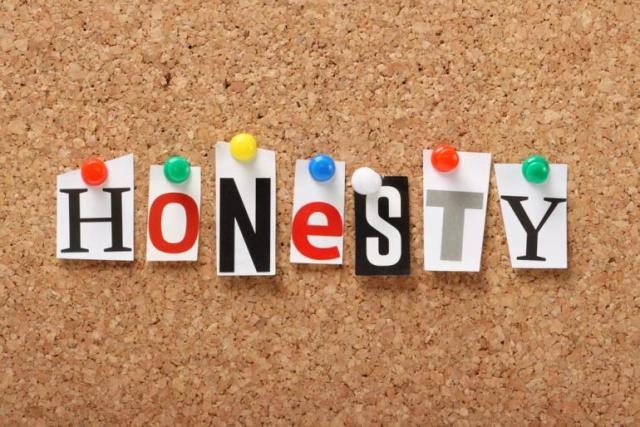
Honesty

honesty
Honesty.

We all want it in our relationships.

But is dishonesty ever “alright”?

It seems like a simple question at first.

Of course dishonesty is not alright – we want honesty all the time. After all, if you can’t trust someone about the little things then you can’t trust them about the big things, right?

But when you really look at it, it’s not really that straightforward.

What is dishonesty? There are three main forms of dishonesty:

  1. Lies
  2. half truths
  3. lies by omission

Some people think of honesty only in terms of lies, but it seems very clear that it’s more than that. Honesty is not only about the words you say and the actions you take.

It’s also about the things you don’t say.

You can be 100% honest in everything “you say”, while still being very secretive and deceitful. Half-truths and lies by omission are as damaging (if not more) than the things that you say.

silently_lying_60

Intimacy vs. Autonomy

Intimacy is all about closeness, and the way to build intimacy is through the sharing of your thoughts and feelings.

No one shares everything however, and we shouldn’t want them to. It’s important to balance intimacy with autonomy. Even when we are part of a relationship, we are still an individual and it’s important not to lose sight of that.

When you see your partner at the end of the day, it’s common practice to ask about their day. When we do this we don’t actually want to know everything. We aren’t looking for an itemized list of what your partner did during the day, minute by minute (at least I hope not). What we are really looking for is a summary, with maybe some of the highlights and lowlights of that day. We want to know what was important to them, and by them sharing that with us they are both maintaining and building a sense of intimacy.

It’s up to each person to determine what the “relevant” details are, and this is one of the places we get ourselves in trouble. What it relevant to one person may be different from what is relevant to another.

Let’s say you had a cheeseburger for lunch.

Now let’s say you had sex with a co-worker at lunch.

Maybe it’s just me, but these seem like they are pretty different things. Having sex with your co-worker is kind of a big deal, and sharing that knowledge would probably have a different impact on your relationship then telling your partner you had a cheeseburger.

One seems a wee bit more important in terms of relevance to your relationship than the other, and although the fallout would be considerable, I think it’s a safe bet that your partner deserves to know about the lunch sex.

But what about the cheeseburger? Is there any need to tell them about that?

Normally the answer would be no. But it comes down to context.

What if you and your partner are on a diet together, and the cheeseburger was a way of “cheating” the diet?

What if you are saving up for something and you promised to brown bag a lunch in order to save up money?

Well then perhaps the cheeseburger IS actually relevant. Maybe your partner WOULD be hurt if they knew about the cheeseburger.

honestyisintimacy

Intent

When withholding information from your partner (either through half-truths or complete omission) it comes down to intent.

WHY are you withholding information?

Is it because you truly thought it wasn’t important and it didn’t even occur to you to tell them? Is it because you want to surprise them with something? Or is it because you were feeling guilty and you didn’t want them to find out?

Sometimes people have disconnects on what “is important”, and this is an area where communication comes into play. Over time these sorts of disconnects will be sources of conflict for a couple, and this is natural and even healthy conflict.

When there are disconnects on what is important you can use them as opportunities to understand your partner better, and be a better partner to them in the future.

But if you are ever withholding information or keeping secrets out of shame or guilt, then you KNOW you have done something wrong. If this happens, any withholding is intentionally being deceptive.

Drawing the Line

Is it ever alright to intentionally be deceptive?

Sure, if you want to surprise your partner with something. It’s kind of hard to surprise them with things if you can’t keep some secrets.

But what about secrets that would hurt them?

I think there probably is a bit of a grey area here as well.

We all run into problems and issues in life. And sometimes we don’t want to share those. Sometimes we need to be able to work through things on your own.

That’s understandable to a degree. We don’t want to be the person who is alarming our partner by crying wolf every time we have concern or a fear. Sometimes we realize our fears are nothing, and it’s best not to stir the waters by raising them.

It’s important to be very careful with this though.

If these fears persist for a long time, or if they start to spill over into and affect the relationship, then they are pretty damned relevant. At that point choosing to keep them to ourselves will only ever do harm. It will break down trust, and damage the integrity of the relationship. And the longer it goes on, the more damage will be done.

Being Honest

I think being honest in a relationship doesn’t mean you are always truthful. It doesn’t mean you have to share every little thing. There are cases where you will hold things back, or even outright lie in the short term (with surprises for example).

To me it comes down to three very important things:

  • Intent
  • Empathy
  • Respect

We all choose our own actions. If we are in a relationship, then we need to think about our partners in the things that we do.

If our intent is good in the sense that we are considering our partner and being respectful towards them, we may still get ourselves in trouble if there is a disconnect between what is important to one versus the other. But those sorts of conflicts are fine.

We should never hide behind lies and partial truths or omissions out of shame or guilt though. Those sorts of things will only do long term harm.

And we should never do things that are disrespectful to our partner, or we know would hurt them if they found out. If we are doing that, then our relationships are built on a rotten foundation. And eventually, they will crumble under the weight of our own deceit.

Acting with respect, empathy and good intent is always the best approach.

The truth isn’t always easy to face; but it’s always the right answer.

we-all-need-to-know-what-it-means-to-be-honest

Under Pressure

pressure

Recently I discussed the idea that many (and perhaps most) relationship issues are not actually issues with the relationship, but are rather issues with coping skills and handling stress and pressure.

Sometimes life gets hard, and there is a sense of being “trapped” in a situation and a longing to be “free”.

Free from responsibility.

Free from expectation.

The things is, that sort of freedom is a fantasy and is not attainable. I would also argue it’s actually not even desirable.

Responsibility, pressure and expectations are part of life. We all have them and always will. Even at your most “free”, you had them.

People sometimes believe they will be happy if they can only find “freedom”, and life without responsibility and pressure.

And when life gets hard, people sometimes are willing to throw away the good parts of their life with the bad, just to have a taste of freedom – even if it’s just for a moment.

But any escapes from them are always temporary, and never real.

Your Life is Not Your Own

We are individuals. We can be who or what we want. We are free to make our own choices. In that sense, we are entirely free.

But just as throwing stones in a pond creates ripples, each and every choice we make has impacts, or consequences. And because of that, none of us are ever truly free.

Does that mean you should live for others and do that what want?

No. Not at all.

You should never live for someone else. You should always be able to tell other people “no”, and do what you want.

But those choices about what you want don’t only affect you. And it’s important to understand that when making them.

Are We Ever Truly “Free”?

Think of your late teens/early 20’s. Some people call these years “the best years of your life”.

I completely disagree with that notion, and think it’s actually pretty sad to think. If your life peaked at 18 or 20, there’s *probably* something wrong. Ideally your current years should be your best – whatever they are.

That said, those years from 18-25 are probably when you had the most freedom.

You were considered an adult. You may have been living with your parents still, or you may have been out on your own for the first time. But chances are, for the first time in your life you were making your own decisions. Your own choices.

You probably had a job, so you now had money to do some of the things you wanted. Maybe you were going to school, but if so it was up to you if and when you wanted to go.

Life was easy.

Your biggest concerns were whether to study, work or to go out with your friends tonight.

Your choices largely affected you.

But even then you weren’t free. You couldn’t truly do whatever you wanted.
If you wanted to go on a vacation or get something new you still needed to save for it. Or rack up credit card debt, but eventually that caught up to you.

If you were on your own you still needed to come up with money for food and rent. And if you were living with your parents, you knew that one day that would have to end.

Your choices still had impacts – it’s just that less people were impacted by them. And those impacts were more indirect.

carefree

Feeling Pressure

So where (and when) does pressure come in?

I think pressure comes in two related forms. Look at the following definitions of pressure:

– the continuous physical force exerted on or against an object by something in contact with it.
– the use of persuasion, influence, or intimidation to make someone do something.

The first definition is like responsibility. Work, mortgage, bills, parenting, our relationship. They are always there, constantly. Sure, there are weekends, and maybe a couple of weeks vacation every year. But as much as we may wish it, responsibilities don’t go away.

The second definition is like expectation. Expectation is when you feel that you need to do something, or you feel you are being measured against some sort of standard.

When you look at these concepts expectation and responsibility, pressure really comes when there is a struggle to meet one or both of them.

Expectations

While responsibility is something we all have and there is no real escape from it, expectation is a bit different.

Expectation may appear to come from others, but it is actually largely internal. Whether others expect something of you or not in many ways doesn’t matter. What really matters is what you expect from yourself, what you believe others expect of you and what you expect you should be able to do for others.

The pressure people feel from expectation comes from within. Often we “believe” that other people expect something from us, when they don’t. Or maybe they do, but not nearly to the extent that we believe they do.

Even if someone does expect something of us, that expectation has no power over us unless we also expect it of ourselves.

When we internalize this expectation, it gives us a sense of how we are being measured. And when we feel we aren’t meeting it, we experience guilt and shame as a result.

So expectation is the voice inside our head, telling us we need to do this, or that. It is the internal critic, and it is this expectation we place on our self that tells us we aren’t good enough, smart enough, or pretty/handsome enough.

Being “Free”

When the pressure of responsibility and expectation becomes too great, people break.

That’s when they feel trapped, and feel a need to be free. But when you are feeling this sort of pressure, the “freedom” you are looking for is simply an escape, and often an unhealthy one.

A few year ago a buddy of mine’s girlfriend died. They had been together for a lot of years, and had four kids together. Not long after their fourth child, things went bad. The pressure of everything got to her, and according to my buddy she talked about just wanting to “be free”. She walked out, leaving him with the kids, and ended up escaping into a world of drugs. Within six months she was dead of an overdose.

That’s a pretty extreme case, but this next one is more familiar:

Another buddy was married, and he and his wife welcomed their first child. In his mind, life was good. They had a house, cottage, and family. They both had pretty good jobs, and a great future. Then one day she told she wanted out, with no warning that there were any troubles between them. He felt blindsided, and tried getting them to counseling, but she was going through the motions. She had decided she was done before he even had a chance.

So they split up, and she went back to her “party days”. Around two years later she contacted him and told him she realized she had made a huge mistake. She wondered if it would be possible for them to try and work things out. The pressure of life had gotten to be too much for her, and she wanted to be free. But she realized that what she was chasing wasn’t real. It was simply an escape from life.

It was too late. Too much damage had been done, and he had moved on.

Pressure and Anxiety

People have different levels of stress, and we also have different ways of coping with the stresses in our life. Everyone feels pressure at some point in time, but this is accentuated for people with anxiety issues.

My buddy Gandalf is somewhat of an expert on anxiety (in my mind anyhow), and he gave me following description of how the dual pressure of responsibility and expectation affects someone with an anxiety disorder…

Most people fear failure. But when they fail most people accept something didn’t work and try a different approach. When someone has an anxiety disorder they cannot separate the failure of a task with the failure of their core being. Plus, they fear others will dislike them if they fail, especially if they value the other person’s approval. With little to no internal self-worth, their self-worth come from the people they are seeking approval from.

This makes anxiety suffers avoid responsibility, unless they can control the outcome so that it’s always a success. They pick battles that they know they’ll win before starting. But in a weird twist they also fear success, because it usually means increased responsibilities they cannot control and automatically succeed at. So the easiest path in life is to avoid responsibilities.

This is freedom, but it’s actually freedom from worrying, not responsibilities. Responsibilities cause fear, worrying, and anxiety, and all they want is for that to stop. Being unable to handle the fear of failure, the only option is to not be responsible for anything. Thus, when free of responsibilities, they are free of the anxiety that comes with it, and they are “free”.

Expectations are a subset of responsibilities. These are personal evaluations of a person by another, like a friend, family member, or coworker. They place a condition on their relationship that one tries to live up to. If the person suffering anxiety feels they are not meeting that expectation, they start to worry the other person will not like them and be angry with them. Also, if the anxiety sufferer feels they are exceeding the other person’s expectations, they want that external validation. When it’s not there, they get upset and feel like they are not appreciated.

Like responsibilities, expectations are to be avoided as well, and resentment occurs when the person suffering from anxiety feels that expectations have been placed on them by others, especially ones that they feel they cannot succeed at, or live up to. The main difference is responsibilities can usually be chosen, while expectations are usually arbitrary.

Responsibility and expectation can be hard for anyone, but when someone has anxiety feelings of guilt and shame also get mixed up in there.

Not a lot of fun.

Managing Expectations

Which brings me back to my regular topic, relationships.

Relationships inherently have both responsibility and expectations. That’s not a bad thing, but when life is hard these responsibilities and expectations can be difficult. And the pressure can take a toll on our relationships.

When we are under pressure, hopefully our partner will be understanding and try to help alleviate some of that pressure. But when the pressure persists for extended periods, then it’s important to try and understand it.

When you are feeling pressured, trapped and in need of an escape make sure you ask yourself the right questions. Is it really the relationship? Often relationships are blamed for pressure because stress spills over into them, making them an easy target.

Maybe the pressure is actually coming from responsibility.

If so, we taking too much on? Are there ways we can lessen the load, or are the responsibilities we face part of normal everyday life?

If our responsibilities can’t change, then we have to look at expectations. Expectations normally come from within. What is your inner critic telling you? Working to silence (or at least reduce) the internal critic is one of the most effective ways of managing stress.

Actively work on managing your stress and your internal critic. Your physical and mental well being will thank you for it, and so will your relationship.