The focus of my writing is relationships (specifically long term relationships), and the trials and tribulations they can run into. As my thoughts on relationships have evolved I have realized that beyond the interpersonal dynamics that come to play in a relationship, everything is still built on individuals.
In relationships the whole is often greater than the sum of the parts. But at the same time a chain is only a strong as its weakest link. Cliché? Sure. But that doesn’t make it any less true. When one person is going through a difficult time, the other person needs to step up and help them. One individuals problems affect the whole relationship, and can potentially destroy it. So for the health of both the relationship and the individual, it’s very important that the members of the relationship deal with their own issues.
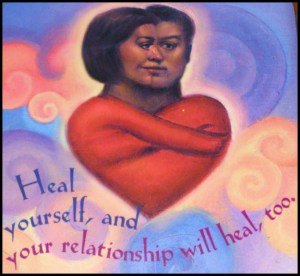
Because of that, the last few weeks I’ve taken a bit of a step back and focused more on the individual. My last two entries have been about understanding who we are, and accepting ourselves for who we are. Today’s entry finishes off that line of thought with a few additional thoughts that didn’t quite fit anywhere else.
A Perfect World?
I would like to think I came from a pretty good home. I’m sure it was better than some and worse than others, but for me it was home. Back in my high school days I had a buddy who would hang out at my place (my parents place) all the time. One day when he was over, he witnessed some sort of a family blow up. I can’t remember the details, but as with any family it could have been any number of things. I do remember what came next though. In the awkward/embarrassed silence that followed, he turned to me and said
I always thought you had the perfect family, but yours is just as screwed up as mine.
Fast forward many years, and a few months back I was talking to another friend. His family is going through some very difficult times, and he needed to vent. You know how on a hot day when you look down a road into the distance you can see the heat radiating off of it? This was kind of like that; as he talked I could almost see the pain radiating off of him. When we parted we did one of those awkward half pat man-hugs, acknowledging that something significant had just passed between us, but we weren’t quite sure what to do about it. He thanked me, and told me that he was glad we talked because it’s been weighing him down and he doesn’t really have anyone else to talk to.
These stories illustrate two very important things to me:
- We tend to believe other people’s situations are better than our own. In reality, every person and every family has their own issues.
- When our own issues are weighing us down, we often feel alone.
Dealing with Pain
I have always considered myself a “strong” person, and believed I could deal with anything life threw at me. I have also always been fiercely independent, taking a sense of pride in the fact that I had been able to fairly successfully navigate the waters of life on my own.
When my life took its unexpected turn a few years back, all of that was tested. I found myself in waters I couldn’t navigate and I was flailing, drowning if you will. I was a basket case, and from day to day I had no idea how to cope. It was a difficult time, and thinking back what stands out the most is how alone I felt.
I knew I had people who I could turn to, but I didn’t even want to talk to my closest friends and family. I didn’t want to tell them what was going on. I was embarrassed by it. To tell people would be to admit it – to admit that I was a failure. So instead I tried to pretend nothing was happening. I got up every day and got ready for work. But now in addition to putting on my clothes I had to put on my fake smile, while inside of me everything felt broken.
Sharing Your Story
The first person I opened up to was my brother. He will probably always see me as the annoying little brother, but to me he’s always been an easy person to talk to and I’ve always known he would be there if I ever needed him. One of the things I remember from those early conversations is him telling me to make sure I had my support net – people I could talk to.
One of the next people I talked to was a close buddy. I felt guilty “dumping my issues” on him because I knew he was dealing with some fairly serious issues of his own. But something interesting happened. Although our situations were different, he could relate to everything I felt. All the emotions I was going through were things that he had gone through as well. And my opening up to him allowed him to open up to me as well. We talked, we laughed and we cried. But that opening up and allowing ourselves to be vulnerable was cathartic. And I would like to think it helped both of us.
Over time I opened up to more people and I was surprised by how common my story was, and by how many people were going through similar issues. One guy’s wife left him just after their first child was born because she found the role of wife and mother wasn’t quite what she expected and she wanted “to be free”, another guy found out his wife was having an affair after many years of marriage, and yet another was living in a marriage where he and his wife were nothing more than roommates anymore. The stories were different, but the pain was the same. So was the sense of isolation and the feeling of failure.
Knowing that other people were going through similar things didn’t change my situation, but it made me realize I wasn’t alone. And somehow that helped.
Struggling to Cope
About a year ago a co-worker killed himself, and it sent a wave of shock through my company. Suicide? The guy in question had always seemed so positive and happy. How could this happen? That got me wondering if he had also been getting dressed every morning and then putting on a smile, hiding the turmoil inside.
I didn’t know him well, and I don’t know what his support net was like. Maybe if there were more people he had been able to open up to, he would still be here today.
Suicide is pretty extreme, and I won’t pretend to know the specifics of his case. But I will say that everyone has their own ways of coping with things. Usually those approaches work for us and we are able to “get by”. But sometimes we face situations or issues where our coping mechanisms are no longer sufficient, and we don’t know what to do.
I’m guessing this is how a lot of addictions start, as they are ways to numb ourselves to the situations that we are facing. And this is also probably where mental health issues start to arise. I’m not a doctor, but from what I understand mental health issues often arise due to a traumatic event or prolonged periods of stress causing brain chemistry to change slightly, altering the way someone perceives the world.
When I was younger I would hear stories of people “snapping”, and having some sort of mental breakdown or psychotic episode. The person in question was always referred to as “going crazy”. The things that make the news are always the extreme cases, but like everything else it can happen to varying degrees.
We are all Damaged
Look around at the people you see on a day to day basis – your co-workers, friends, classmates, even your family. How well do you really know them? If you think back to my gemstone analogy, we only see certain aspects of people.
We choose which parts of ourselves we present to the outside world, and it stands to reason that the parts we show are the ones we are least likely to fear being judged on. Statistically speaking, some of the people you talk to every day are struggling with very real issues. Alcoholism, drug abuse, gambling problems, serious illness (both physical and mental) to themselves or a loved one, failing marriages…
…the list goes on. It is probably happening right in front of you, and you don’t see it. They come to work every day, putting on their smiles, and trying to mask the pain they feel inside.
Even for your closest friends and family, you may know them well but do you really know the intimate details of their lives? You may know their job, but do you know how much money they make? You see the material things that are on display like their clothes, their cars and their homes. But do you know what their level of debt is? You may see how they interact with their spouses in public, but does that really tell you how happy they are in their marriage? Sometimes people hear about a couple splitting up and it comes as a complete shock. Sometimes the first thought is “I thought they were happy together”. Even with our closest friends and family, we still choose which parts of our story we want to reveal.
In reality, we are ALL damaged in one way or another. All the people you see on a day to day basis have their own flaws and issues. Everyone has problems. Every relationship has problems.
And you know what? That’s okay. It doesn’t make us any better or worse than anyone else, it just makes us human.
There is a crack in everything.
That’s how the light gets in. – Leonard Cohen
Don’t Compare!!!
Going back to my buddy at the beginning, he knew all the details of his family but had a limited view of my family. Comparing them, he thought we were “perfect”.
It’s a difficult thing to do, but try not to compare yourself to others. Because really, it’s impossible to do an accurate comparison. You know all the details of your own life, but you don’t know the details of anyone else’s. Chances are some parts of their lives are better than yours, and other parts are worse. Everyone has problems. Perfection doesn’t exist.
It is especially damaging to compare relationships. You don’t know the details of someone else’s life. Chances are, it has problems too. Instead of focusing on what you are missing, it’s better to focus on what you can do to improve things.
Another common problem is comparing your current relationship to a previous one. There may be some things that were better before, but how much time has passed? Are you the same person you were then? Did you have the same responsibilities then that you do now?
If you are ever making comparisons about your life or your relationships to look at what is wrong, or missing, you are doing yourself and your relationship a great disservice. No good can ever come of it. You need to judge your situation on its own merits.
Look for the Positive
Accept that there will always be issues, and that life will always have disappointments. It’s easy for the “bad times” to overshadow the good, but instead of focusing on the negative focus on what is good in your life.
Remember that you aren’t alone. Everyone has issues, everyone has problems. I haven’t read the book “The Happiness Project” (it’s on my to-do list), but from what I know of it, it mirrors my personal philosophies. Happiness is a choice. Perhaps you can’t “make yourself be happy”, but at the very least you can influence your level of happiness by how you approach life.
Look for the positive in things. Instead of focusing on what is wrong, look at all the good around you. Take time out every day to appreciate what you have instead of focusing on what you don’t. Accept that problems and issues are normal, and that’s alright. Problems are simply opportunities for improvement.
If you have been set in a negative mind-set this sort of change isn’t easy, but it is possible. Make it part of your everyday life. It will feel forced at first, but over time it will become natural.
Identity Crisis Recap
As individuals we are all seeking happiness, fulfillment and belonging. We are social creatures, and it is through our relationships that we find these things.
We are constantly juggling many roles though, and sometimes it can feel overwhelming and we can feel lost. I’ve talked to many people who have spoken of how they lost their identity in their relationship/marriage. Or more accurately, they allowed their relationship to define their identity.
Your relationship should be important to you. I would argue that it, and the person you are choosing to be with should be the most important thing in your life. But they should never be the only thing. We are complex, and have many interests and needs. Always take time away from your spouse to pursue other interests. That time away is just as important for nurturing your relationship as the time you spend together.
Commit yourself fully to your relationship, body, mind and soul. Never hold back. This opening up and allowing yourself to be vulnerable allows you to maximize the satisfaction you can get out of the relationship. Yes, you will get hurt sometimes. But you will also be open to a level of connection that can’t be achieved if you build up walls to “protect yourself”.
In order to commit yourself fully to a relationship, you must first love yourself. Stop trying to play a role. No one is perfect, and that’s alright. You need to accept yourself as you are, and be able to say “I can always improve, but I am enough”.
Don’t compare yourself and your situations to others. Everyone has problems and everyone has issues. It’s part of what makes us human. In order to be happy, it’s important to focus on the positive and not the negative. Even problems are simply opportunities for improvement.
Lastly, when times are tough remember that you aren’t alone. Don’t be embarrassed to reach out and ask for help. Vulnerability isn’t a sign of weakness.

 thezombieshuffle